Folklore · Latin America · Legend
La Llorona (The Weeping Woman)
Also known as: The Weeping Woman, The Wailing Woman, Llorona, La Llorona de los Ríos, La María Pardo
In short
La Llorona is the ghost of a woman who drowned her children and now wanders at night near rivers and lakes, crying for them. The legend is told across Mexico, Central and South America and among Mexican Americans in the United States. Names, places and the reason for the crime change from country to country.
At a glance
| Where | Mexico, Central America, much of South America, Puerto Rico and the southwestern United States |
|---|---|
| Earliest record | A weeping woman among the omens before the Spanish conquest, in the Florentine Codex compiled under Bernardino de Sahagún, 16th century |
| Best-known version | A woman abandoned by her lover drowns her children in a river and is condemned to search for them |
| Type | Ghost, lost soul (alma en pena), cautionary tale |
| Her cry | Usually given as "¡Ay, mis hijos!" ("Oh, my children!") |
| When she appears | At night, near rivers, lakes, canals and roads |
The best-known version Contains the ending
There is no single original text. The version most people know runs like this. A young woman, often called María, falls in love with a man of higher rank or wealth. They have children. In time he leaves her, or marries a woman of his own class.
In grief or in anger she takes the children to a river and drowns them. When she understands what she has done, she runs along the bank looking for them and dies there, by drowning or of sorrow. Her soul cannot rest until she finds them.
So she walks at night along rivers and lakes, dressed in white, with long black hair, crying for them. People who meet her are said to fall ill or have bad luck. In many homes the story is told to keep children away from the water after dark.
Early records and colonial Mexico
The Florentine Codex, compiled in the second half of the 16th century by the Franciscan friar Bernardino de Sahagún and his Nahua informants, lists omens that came before the fall of Tenochtitlan. The sixth omen is a woman heard at night, weeping and crying out for her children, saying that they must go far away.
Sahagún himself linked this weeping figure to the goddess Cihuacóatl ("snake woman"), a mother goddess tied to childbirth and midwives. Many modern writers repeat the link. It is an interpretation, and scholars differ on how far a 16th-century omen and a later ghost story are the same figure. Others point to European parallels, such as the German White Lady.
In colonial Mexico City people told of a weeping woman crossing the Plaza Mayor at night. In some colonial and later versions she is identified with La Malinche, the Nahua woman who interpreted for Hernán Cortés. She weeps for betraying her people, or for her son Martín Cortés, who was taken to Spain. These are legends; the historical Malinche did not kill her children. Another Mexican version names her Luisa, abandoned by a nobleman called Nuño de Montes Claros.
How other places tell it
- Guatemala: she is named María, and her son Juan de la Cruz.
- Costa Rica: she is the daughter of a Huetar king, and her child dies at a waterfall; tellings differ on who throws the baby. She is also placed on the Río Grande de Tárcoles.
- Nicaragua: an Indigenous woman from Moyogalpa on Ometepe Island who drowns her child in Lake Nicaragua.
- Colombia: in Antioquia she is called La María Pardo. In Pasto she comes out on nights of the full moon.
- Ecuador: she cuts off the little finger of the people she appears to.
- Uruguay: she drowns with her child in the lake of Parque Rivera in Montevideo.
- Puerto Rico: she merges with the vanishing hitchhiker story and appears at the Las Calabazas bridge.
What she is
Folklorists read the legend as a warning. To young women it warns against trusting men of a higher class and against pregnancy outside marriage. To children it warns against going near water at night. Some versions add that she punishes drunk or unfaithful men. Chicana writers have retold her in other ways. In Sandra Cisneros's story Woman Hollering Creek, a creek called La Gritona becomes a place of escape for an abused wife.
In modern culture
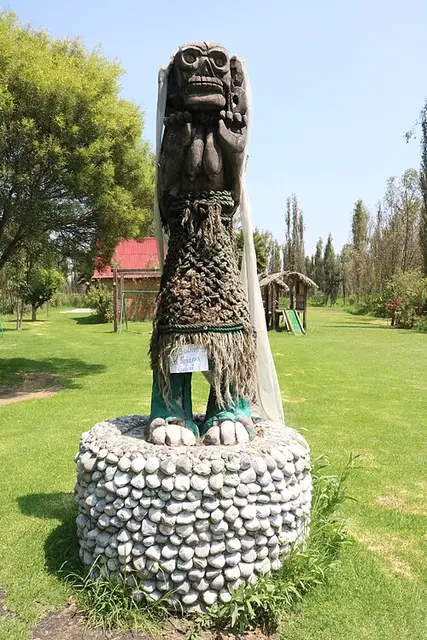
Mexican cinema took up the legend early, with La Llorona directed by Ramón Peón in 1933 and René Cardona's La Llorona in 1960. Later films include The Curse of La Llorona (2019) and Jayro Bustamante's La Llorona (2019), which ties the figure to the Guatemalan civil war. The Mexican folk song La Llorona, recorded by Chavela Vargas and many others, is a love song that shares the name. It is heard in Pixar's Coco (2017). In Xochimilco, Mexico City, a small island in the canals known as the Isla de la Llorona has statues of her.
Similar legends elsewhere
Same story: the plot is close. Same kind of figure: a similar being in a different story.
- Same kind of figure · IrelandBansheeA crying woman heard at night, linked to death; she mourns family members and has no crime of her own
- Same kind of figure · Venezuela and ColombiaEl SilbónAnother lost soul of the plains, cursed to wander for killing a family member
- Same kind of figure · VenezuelaLa SayonaA woman's ghost of the Llanos who punishes unfaithful men; sometimes mixed with La Llorona
- Same kind of figure · Germany and Central EuropeThe White Lady (Weiße Frau)A woman in white seen near castles or water, often as a sign of death
FAQ
Is La Llorona real?
She is a figure of folk belief. Many people in Mexico and Central America tell of hearing or meeting her, and the story is passed on as true in many families, but there is no historical woman behind it that can be identified.
What does La Llorona say?
Her cry is usually given as "¡Ay, mis hijos!" ("Oh, my children!"). In the Florentine Codex omen the weeping woman tells her children that they must go far away.
Is La Llorona the Aztec goddess Cihuacóatl?
Bernardino de Sahagún connected a weeping figure in his 16th-century work with Cihuacóatl, and many writers follow him. Others think the colonial ghost story grew from several sources, including European tales of women in white. The question has no settled answer.
Is the song La Llorona about the ghost?
Not directly. The folk song is a love song addressed to a woman called llorona. It shares the name and some of the mood.
Sources
- Historia general de las cosas de Nueva España (Florentine Codex), Book 12, the omens, Bernardino de Sahagún and Nahua informants, 16th century
- La Llorona, Spanish Wikipedia
- La Llorona, English Wikipedia
- The Terrifying True Origins of Latin America's Weeping Woman La Llorona, TheCollector
- Cihuacōātl, English Wikipedia
Folktales have many versions. This page follows the best-known version and the earliest written records. Sources checked .