Folklore · Japan · Folktale
Kaguya-hime (The Tale of the Bamboo Cutter)
Also known as: Princess Kaguya, かぐや姫, The Tale of the Bamboo Cutter, Taketori Monogatari, 竹取物語, Nayotake no Kaguya-hime, The Shining Princess
In short
Kaguya-hime is the heroine of Taketori Monogatari, The Tale of the Bamboo Cutter. An old bamboo cutter finds her as a tiny girl inside a shining stalk of bamboo, and she grows into a woman of great beauty whom five nobles and the Emperor try to win. The tale was written by an unknown author in the Heian period and is thought to be the oldest surviving Japanese monogatari.
At a glance
| Where | Japan; the court world of Heian-kyō (Kyoto) |
|---|---|
| Written | Late 9th or early 10th century, author unknown |
| Earliest mention | The Tale of Genji (about 1000) calls it the ancestor of all tales |
| Oldest copies | Fragments from the 14th century; complete manuscripts from the late 16th century |
| Type | Monogatari (prose tale); a heavenly woman who must return to the sky |
The story Contains the ending
An old man, Sanuki no Miyatsuko, makes his living cutting bamboo, so people call him the Bamboo Cutter. One day he finds a stalk that shines and, inside it, a girl about three sun (9 cm) tall. He and his wife raise her. From then on he keeps finding gold inside bamboo, and the family grows rich. Within about three months she is a grown woman, and she is named Nayotake no Kaguya-hime, the shining princess of the supple bamboo.
Many men try to see her. Five noblemen keep at it day and night, and she agrees to marry whoever brings what she asks for. Each task is impossible, and each man fails.
- Prince Ishitsukuri: the stone begging bowl of the Buddha, from India. He brings a sooty bowl from a temple in Yamato.
- Prince Kuramochi: a branch from the island of Hōrai with silver roots, a gold trunk and white jewels for fruit. He has craftsmen forge one, and they come to ask for their wages.
- Minister Abe no Miushi: a robe of fire-rat fur from China. He buys one from a merchant, and it burns when tested.
- Ōtomo no Miyuki: the five-coloured jewel from a dragon's neck. He is caught in a storm at sea, comes home half dead, and gives up on her.
- Isonokami no Maro: a cowrie shell carried by a swallow. He falls from a basket while reaching into a nest, finds he is holding old swallow droppings, and dies.
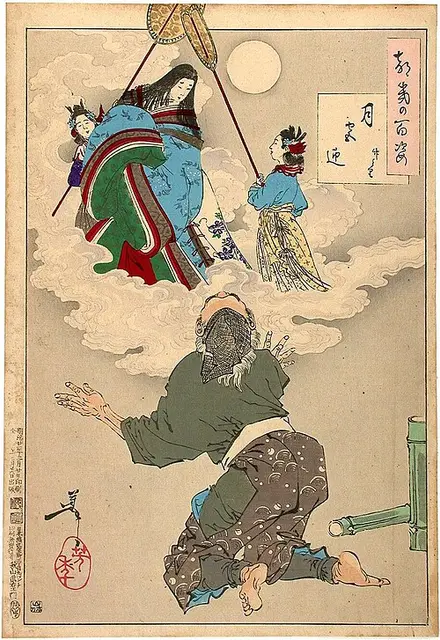
The Emperor hears of her, comes to see her on the pretext of a hunt, and is refused. They write to each other for about three years. Then she begins to weep at the moon. She tells the old man she is from the capital of the moon and must go back on the fifteenth night of the eighth month. The Emperor sends 2,000 soldiers to guard the house, but when the moon people come in a flying carriage, no one can fight. She writes a letter for the old man, leaves a letter and a jar of the elixir of immortality for the Emperor, puts on a feather robe that takes away her earthly feelings, and goes up into the sky.
The Emperor does not want to live forever without her. He has the letter and the elixir burned on the mountain in Suruga that is closest to heaven. The text says the mountain was named Fuji because a great many soldiers (tsuwamono) climbed it with the order. The name is also read as fushi, deathless, and smoke is said to rise from it still.
Text and author
No original manuscript survives. The oldest pieces are fragments from the 14th century attributed to the hand of Emperor Go-Kōgon, and complete copies date from the late 16th century. Accounts differ on which complete copy is oldest.
The author is unknown. Names put forward include Minamoto no Tōru, Minamoto no Shitagau, Henjō, Ki no Tsurayuki and Sugawara no Michizane. Scholars generally infer an educated man of the upper class living near the capital, Heian-kyō.
Related tales
Stories of a child born from bamboo are more common in China and Southeast Asia than in Japan. A Tibetan tale from Aba in Sichuan, Banzhu Guniang (The Girl of the Spotted Bamboo), has a very similar run of suitors and tasks. Some scholars once argued the two came from a common source. Most now think the Tibetan tale is a retelling of the Japanese one.
The ending, a woman from heaven who puts on a feather robe and goes back, is shared with the hagoromo (feather robe) legends of Japan and the wider swan-maiden family.
In modern culture
Isao Takahata's 2013 Studio Ghibli film The Tale of the Princess Kaguya retells the story as a feature-length animation. Picture books, manga and anime have retold it many times.
Similar legends elsewhere
Same story: the plot is close. Same kind of figure: a similar being in a different story.
- Same story · East AsiaSwan maiden talesA woman from the sky puts on her feather robe and goes back, leaving the human world
- Same kind of figure · ChinaChang'eA woman on the moon linked to an elixir of immortality, but a different story
- Same story · Tibet (Sichuan)Banzhu GuniangFive suitors with impossible tasks; most scholars think it derives from the Japanese tale
FAQ
Why does Kaguya-hime go back to the moon?
She was sent down from the moon for a time, and in the text the moon envoys say that time is over. She does not want to leave the old couple, but nobody on earth can stop the moon people.
Is The Tale of the Bamboo Cutter a folk tale?
It is a written work by an unknown Heian author. It uses folk motifs such as a child found in bamboo and a woman from heaven, and it is thought to be the oldest surviving Japanese prose tale.
How is Kaguya-hime connected to Mount Fuji?
At the end the Emperor has the elixir of immortality burned on a mountain in Suruga. The tale gives this as the origin of the name Fuji.
Sources
- 竹取物語 (Taketori Monogatari), unknown, late 9th to early 10th century
- 竹取物語 (retelling), 和田萬吉 (Wada Mankichi), Aozora Bunko
- 竹取物語 現代語訳つき朗読 (original text with modern translation), roudokus.com
- 竹取物語, Japanese Wikipedia
- The Tale of the Bamboo Cutter, English Wikipedia
Folktales have many versions. This page follows the best-known version and the earliest written records. Sources checked .