Folklore · One story, many countries · Tale type ATU 400
Swan Maiden Tales Around the World
Also known as: Swan maiden, Celestial wife, Hagoromo, 羽衣伝説, 牛郎织女 (Niulang Zhinü), 선녀와 나무꾼, Jaka Tarub, ATU 400
In short
In a swan maiden tale a man finds bird women or heavenly women bathing, hides the feather robe of one of them so she cannot fly away, and marries her. Years later she finds the robe and flies back to the sky. The story is told across East and Southeast Asia and Europe. The oldest dated written version is Chinese, from Gan Bao's Soushen ji of the 4th century.
At a glance
| Tale type | Usually filed under ATU 400, The Man on a Quest for His Lost Wife; some versions under ATU 313 or 465A |
|---|---|
| Where | China, Japan, Korea, Indonesia, Northern Europe and many other places |
| Oldest dated version | The feather-robe woman in Gan Bao's Soushen ji, Jin dynasty, 4th century |
| Key object | A robe of feathers, a winged garment or a shawl, without which she cannot fly |
| Usual ending | She finds the robe and returns to the sky |
The shared outline
- Several women from the sky, often six to eight, come down to bathe in a lake, a spring or the sea.
- A man takes or hides the robe of one of them. The others fly away.
- She cannot leave, so she marries him or lives in his house. Children are born.
- She finds the robe, often hidden in the rice store, and flies back.
- In some versions the man follows her to the sky or meets her only once a year.
Versions compared Contains the ending
| Version | Place and date | Who she is | How she gets the robe back | Ending |
|---|---|---|---|---|
| The feather-robe woman | China, Gan Bao, Soushen ji, 4th century | One of six or seven women in feather robes in a field in Xinyu, Yuzhang. They are birds | Her daughter asks the father and learns it is under the rice stack | She flies away, then comes back with robes for her three daughters, who also fly off |
| Ōmi Fudoki fragment | Japan, Lake Yogo, Shiga. Quoted in the Teiō hennen ki under the year 723 | A heavenly maiden (tennyo) | She finds the robe | She leaves the man and her children and returns to the sky |
| Tango Fudoki | Japan, Mt. Hiji, Kyoto Prefecture | One of eight maidens bathing at the Manai spring | An old couple keep her robe and adopt her. She brews sake that makes them rich | They drive her out. She settles elsewhere and is worshipped as the goddess Toyoukebime |
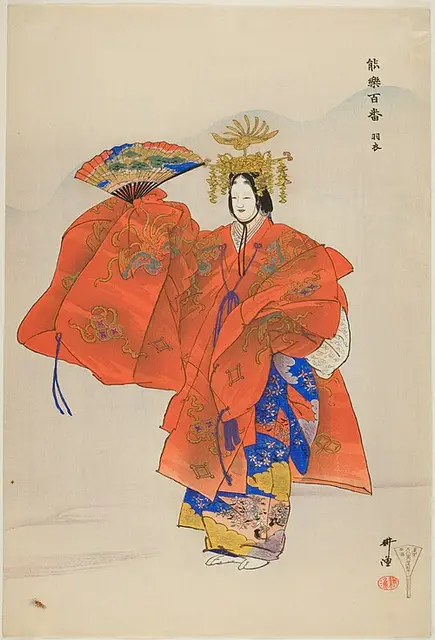
| Hagoromo (Noh play) | Japan, Miho no Matsubara, Shizuoka. Author unknown, mentioned from 1524 | A tennin whose robe hangs on a pine | The fisherman Hakuryō returns it in exchange for a dance | She dances and rises into the sky. No marriage |
| The Cowherd and the Weaver Girl | China. Stars named in the Shijing, the love story from the 6th century | The Weaver Girl, a weaver of heaven | In modern versions she is taken back to heaven, and the Queen Mother draws the Milky Way with her hairpin | The Milky Way divides them. They meet once a year on a bridge of magpies, on the 7th day of the 7th month |
| The Fairy and the Woodcutter (선녀와 나무꾼) | Korea, told across the country | A fairy (seonnyeo) who comes down to bathe | He shows her the robe after two children, against the deer's advice to wait for three | She flies up with the children. In one ending he rides a bucket up to heaven, returns to visit his mother, falls from his horse and becomes a rooster |
| Jaka Tarub | Java, Babad Tanah Jawi | Nawang Wulan, one of seven bidadari | He breaks her one rule and opens the rice pot. As the rice runs low she finds her shawl in the rice barn | She returns to heaven. Their daughter Nawangsih is said to be an ancestor of the Mataram kings |
| Völundarkviða | Norse, Poetic Edda | Three swan maidens who meet Völundr and his two brothers by a lake | The poem does not tell of a stolen robe | After some years the women leave. The poem does not say why |
What differs
- Wife or guest. In most versions she is a wife and mother. In the Tango Fudoki she is the adopted daughter of an old couple, and in the Noh play Hagoromo there is no marriage at all.
- The man's fate. In the Soushen ji and Jaka Tarub he is simply left behind. The Korean tale follows him to heaven and back. The Chinese Cowherd and Weaver Girl keeps the couple apart but lets them meet once a year.
- Ties to a place or a family. The Japanese versions are tied to a lake, a spring or a pine on the shore. Jaka Tarub is tied to the royal line of Mataram, and the Tango maiden to the worship of a goddess.
How the Cowherd and the Weaver Girl joined the type
The two names began as stars. The Shijing, in the poem Da Dong, names the Weaver Girl and the Ox Herd as stars without any story. A Han dynasty poem among the Nineteen Old Poems describes the two stars on either side of the Milky Way. The oldest text in which they marry and are parted is Yin Yun's Xiaoshuo of the Liang dynasty, where the Heavenly Emperor marries them and then separates them because she stops weaving.
The bathing maidens and the stolen clothes came later. According to Chinese Wikipedia, the full plot with the old ox, the stolen clothes and the chase into heaven appears only in late Qing and early Republican printed books and in the Peking opera Tianhe Pei. Before that, the Soushen ji swan maiden and the Cowherd story were separate tales.
In modern culture
The Noh play Hagoromo is still performed. At Miho no Matsubara a pine called Hagoromo no Matsu is shown as the tree where the robe was hung, and the nearby Miho Shrine keeps a piece said to come from it. The pine grove was added to the World Heritage List in 2013 as part of Fujisan. The Qixi festival on the 7th day of the 7th lunar month gave rise to Japan's Tanabata and Korea's Chilseok, and is often called Chinese Valentine's Day.
Similar legends elsewhere
Same story: the plot is close. Same kind of figure: a similar being in a different story.
- Same story · JapanYuki-onnaA wife who is not human leaves once her husband speaks of the night they met
- Same story · JapanThe Crane Wife (Tsuru no Ongaeshi)A wife who is really a crane leaves after her husband looks in while she weaves
- Same kind of figure · JapanKaguya-himeA woman from the moon puts on a heavenly feather robe and forgets the earth as she goes back
- Same kind of figure · ChinaChang'eA woman who leaves her husband and rises to the moon, though without any robe
- Same story · FranceMelusineA wife makes her husband promise never to see her on a Saturday. He looks, and later she leaves as a dragon
FAQ
What is the ATU number of the swan maiden tale?
Most indexes place it under ATU 400, The Man on a Quest for His Lost Wife. Some versions are also classed as ATU 313 or 465A. Stith Thompson's motif index lists the swan maiden as motif D361.1.
Is the Cowherd and the Weaver Girl a swan maiden story?
Its modern version is, with the bathing maidens and the hidden clothes. Older texts tell only of two stars, and later of a married couple parted by the Heavenly Emperor. The stolen-clothes episode was joined to it much later.
Where is the Hagoromo legend set?
The best-known version is set at Miho no Matsubara on Suruga Bay in Shizuoka. Older records place the story at Lake Yogo in Shiga and at Mt. Hiji in northern Kyoto Prefecture.
Does the heavenly wife ever stay?
Rarely. In a few Korean versions the woodcutter passes tests in heaven and lives there with his family. In most versions she leaves for good.
Sources
- 搜神記 卷十四 (Soushen ji, ch. 14), 豫章新喻縣男子, Gan Bao, 4th century
- 近江国風土記 逸文 (Ōmi Fudoki fragment) and 丹後国風土記 逸文 (Tango Fudoki fragment), via Japanese Wikipedia 羽衣伝説
- 羽衣 (Hagoromo), Noh play, Unknown, before 1524
- Babad Tanah Jawi, Javanese chronicle
- Völundarkviða (Poetic Edda), Anonymous
- Swan maiden, English Wikipedia
- 羽衣伝説, Japanese Wikipedia
- 羽衣 (能), Japanese Wikipedia
- Hagoromo (play), English Wikipedia
- 牛郎织女, Chinese Wikipedia
- 나무꾼과 선녀, Encyclopedia of Korean Culture (한국민족문화대백과사전)
- Jaka Tarub, Indonesian Wikipedia
- Miho no Matsubara, English Wikipedia
- Qixi Festival, English Wikipedia
Folktales have many versions. This page follows the best-known version and the earliest written records. Sources checked .