Folklore · Japan · Creature
Yuki-onna (Snow Woman)
Also known as: Snow Woman, 雪女, ゆきおんな, Yukionna, Yuki-jorō, Yuki-musume, Woman of the Snow
In short
Yuki-onna is a female spirit from the legends of Japan's snowy regions, especially Tōhoku and Hokuriku. She wears white, her skin is as pale as snow, and she appears on nights of heavy snow. In many stories she breathes on a person and they freeze to death.
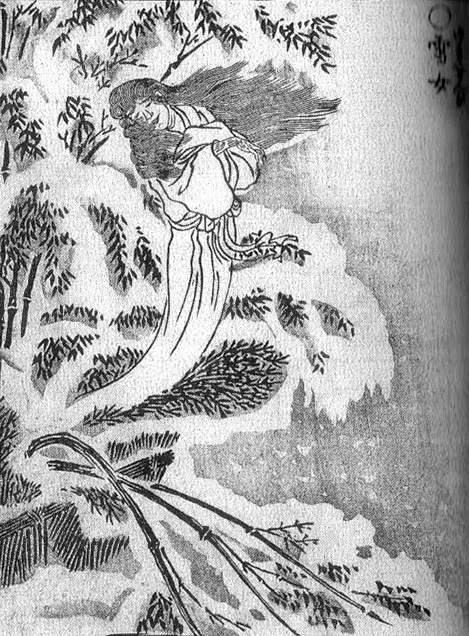
At a glance
| Where | Snowy regions of Japan: Aomori, Iwate, Yamagata, Niigata and others each have their own versions |
|---|---|
| Earliest record | Sōgi Shokoku Monogatari (1685), which says the poet Sōgi saw a snow woman about 3 metres tall in Echigo (now Niigata) |
| Best-known version | Yuki-Onna in Lafcadio Hearn's Kwaidan (1904) |
| Type | Snow spirit, ghost of someone who died in the snow, or a non-human wife |
| When she appears | Snowy nights; in some places on Koshōgatsu (around 15 January) or on full-moon nights |
The story in Lafcadio Hearn's Kwaidan Contains the ending
Hearn wrote that the story was told to him by a farmer of Chōfu, Nishitama district, in Musashi province, as a legend of his native village. The place is now part of Ōme, Tokyo.
An old woodcutter, Mosaku, and his 18-year-old apprentice, Minokichi, are caught by a snowstorm on the way home. The ferryman has left his boat on the far side of the river, so they spend the night in his small hut. Minokichi wakes to see a woman in white bending over Mosaku and breathing on him. Mosaku freezes to death. The woman looks at Minokichi and says she will spare him because he is young and good-looking. If he ever tells anyone about that night, even his mother, she will kill him.
The next winter Minokichi meets a girl named O-Yuki on the road and marries her. They have ten children, and the villagers remark that she never seems to grow older.
One night, watching her sew by lamplight, Minokichi remembers the night in the hut and tells her about it. O-Yuki stands up and says the woman was her. She says she does not kill him only because of the children, and tells him to take good care of them. Then she turns into a white mist, rises through the smoke-hole in the roof and is never seen again.
How other places tell it
- Hirosaki, Aomori: holding the baby. A snow woman asks a passing samurai to hold her child. He takes the child with a dagger held in his mouth, comes to no harm, and is given treasure when he hands the child back. Stories of this kind are close to those of the ubume, the ghost of a woman who died in childbirth.
- Tōno, Iwate: out with the children. On Koshōgatsu or on full-moon nights, the snow woman comes out to play with many children. Parents used the story to warn children not to stay out late.
- Kaminoyama, Yamagata: warming at the fire. A woman comes to an old couple's house to warm herself at the hearth. When she leaves at night she turns into snow mist and goes out through the smoke vent.
- Ojiya, Niigata: the icicle wife. A man marries a woman of unknown origin. When she is made to take a bath she vanishes, and only pieces of icicle are left floating in the tub. Aomori and Yamagata tell similar stories under names such as shigama nyōbō.
What she is
The folklorist Konno Ensuke sorted yuki-onna legends into three groups: the spirit or embodiment of snow, the ghost of someone who died in the snowy mountains, and stories that later turned into comic tales. The icicle-wife story is his example of the comic kind.
In the Edo period, the scholar Yamaoka Genrin argued that snow women are born from deep snow, in the same way that deep water produces fish, since both snow and women were thought of as yin.
Some scholars doubt that Hearn's version is a traditional tale. Makino Yōko points to the influence of Théophile Gautier's vampire story La Morte amoureuse. Accounts differ on how much of the plot came from the farmer and how much from Hearn.
In modern culture
Masaki Kobayashi's 1964 film Kwaidan adapts Hearn's story as one of its four parts, The Woman of the Snow. In Akira Kurosawa's Dreams (1990), the segment The Blizzard shows a snow woman trying to lure a freezing mountaineer to his death. A bronze statue of a yuki-onna stands on Mizuki Shigeru Road in Sakaiminato, Tottori. Snow-woman characters in anime and games usually keep the white clothes, the cold, and a bond with a human man.
Similar legends elsewhere
Same story: the plot is close. Same kind of figure: a similar being in a different story.
- Same story · JapanThe Crane Wife (Tsuru no Ongaeshi)The wife is really a crane and leaves when her husband breaks his promise not to look
- Same story · FranceMelusineShe forbids her husband to see her on Saturdays; he looks and finds her lower half is a serpent
- Same story · East AsiaSwan maiden talesA man marries a woman from another world, and in the end she goes back
- Same kind of figure · DenmarkThe Snow QueenAndersen's 1844 fairy tale; also a woman of ice, but a different story
FAQ
Is Yuki-onna good or evil?
Both appear. In most legends she freezes people and is something to avoid. In Hearn's version she spares Minokichi, lives with him for years and does not kill him at the end, so many readers remember her as a sad figure.
Why does Yuki-onna spare Minokichi?
In Hearn's text she says she pities him because he is young and handsome. Her condition is that he never speaks of that night.
Is Yuki-onna the same as the Snow Queen?
No. They only share ice and snow. The Snow Queen is a literary fairy tale by Hans Christian Andersen about a girl, Gerda, who goes to rescue her friend Kai.
Sources
- Kwaidan: Stories and Studies of Strange Things (Yuki-Onna; Introduction), Lafcadio Hearn, 1904
- Sōgi Shokoku Monogatari (宗祇諸国物語), book 5, anonymous, attributed to Sōgi, 1685
- Gazu Hyakki Yagyō (画図百鬼夜行), Toriyama Sekien, 1776
- 雪女, Japanese Wikipedia
- Yuki-onna, English Wikipedia
- Kwaidan (film), English Wikipedia
Folktales have many versions. This page follows the best-known version and the earliest written records. Sources checked .