Folklore · China · Legend
Legend of the White Snake (Bai She Zhuan)
Also known as: Madame White Snake, Lady White Snake, 白蛇传, Baishe zhuan, Bai Suzhen, White Snake legend
In short
The Legend of the White Snake is a Chinese legend about a white snake spirit who takes the form of a woman, Bai Suzhen, and marries a young man, Xu Xian, in Hangzhou. The Buddhist monk Fahai sets out to separate them and imprisons her under Leifeng Pagoda by West Lake. It is counted among China's Four Great Folktales.
At a glance
| Where | Hangzhou and West Lake, Suzhou and Zhenjiang, in the Southern Song period |
|---|---|
| Earliest full version | Feng Menglong, Madam White Is Kept Forever Under Leifeng Pagoda, in Jingshi Tongyan (1624), ch. 28 |
| Main figures | Bai Suzhen (Lady White), Xiaoqing (Green), Xu Xian (Xu Xuan in early texts), the monk Fahai |
| Type | Romance between a human and an animal spirit; one of China's Four Great Folktales |
| Heritage status | On China's national list of intangible cultural heritage since 2006 |
The story in Feng Menglong's 1624 version Contains the ending
Feng Menglong's story is the oldest text that has the whole plot. The hero is Xu Xuan, a 22-year-old orphan who works in a herbal medicine shop in Hangzhou and lives with his sister and her husband.
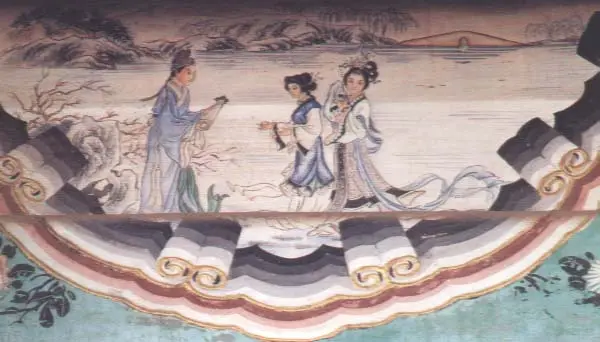
On the Qingming festival Xu Xuan is caught in the rain by West Lake and takes a boat. A woman in white, Bai Niangzi, and her maid Qingqing step aboard. He pays her fare and lends her his umbrella. When he goes to fetch it, she offers to marry him and gives him silver. The silver turns out to be stolen from a government treasury, and Xu Xuan is sent into exile in Suzhou. She follows him there, and later to Zhenjiang. At Zhenjiang his employer spies on her and sees a huge white snake.
Xu Xuan visits Jinshan Temple, where the abbot Fahai sees through her. Back in Hangzhou, Fahai gives Xu Xuan an alms bowl. He brings it down over his wife's head and she is trapped. Fahai reveals that she is a great white snake and Qingqing a thousand-year-old green fish from West Lake. He seals them both under Leifeng Pagoda with a verse: when West Lake runs dry, when the rivers no longer rise and when Leifeng Pagoda falls, the white snake will come out into the world. Xu Xuan becomes a monk and dies years later in meditation.
In this version Lady White is a danger, and the story warns men against beautiful women. The later, gentler heroine comes from the stage.
How the story changed
- Before Feng Menglong. A Tang tale, Li Huang, in the collection Boyi Zhi, has a white snake that takes the form of a woman and seduces a man. The Three Pagodas of West Lake, kept in a Ming collection of storytellers' scripts, has a white snake woman sealed under pagodas in West Lake. Scholars differ on whether that text goes back to the Song.
- Qing operas. Huang Tubi's play Leifeng Pagoda (1738) still follows Feng Menglong. Fang Chengpei's 34-scene Leifeng Pagoda (1771), performed for the Qianlong Emperor, adds the theft of the magic herb to save Xu Xian's life and gives the couple a son.
- Late Qing novel. The vernacular novel Baishe Quanzhuan collects the scenes known today: the realgar wine at the Duanwu festival that forces her to show her snake form, the flooding of Jinshan Temple, and the son who comes first in the imperial exam and frees his mother from the pagoda.
- Names. Early texts call the hero Xu Xuan and the maid a green fish. The later stage tradition renames him Xu Xian and makes the maid Xiaoqing, a green snake. Tian Han's revisions of the Peking opera in the 1940s and 1950s made Bai an unmarried young woman rather than a widow.
Leifeng Pagoda
Leifeng Pagoda stands on the south shore of West Lake in Hangzhou. It was built in the 970s under Qian Chu, king of Wuyue. Japanese pirates burned its wooden parts in the Jiajing reign of the Ming, leaving the brick core. On 25 September 1924 the old pagoda collapsed, weakened in part by people taking bricks they believed had healing powers. Lu Xun wrote an essay on its fall. A new pagoda opened on the same site on 25 October 2002.
In modern culture
Toho's film Byaku Fujin no Yoren (1956) and Toei's animated Hakujaden (1958), the first Japanese colour feature-length animated film, brought the story to Japan. Tsui Hark's Green Snake (1993), from Lilian Lee's novel, tells it from Xiaoqing's side. Chinese opera troupes still stage single scenes from the Qing plays, such as Stealing the Herb.
Similar legends elsewhere
Same story: the plot is close. Same kind of figure: a similar being in a different story.
- Same story · Greece / EnglandLamia (Keats)A serpent woman marries a young man and is unmasked by a philosopher at the wedding feast
- Same story · FranceMelusineA wife who is part serpent leaves once her husband sees her true form
- Same story · JapanKitsune fox wivesAn animal spirit marries a man and is exposed; Kuzunoha leaves her son behind
- Same kind of figure · East AsiaSwan maiden talesThe Cowherd and the Weaver Girl, another of the Four Great Folktales, also parts a couple from different worlds
FAQ
Is the White Snake evil?
In Feng Menglong's 1624 story she is dangerous and the tale is a warning. In the Qing operas and later versions she is a loyal wife who risks her life for her husband, and Fahai becomes the villain.
What are the Four Great Folktales of China?
The usual list is the Legend of the White Snake, Lady Meng Jiang, the Butterfly Lovers and the Cowherd and the Weaver Girl. Some lists swap one for another tale.
Is Leifeng Pagoda real?
Yes. It stands on West Lake in Hangzhou. The old pagoda fell in 1924 and a new one was opened in 2002.
Why is it Xu Xuan in some books and Xu Xian in others?
Feng Menglong and other early texts call him Xu Xuan. The name Xu Xian comes from the later stage and novel tradition and is the one used today.
Sources
- 警世通言 卷二十八 白娘子永鎮雷峰塔 (Jingshi Tongyan, ch. 28), Feng Menglong, 1624
- 雷峰塔傳奇 (Leifeng Pagoda), Fang Chengpei, 1771
- Legend of the White Snake, English Wikipedia
- 白蛇传, Chinese Wikipedia
- Leifeng Pagoda, English Wikipedia
- 雷峰塔, Chinese Wikipedia
- 白蛇伝 (1958年の映画), Japanese Wikipedia
Folktales have many versions. This page follows the best-known version and the earliest written records. Sources checked .