Audio
How to measure decibels with your phone or laptop
You want to know how loud a room, a machine or a neighbour really is. You will start the meter, read the level and the average, calibrate it if you have a reference, and compare the result with safe limits. It uses your device's microphone in the browser tab.
A phone or laptop microphone gives an estimate, not a legal measurement. For a complaint or a workplace check, use a certified sound level meter.
Open Decibel meterContents
Open the Decibel meter on cv.cm
Leave Frequency weighting on A (like human hearing), which is what noise rules use, and Response on Fast (125 ms). Choose Slow (1 s) for a steadier number.
Open Decibel meterStart the meter
Press Start and allow the microphone. Keep the device still, about 1 m from the source, with the microphone pointing at it and nothing covering it.
Read the level
The big number is the current level in dB(A), with a band such as Quiet or Loud. The graph shows the last 60 seconds; the dashed line is 85 dB.
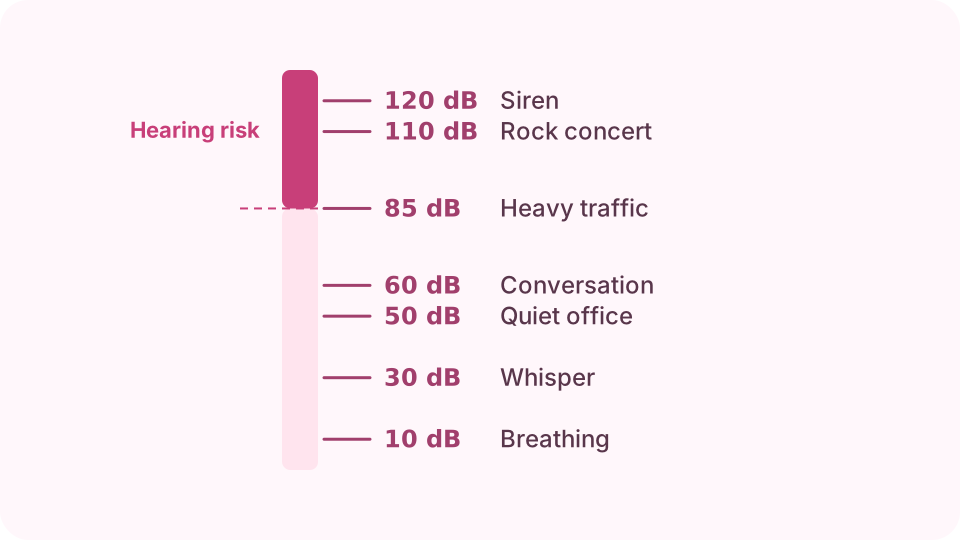
Typical sound levels from breathing to a siren. Measure over time
Let it run for at least a minute. Average (Leq) is the energy average, which is how noise limits are written; Max catches the peaks. Press Reset min/max to start a new measurement.
Calibrate if you can
Place a real sound level meter next to the device and play a steady sound. Change Calibration (dB) until both show the same number. Without a meter, check that a quiet room reads about 30–40 dB.
Compare with safe limits
Long exposure above 85 dB(A) can damage hearing. NIOSH allows 8 hours at 85 dB(A) and half the time for each extra 3 dB. For sleep, the WHO advises keeping night noise outside the bedroom below about 40 dB.
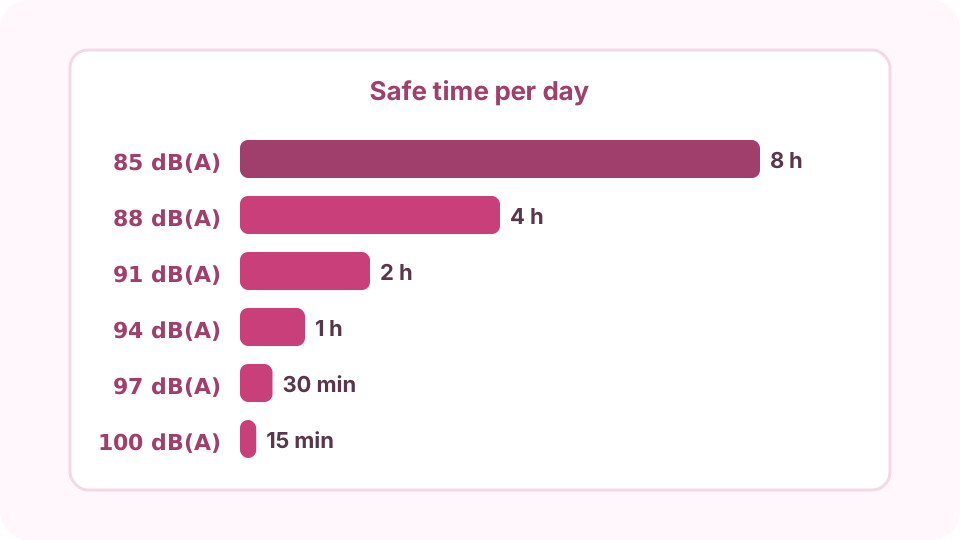
Safe listening time halves for every 3 dB above 85 dB(A).
FAQ
Can a phone measure decibels accurately?
To within a few dB after calibration, for levels between about 35 and 100 dB. Below that the microphone's own noise shows; above it the microphone may clip.
What is the difference between dB and dB(A)?
dB(A) is weighted like human hearing, turning down low rumbles and very high tones. Most noise limits use dB(A).
What does Leq mean?
The equivalent continuous level: the steady level with the same total sound energy as the changing noise you measured.
Why does the reading change with distance?
Sound spreads out: in open space each doubling of distance from a small source lowers the level by about 6 dB.
Is the sound recorded?
No. The microphone signal is analysed in the tab and discarded. Nothing is stored or uploaded.