Math and school
How to flip a coin online
Two people need a fair decision, or a class wants to see how chance behaves, and nobody has a coin. You will agree the call, flip one coin or up to 1,000, and read the totals and streaks. It runs in your browser.
Each coin uses one secure random bit from your browser, so heads and tails are equally likely and earlier flips do not matter.
Open Coin flipContents
Agree on the call first
Say who has heads and what each side means before you flip, and that one flip decides. A decision made in advance is what makes the flip fair to everyone.
Open Coin flip on cv.cm
Tap the coin or press Flip. Space and Enter also flip it. The face shown when it stops is the result.
Open Coin flipFlip many coins at once
Choose 10, 100 or 1,000 under Coins per flip. All of them land together and the page shows how many came up heads and tails, which is handy for a probability lesson.
Read the totals
Results add up every flip since the last Reset, so press Reset first to read one batch on its own. Expect close to half each, not exactly half: in 100 coins, anything from 40 to 60 heads happens about 96% of the time.
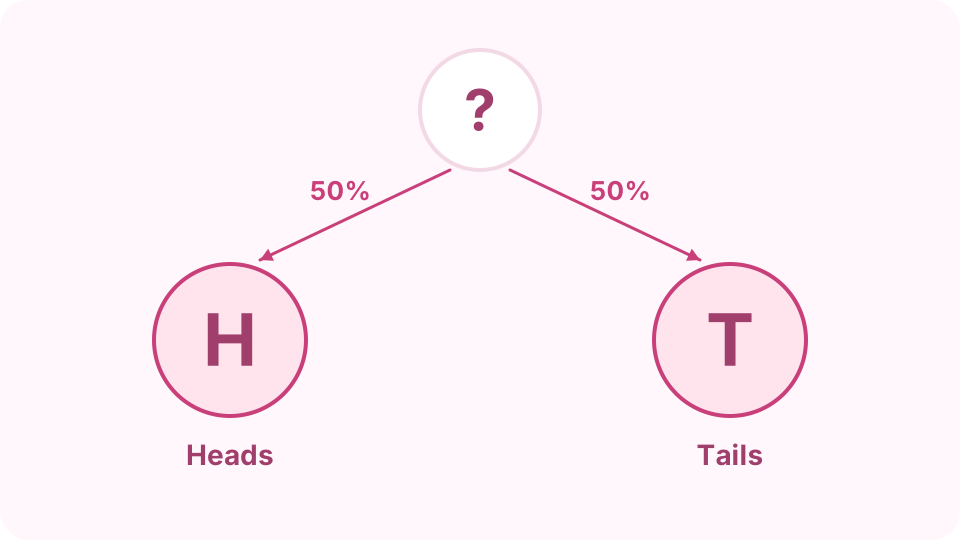
Every flip is an even split: one bit, two equal faces. Do not read meaning into streaks
Longest streak and Current streak show runs of the same face. They look surprising but are normal. After five heads in a row, the next coin is still 50% heads.
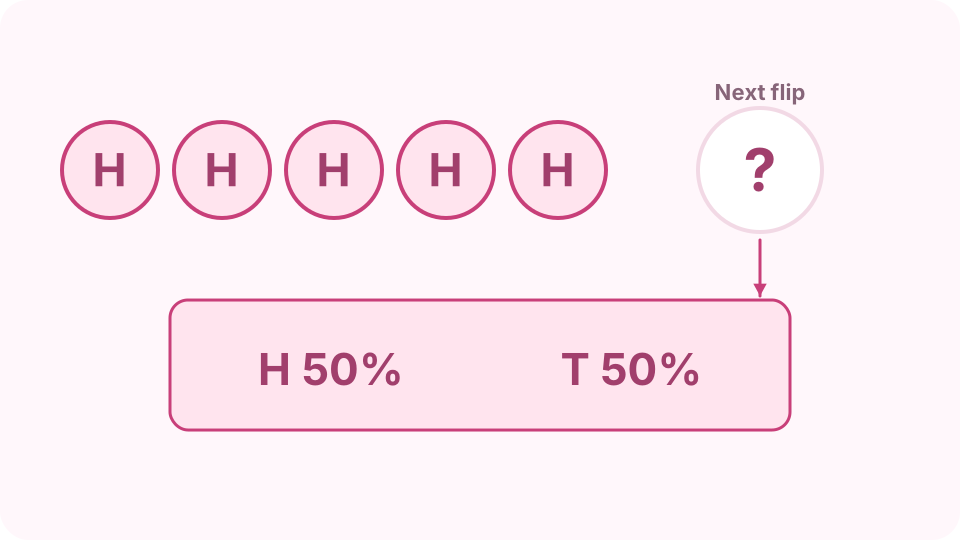
The coin has no memory: after any run, the next flip is still 50%. Copy or reset
Copy results gives you a line with the totals to paste in a chat or a report. Last 100 coins shows the recent faces in order. Reset starts a new count.
FAQ
Is an online coin flip really fair?
Yes. Each flip takes one bit from your browser's secure random generator, so both faces are equally likely. Nothing is sent to a server, so the result is made on your device.
Are heads more likely after a run of tails?
No. Believing so is called the gambler's fallacy. Each flip is independent of the ones before, so the chance stays at 50%.
How long a streak is normal?
Longer than most people guess. In 100 flips, a run of 6 or more of the same face is usual, and that does not mean anything is wrong.
Why did I not get exactly 500 out of 1,000?
Exactly half is actually rare, at about 2.5% for 1,000 coins. Most results fall between 470 and 530 heads, and the share gets closer to 50% as the number of flips grows.
Can I use it for something serious?
It is fair for everyday decisions, games and teaching. If a draw has legal or money rules, follow the official process, since it may need a witness or an audit.