Money
How to calculate a mortgage payment
Before you talk to a bank, you want to know what a home will cost each month and in total. You will turn the price, down payment, rate and term into a monthly payment and a year-by-year schedule. It runs in your browser.
The result is principal and interest only. Property tax, home insurance and mortgage insurance come on top.
Open Mortgage calculatorContents
Gather the four numbers
You need the home price, the down payment as a percentage, the yearly interest rate and the term in years. The loan is the price minus the down payment: 400,000 with 20% down is a 320,000 loan.
Open the Mortgage calculator on cv.cm
Type the four numbers into Home price, Down payment (%), Interest rate (% per year) and Term (years). The result updates as you type.
Open Mortgage calculatorRead the monthly payment and total interest
With Equal payments, 320,000 at 6.5% for 30 years is 2,022.62 a month. Over 360 payments that is 408,142 in interest, more than the loan itself. A lower rate or a shorter term cuts that figure fast.
Compare Equal payments with Equal principal
Switch Repayment to Equal principal. Each month repays the same part of the loan plus that month's interest, so the same loan starts at 2,622.22, falls by 4.81 every month to 893.70, and costs 312,867 in interest. It saves money but needs a higher payment at the start.
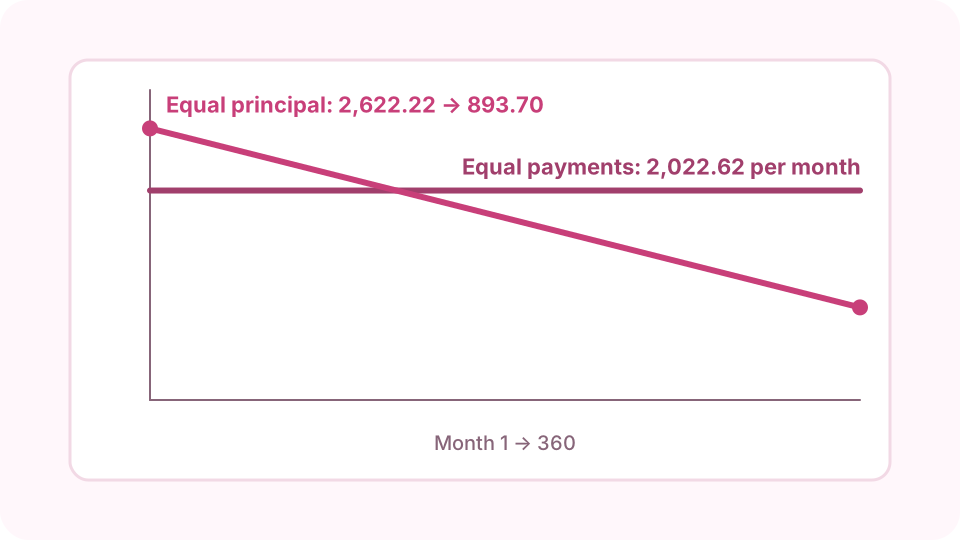
Equal payments stay flat; equal principal starts higher and falls every month. Read the amortization table
Each row is one year: how much went to principal, how much to interest, and the balance left. With equal payments, year 1 is mostly interest (20,695 interest, 3,577 principal); by the last year it is almost all principal.
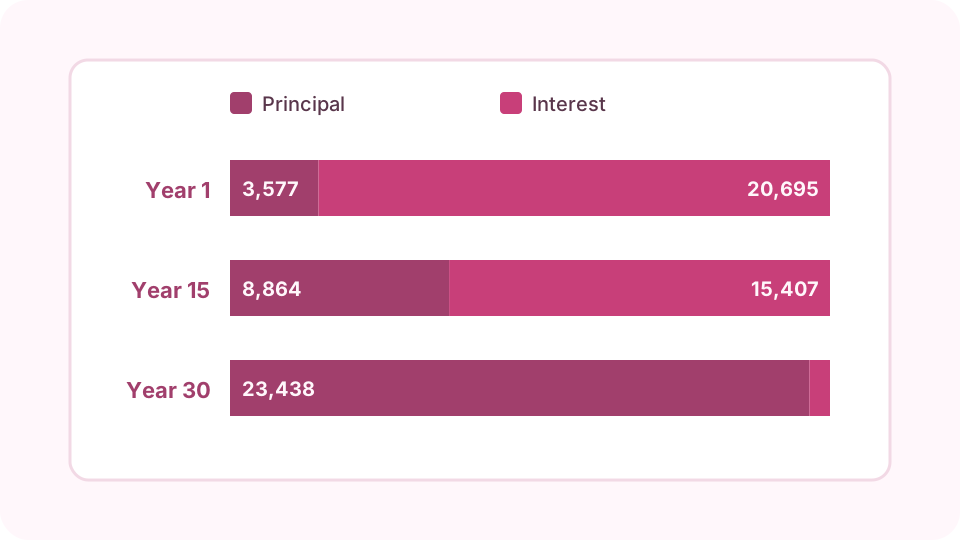
Each year's payments: early years go mostly to interest, later years mostly to the loan. Try other numbers and copy the result
Change one number at a time, such as 10 more years or 1% less interest, to see what it really changes. Copy result copies the summary for your notes or a message.
FAQ
What is the formula for a monthly mortgage payment?
M = P × r × (1 + r)ⁿ ÷ ((1 + r)ⁿ − 1), where P is the loan, r the yearly rate ÷ 12 and n the number of months. 320,000 at 6.5% for 30 years gives 2,022.62.
Is equal principal better than equal payments?
It costs less interest because the loan shrinks faster, but the first payments are higher. Equal payments are easier to budget. Choose the one your income can carry at the start.
How much does a bigger down payment help?
Every unit of down payment is a unit you do not borrow, so the payment and the interest fall in the same proportion. In the US, 20% down usually also avoids mortgage insurance.
Why is so much of the first payment interest?
Interest is charged on the balance still owed, which is highest at the start. As the balance falls, more of the same payment goes to the loan.
Does the result match what my bank will charge?
For the same loan, rate and term, the principal and interest should match to the cent or within rounding. Bank quotes may add fees, tax, insurance or a different rate type.