Math and school
How to find the factors of a number
You need the factors of a number for homework, for simplifying, or to check whether it is prime. You will find them by hand for a small number, then read the full answer for any whole number up to 18 digits. It runs in your browser with exact maths.
A factor divides a number with nothing left over. Each factor comes with a partner, so you only need to test up to the square root.
Open Factor calculatorContents
Find the prime factors by hand
Keep dividing by the smallest prime that fits. 360 ÷ 2 = 180, ÷ 2 = 90, ÷ 2 = 45, ÷ 3 = 15, ÷ 3 = 5, and 5 is prime. So 360 = 2³ × 3² × 5.
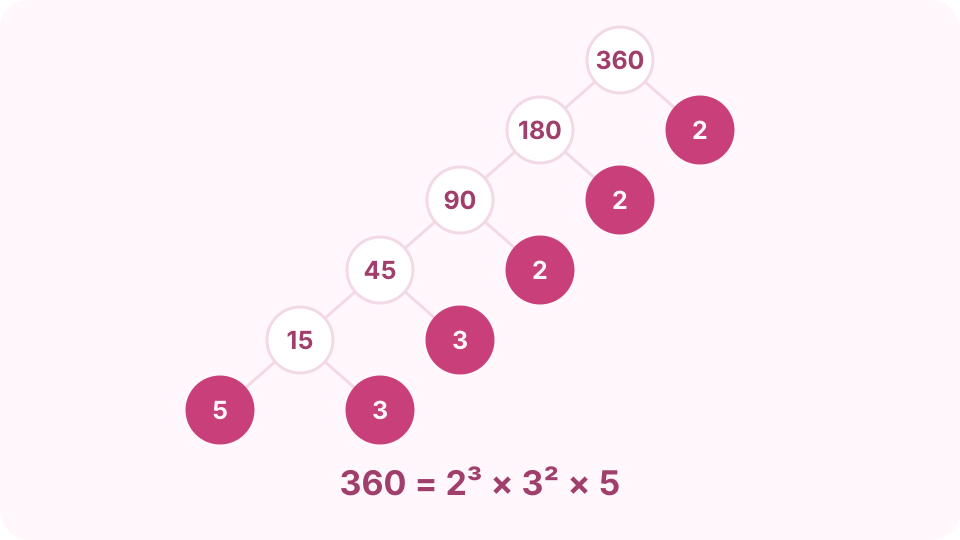
Split until every branch ends in a prime: 360 = 2³ × 3² × 5. Open the Factor calculator on cv.cm
Type a whole number or tap an example such as 97 or 1001. You can group digits in threes, as in 1,234,567. The answer updates as you type.
Open Factor calculatorRead prime or composite
The first line says whether the number is prime, and the table lists the Previous prime and Next prime. 97 is prime; 1001 is not, as 1001 = 7 × 11 × 13. 1 is neither, as it has only one factor.
Read the prime factorization
Prime factorization gives the compact form, and Written out repeats every prime: 2 × 2 × 2 × 3 × 3 × 5. Every whole number above 1 has exactly one such list of primes.
Use factor pairs
Factor pairs are two numbers that multiply to give yours: 36 is 1 × 36, 2 × 18, 3 × 12, 4 × 9 and 6 × 6. They are also every whole-number rectangle of that area, which is useful for layouts and seating.
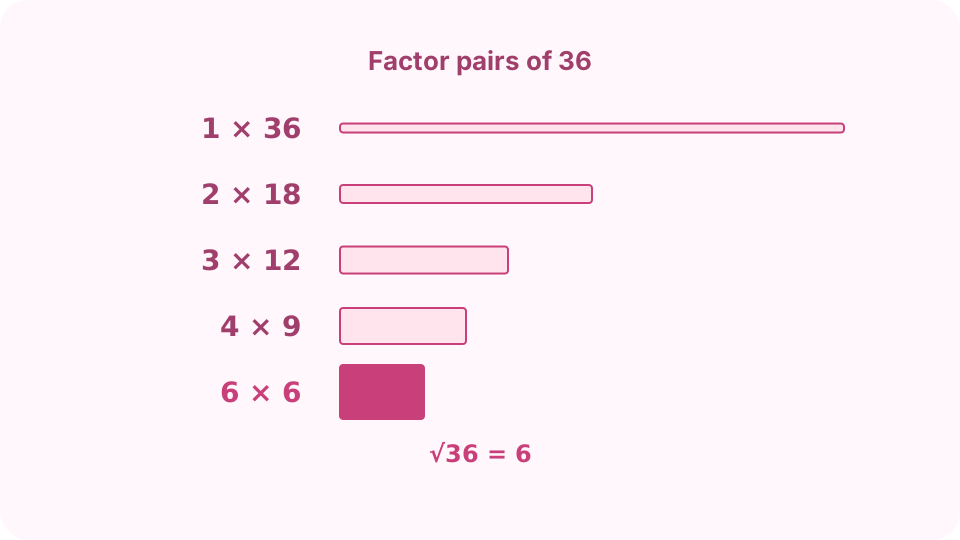
Each factor has a partner, and the pairs stop at the square root. Check the count of factors
Add 1 to each exponent and multiply. 360 = 2³ × 3² × 5¹ has 4 × 3 × 2 = 24 factors, which is the Number of divisors shown. All factors lists them, showing the first 1,000 if there are more.
FAQ
What is the difference between factors and prime factors?
Factors are all the numbers that divide it exactly: 12 has 1, 2, 3, 4, 6 and 12. Prime factors are the primes that multiply to make it: 12 = 2² × 3.
Is 1 a prime number?
No. A prime has exactly two different factors, 1 and itself, and 1 has only one. Keeping 1 out means every number has just one prime factorization.
How many factors does a prime number have?
Exactly two: 1 and itself. A number with an odd count of factors is always a perfect square, as its square root pairs with itself.
Why stop at the square root?
Factors come in pairs, one at or below the square root and one at or above it. If nothing up to the square root divides the number, it is prime.
How large a number can the calculator handle?
Up to 18 digits, with exact whole-number maths. If the number has more than 1,000 factors, the first 1,000 are listed, and the counts stay exact.