Math and school
How to solve a quadratic equation
You have an equation with an x² in it and need the values of x. You will put it in standard form, see how many answers it has, work them out with the quadratic formula, and check them on a graph. A solver checks each step in your browser.
Most mistakes are sign mistakes. Keep the minus sign with its number when you read off b and c.
Open Quadratic equation solverContents
Put the equation in standard form
Move every term to one side so it reads ax² + bx + c = 0. For x² = 3x − 2, subtract 3x and add 2: x² − 3x + 2 = 0. Now a = 1, b = −3 and c = 2.
Open the Quadratic equation solver on cv.cm
Type a, b and c into their boxes. Leave b or c empty if that term is missing: x² − 4 = 0 has a = 1, b = 0, c = −4. a cannot be 0, or it is not quadratic.
Open Quadratic equation solverCheck the discriminant
Δ = b² − 4ac decides the answer. For x² − 3x + 2: Δ = 9 − 8 = 1. Positive means two real roots, 0 means one repeated root, negative means no real roots (two complex ones).
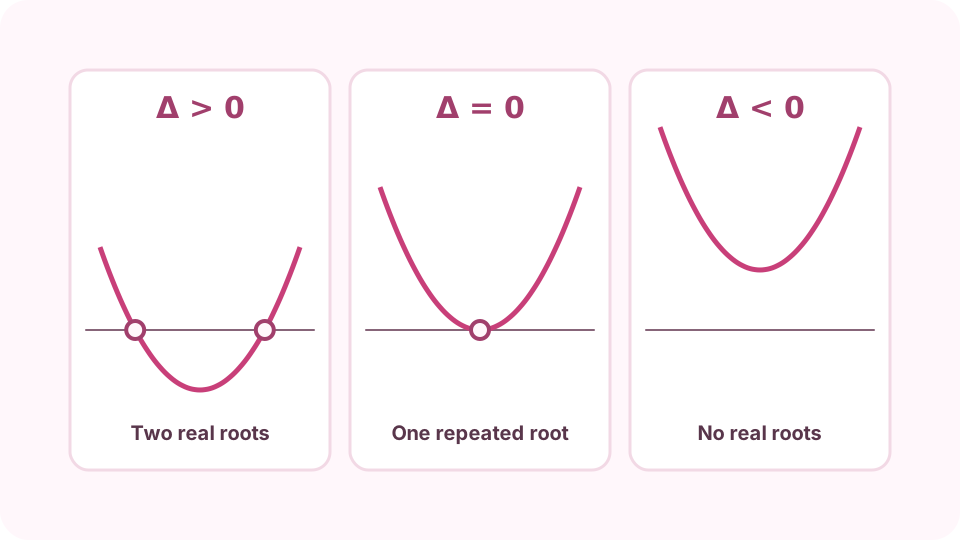
The sign of the discriminant shows how often the parabola meets the x-axis. Apply the quadratic formula
x = (−b ± √Δ) ÷ 2a. Here x = (3 ± 1) ÷ 2, so x = 1 or x = 2. Working shows the same steps with your numbers, so you can follow or copy them.
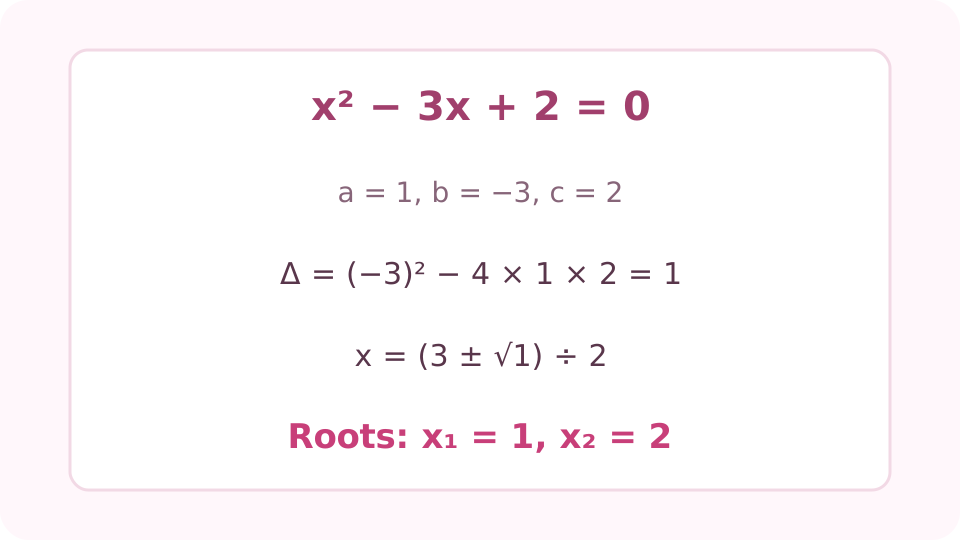
The quadratic formula worked through for x² − 3x + 2 = 0. Read exact roots and the factored form
When a, b and c are whole numbers, the solver keeps exact answers: x² − 2x − 1 = 0 gives 1 ± √2 (about −0.414 and 2.414). Rational roots also give the factored form, such as (x − 1)(x − 2) = 0.
Check with the graph
The roots are where the parabola crosses the x-axis, marked with circles; the filled dot is the vertex. If the curve never reaches the axis, the roots are complex. Copy result copies everything as text.
FAQ
What is the quadratic formula?
x = (−b ± √(b² − 4ac)) ÷ 2a. It solves every equation of the form ax² + bx + c = 0 with a not 0.
What if the discriminant is negative?
There are no real roots and the graph does not cross the x-axis. The roots are complex: for x² + 2x + 5 = 0 they are −1 ± 2i.
When can I factor instead?
When the discriminant is a perfect square and a, b and c are whole numbers, the roots are fractions and the equation factors. x² − 3x + 2 = (x − 1)(x − 2).
How do I find the vertex?
The vertex is at x = −b ÷ 2a. Put that x back in the equation for y. For x² − 3x + 2 it is (1.5, −0.25).
How do I check my answer?
Put each root back into ax² + bx + c. If the result is 0 (or very close, for rounded decimals), the root is right.