Cat breed
Bengal cat
In short
The Bengal is a hybrid cat breed created by crossing the Asian leopard cat with domestic cats, notably the Egyptian Mau. It is known for a wild-looking tabby coat with spots, rosettes or marbling. It is a medium-to-large cat weighing roughly 3.5 to 9 kg, and its ownership is regulated in some places because of its wild ancestry.
Breed facts
| Origin | United States |
|---|---|
| Height at the withers | — |
| Weight | 3.5–9 kg |
| Life expectancy | — |
| Size group | Large |
| Breed standards | CFA, FIFe, TICA, ACFA, NZCF |
From Wikidata (CC0) and the FCI breed list; — means Wikidata lists no figure.
Origin and history
Harrison Weir mentioned leopard cat hybrids as early as 1889, but Jean Mill of California is credited with the modern breed after a deliberate cross in 1963. TICA accepted the Bengal as a new breed in 1986 and gave it championship status in 1991; the GCCF followed in 1997 and FIFe in 1999. It is now TICA's most popular breed. Some countries and US states restrict or ban ownership, especially of early generations.
Appearance and coat
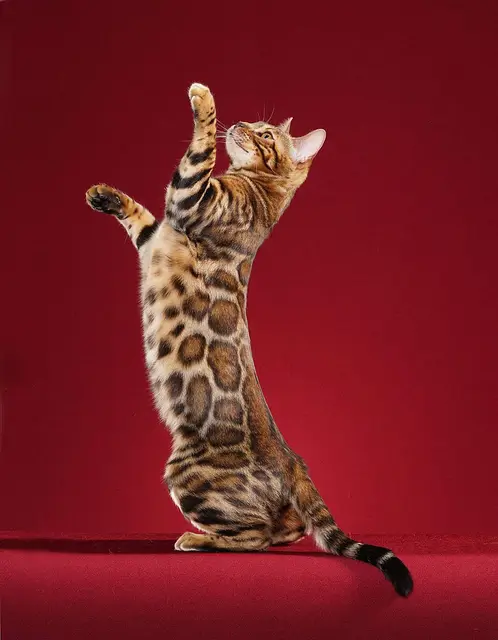
Bengals are the only domestic breed with rosette markings, inherited from the leopard cat. Coats come in spotted, rosetted and marbled tabby patterns in black (brown) or blue, with or without silver or charcoal, plus colourpoint snow variants. A 2024 genome study found an average of 3.48% leopard cat DNA. A long-haired form, sometimes called the Cashmere Bengal, is recognised by some registries.
Temperament
The source text gives little detail on temperament, and individual cats vary. Breeders generally describe the Bengal as an active breed.
Care and exercise
Sources give little specific detail on care. Breeders often claim the Bengal is hypoallergenic, but this has not been scientifically proven, and geneticist Leslie Lyons notes there is no such thing as a hypoallergenic cat. Owners should also check local rules, as ownership is regulated in some areas.
Health
A UK study found a life expectancy of 8.51 years, compared with 11.74 for all cats. Conditions reported in the breed include hypertrophic cardiomyopathy, which one 2013 study put at 16.7%, Bengal progressive retinal atrophy, pyruvate kinase deficiency and ulcerative nasal dermatitis. Breeding cats are commonly screened for HCM and tested for PK deficiency.
General information, not veterinary advice.
FAQ
Are Bengal cats hypoallergenic?
This is often claimed but has not been scientifically proven, and experts note that no cat is truly hypoallergenic.
Is it legal to own a Bengal cat?
In many places yes, but some countries, US states and cities restrict or ban them, particularly early generations close to the leopard cat.
How big do Bengal cats get?
They are a medium-to-large breed, weighing roughly 3.5 to 9 kg.