Dog breed · FCI 8
Labrador Retriever
In short
The Labrador Retriever, or Lab, is a British gun dog developed in the 19th century from St. John's water dogs imported from Newfoundland, now part of Canada. It is a medium-large breed; the FCI gives about 56 to 57 cm for dogs and 54 to 56 cm for bitches. Labradors are commonly described as friendly, energetic and playful, and are widely used as guide and assistance dogs.
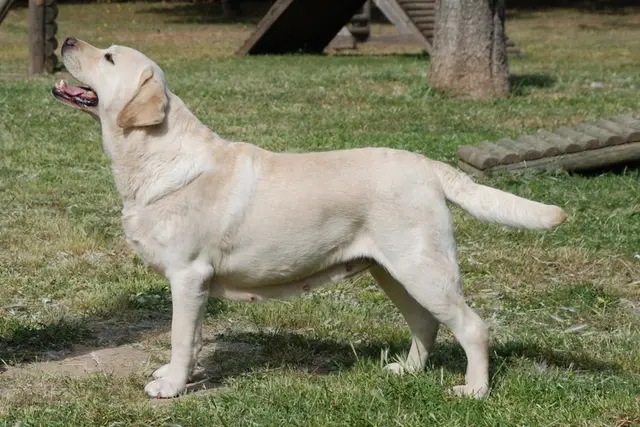
Breed facts
| Origin | Canada and United Kingdom |
|---|---|
| Height at the withers | 54–57 cm |
| Weight | — |
| Life expectancy | 10 years |
| Size group | Medium |
| FCI | Group 8: Retrievers, Flushing dogs, Water dogs · standard no. 122 |
| Breed standards | FCI, The Kennel Club (UK) |
From Wikidata (CC0) and the FCI breed list; — means Wikidata lists no figure.
Origin and history
St. John's water dogs, bred by European settlers in Newfoundland, reached Britain by the 1830s on ships trading with Poole in Dorset. The 10th Earl of Home, the 5th Duke of Buccleuch and the 2nd Earl of Malmesbury used them as gun dogs and for waterfowling.
In the 1880s their successors established the breed; the dogs Buccleuch Avon and Buccleuch Ned are ancestors of all modern Labradors. The name was common in England by 1870, the Kennel Club recognized the breed in 1903 and the first AKC registration came in 1917.
Appearance and coat
Labradors are medium-large and muscular, about as long from withers to tail base as they are tall. They have a broad head, kind brown or hazel eyes, ears hanging close to the head and a thick otter tail, which both the Kennel Club and AKC call a distinctive feature. The short, dense, water-resistant coat comes in solid black, yellow (cream to fox-red) and chocolate. Field and show lines differ noticeably, though all descend from British stock.
Temperament
The breed is commonly described as friendly, energetic and playful, and intelligent with initiative in working roles. The AKC standard calls the true Labrador temperament as much a hallmark of the breed as its otter tail. Its soft mouth lets it carry game without damage, and it has a high success rate as a guide dog.
Care and exercise
Sources note that, though content as companions, Labradors need both physical and mental stimulation. Bred to retrieve on land and in water, they have webbed paws and a waterproof coat suited to swimming. Obesity is reported in the breed, so keeping weight in check is often emphasized.
Health
Conditions reported in the breed include chronic hepatitis and other liver and gall bladder disease, hip and elbow dysplasia, progressive retinal atrophy and progressive rod-cone degeneration, cataracts, exercise-induced collapse and obesity. Lifespan figures vary by study: one UK study found 13.1 years, and a joint study found chocolate Labradors live about 10% shorter than other colors.
General information, not veterinary advice.
FAQ
How big does a Labrador Retriever get?
The FCI standard gives 56 to 57 cm for dogs and 54 to 56 cm for bitches; the AKC allows somewhat taller dogs. The AKC ideal weight is 25 to 36 kg for dogs and 25 to 32 kg for bitches.
What colors do Labradors come in?
Labradors are registered in three colors: solid black, yellow (from creamy white to fox-red) and chocolate. Puppies of all three colors can appear in the same litter.
Are Labradors good family dogs?
They are commonly described as friendly, playful and eager to work, and are among the most popular companion dogs in several countries. They need regular physical and mental exercise.
Where does the Labrador come from?
The breed was developed in the United Kingdom from St. John's water dogs imported from Newfoundland, and it is named after the Labrador region of that colony.