Dog breed · FCI 8
Kooikerhondje
In short
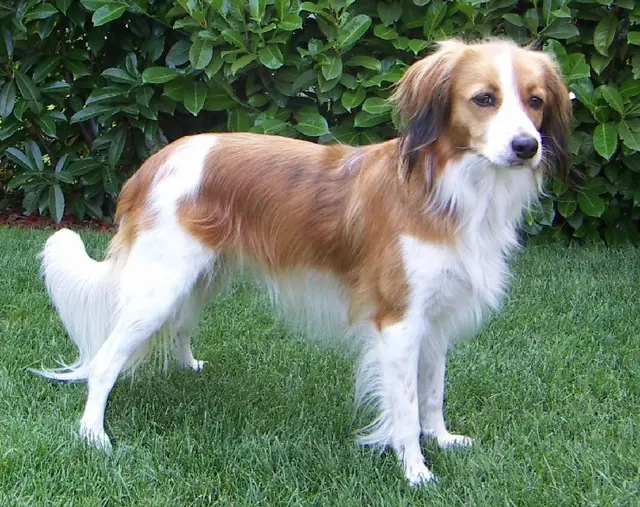
The Kooikerhondje is a small spaniel-type sporting dog from the Netherlands, developed around the 16th century to lure ducks into decoy traps. It stands roughly 35 to 42 cm tall and has a wavy orange-red and white coat with a plumed white tail.
Breed facts
| Origin | Netherlands |
|---|---|
| Height at the withers | 35–42 cm |
| Weight | — |
| Life expectancy | — |
| Size group | Medium |
| FCI | Group 8: Retrievers, Flushing dogs, Water dogs · standard no. 314 |
| Breed standards | FCI |
From Wikidata (CC0) and the FCI breed list; — means Wikidata lists no figure.
Origin and history
The Kooikerhondje was developed in the Netherlands around the 16th century to lure ducks into duck decoys, where hunters could catch them. Its working style imitated foxes, since hunters noticed that ducks were drawn to foxes playing near the water. The breed appears in paintings by Dutch masters such as Jan Steen, Rembrandt and Johannes Vermeer, and is believed to be an ancestor of the Nova Scotia Duck Tolling Retriever.
It nearly died out during World War II until Baroness van Hardenbroek van Ammerstol rescued it. The Dutch Kennel Club recognised the breed in 1971, the American Kennel Club in 2018, and the UK Kennel Club moved it from the gundog to the utility group in 2014.
Appearance and coat
This is a small, spaniel-like dog with a wavy, medium-length double coat in white and orange-red. Its white plumed tail was meant to attract ducks. Some dogs have black ear tips, known as earrings. The FCI standard allows about 38 to 41 cm for males and 36 to 39 cm for females.
Temperament
The source text gives little detail on temperament. As a working decoy and sporting dog, the breed was selected for active, cooperative work alongside hunters; prospective owners usually consult the breed standard and breed clubs for a fuller description of character.
Care and exercise
Sources give little specific guidance on exercise or grooming. As a sporting breed with a medium-length coat, it is generally expected to need regular activity and routine brushing.
Health
Conditions reported in the breed include inflammatory myopathy, Type III von Willebrand's disease, necrotising myelopathy, renal dysplasia, patellar luxation and ataxia. One Dutch study of 842 dogs found patellar luxation in 24% of dogs scanned, with prevalence falling from 28% to 19% between 1994 and 2011.
General information, not veterinary advice.
FAQ
What was the Kooikerhondje bred for?
It was bred to lure ducks into decoy traps by moving near the water, a technique modelled on the way foxes attract ducks.
How big is a Kooikerhondje?
It is a small dog, roughly 35 to 42 cm at the withers, with males slightly taller than females.
Is the Kooikerhondje recognised by the FCI?
Yes. The FCI lists it as breed number 314 in Group 8, with the Netherlands as the country of origin.