Dog breed
German Shepherd
In short
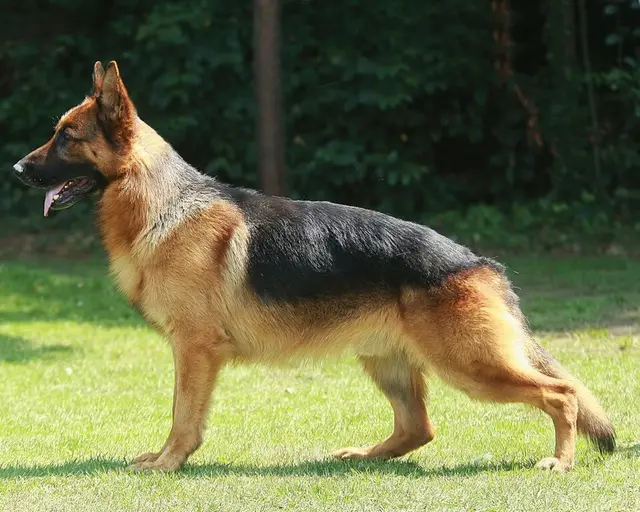
The German Shepherd, known in Britain for decades as the Alsatian, is a German working dog of medium to large size developed from 1899 by Max von Stephanitz from traditional herding dogs. Breed standards give a height of 60 to 65 cm for males and 55 to 60 cm for females. It is described as intelligent, obedient and protective, and is widely used in police, military and search work.
Breed facts
| Origin | Germany |
|---|---|
| Height at the withers | 55–60 cm |
| Weight | 22–40 kg |
| Life expectancy | 10 years |
| Size group | Large |
| FCI | — (Wikidata lists no FCI standard number) |
| Breed standards | — |
From Wikidata (CC0) and the FCI breed list; — means Wikidata lists no figure.
Origin and history
In 1899 Max von Stephanitz, a former cavalry captain, bought a dog named Hektor Linksrhein, renamed him Horand von Grafrath and founded the Verein für Deutsche Schäferhunde. Horand became the first registered German Shepherd Dog, and close inbreeding of his descendants fixed the breed's traits.
The breed gained international recognition after the First World War, when the UK Kennel Club renamed it the Alsatian; the German Shepherd name returned in Britain in 1977. Film dogs such as Strongheart and Rin Tin Tin helped popularize it, and it remains among the most frequently registered breeds worldwide.
Appearance and coat
German Shepherds are longer than they are tall, with a domed forehead, long square-cut muzzle, brown eyes, large erect ears and a bushy tail reaching to the hock. The double coat is close and dense with a thick undercoat, in medium or long variants; long hair is recessive and rarer. Black and tan or black and red are most common, while sable and solid black are accepted by most standards and white is disqualified in conformation shows.
Temperament
Breed standards describe the German Shepherd as self-assured and curious, with a willingness to learn and an eagerness to have a purpose. It is commonly described as highly intelligent, obedient and protective of its owners, and not quick to befriend strangers. Sources note it can become overprotective of family and territory if not socialized correctly.
Care and exercise
The breed is described as moderately active and is bred for work, so it is generally thought to benefit from regular activity and training that gives it a task. It is used for herding, tracking, scent detection, guarding and assistance work, and herding skills are tested in utility dog trials in Germany. The dense double coat is generally said to need regular brushing.
Health
Many common ailments are linked to early inbreeding. Conditions reported in the breed include hip and elbow dysplasia, degenerative spinal stenosis, degenerative myelopathy, von Willebrand disease, exocrine pancreatic insufficiency, haemangiosarcoma and pituitary dwarfism. Overall lifespan is approximately 10 years; a 2024 UK study found a mean of 11.3 years. The Kennel Club also criticizes the extremely sloped topline of some show lines.
General information, not veterinary advice.
FAQ
Is a German Shepherd the same as an Alsatian?
Yes. The UK Kennel Club renamed the breed Alsatian after the First World War, and it was registered again as the German Shepherd from 1977; the word Alsatian was dropped from the formal name in 2010.
How big does a German Shepherd get?
The breed standard gives a height at the withers of 60 to 65 cm for males and 55 to 60 cm for females. It is classed as a medium to large dog.
How long do German Shepherds live?
Overall lifespan is approximately 10 years. A 2024 UK study found a mean of 11.3 years, slightly lower than the average for crossbreeds.
Are German Shepherds good guard dogs?
They are commonly described as protective, curious and wary of strangers, traits valued in guard and police work. Sources stress good socialization to avoid overprotectiveness.