Dog breed
Samoyed dog
In short
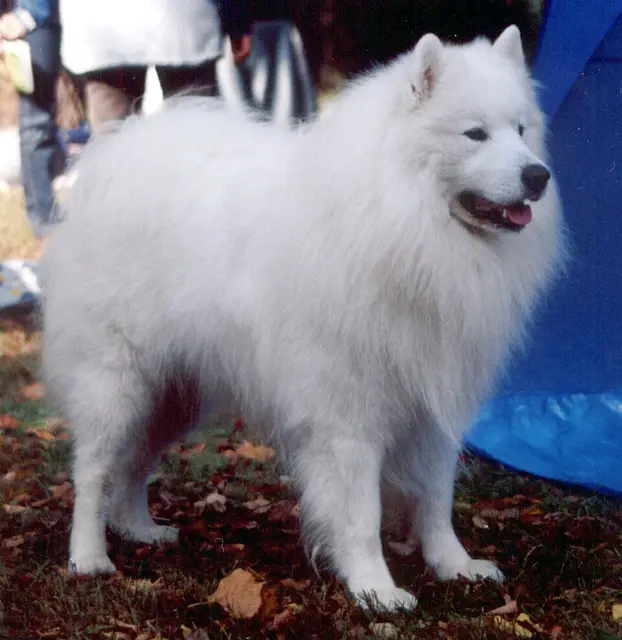
The Samoyed is a spitz-type herding dog from Siberia, named after the Samoyedic peoples and descended from the Nenets Herding Laika. It is a medium-sized dog with a thick, white double coat, used for herding, hunting, protection and pulling sleds. The breed is known for a friendly, agreeable disposition and its 'Sammie smile'.
Breed facts
| Origin | Russia |
|---|---|
| Height at the withers | 50–60 cm |
| Weight | — |
| Life expectancy | — |
| Size group | Large |
| FCI | — (Wikidata lists no FCI standard number) |
| Breed standards | — |
From Wikidata (CC0) and the FCI breed list; — means Wikidata lists no figure.
Origin and history
The Samoyed's ancestor, the Nenets Herding Laika, was a reindeer-herding spitz of the Arctic. DNA evidence shows the Samoyed is a basal breed predating modern 19th-century breeds, and genomic work links it to ancient Arctic dogs of the Yamal Peninsula.
British zoologist Ernest Kilburn-Scott, widely seen as the breed's founder, brought a puppy to England from near Arkhangelsk in 1889, and the first official standard was written in England in 1909. Samoyeds took part in polar expeditions, including Nansen's Fram voyage and Borchgrevink's Southern Cross expedition, where they were the first dogs used in Antarctic exploration.
Appearance and coat
The AKC standard calls for males of 53 to 60 cm and 20 to 29 kg and females of 48 to 53 cm and 16 to 23 kg; the UK standard is slightly smaller. The ears are thick, furry, triangular and erect, and the tail is carried curled over the back and to one side. The dense double coat has long, coarse, silver-tipped guard hairs over a soft, short undercoat, and is white, biscuit or a mix of both. Males usually have larger ruffs.
Temperament
Samoyeds are commonly described as friendly and affable, which makes them poor guard dogs, and aggression is said to be rare. They tend to bark, so they can be diligent watchdogs. They are described as good companions for small children and other dogs and playful into old age, but the Samoyed Club of America notes that bored Samoyeds may become destructive or dig.
Care and exercise
The undercoat sheds heavily once or twice a year, known as blowing coat, and fine hair sheds all year round, so frequent grooming is needed. Although sometimes called hypoallergenic, the breed sheds a fair amount. Samoyeds can compete in agility, carting, obedience, mushing, tracking and herding events.
Health
Life expectancy is about 12 to 13 years, and a 2024 UK study found 13.1 years. Conditions reported in the breed include Samoyed hereditary glomerulopathy, an inherited kidney disease more severe in males, diabetes mellitus, X-linked progressive retinal atrophy, pulmonary stenosis, hip dysplasia and sebaceous adenitis. A genetic test exists for the kidney disease.
General information, not veterinary advice.
FAQ
Do Samoyeds shed a lot?
Yes. The undercoat sheds heavily once or twice a year and fine hair sheds year-round, so the breed needs frequent grooming despite being marketed as hypoallergenic.
How long do Samoyeds live?
Life expectancy is about 12 to 13 years; a 2024 UK study found 13.1 years.
Are Samoyeds good with children?
They are commonly described as friendly, playful and good companions for small children and other dogs. They can bark a lot and may dig when bored.
How big does a Samoyed get?
Under the AKC standard males stand 53 to 60 cm and weigh 20 to 29 kg, and females stand 48 to 53 cm and weigh 16 to 23 kg.