Dog breed · FCI 2
Rottweiler
In short
The Rottweiler is a mastiff-type breed from Germany, named after the old free city of Rottweil, where butchers used it to herd livestock and pull carts of meat to market. Under the FCI standard males stand 61 to 69 cm and females 56 to 63 cm. It is described as strong and confident, with marked watchdog and territorial instincts.
Breed facts
| Origin | Germany |
|---|---|
| Height at the withers | 56–68 cm |
| Weight | 42–50 kg |
| Life expectancy | — |
| Size group | Large |
| FCI | Group 2: Pinscher and Schnauzer, Molossoid and Swiss Mountain and Cattledogs · standard no. 147 |
| Breed standards | FCI |
From Wikidata (CC0) and the FCI breed list; — means Wikidata lists no figure.
Origin and history
The FCI standard regards the Rottweiler as one of the oldest surviving breeds, tracing it to Roman times, when herding dogs crossed the Alps with the legions and later mixed with native dogs around Rottweil. Known as the Rottweil butcher's dog, it drove and guarded cattle and served as a draught dog until railways replaced droving in the mid-19th century.
Demand for police dogs before the First World War revived the breed, and Rottweilers served as messenger, ambulance, draught and guard dogs in both World Wars. The ADRK, formed in 1921, is recognized worldwide as the breed's home club. The American Kennel Club recognized the breed in 1931.
Appearance and coat
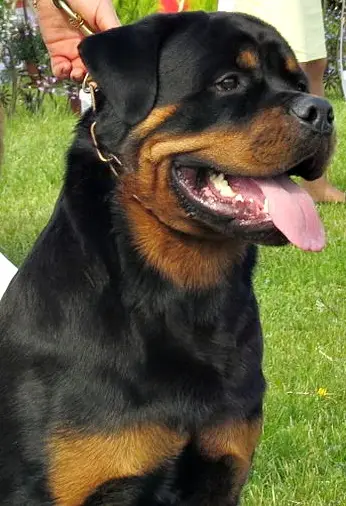
The FCI describes a dog of abundant strength, black with clearly defined rich tan markings on the cheeks, muzzle, throat, chest and legs, over both eyes and under the tail. It has a broad skull, almond-shaped dark brown eyes and medium-sized pendant ears. The outer coat is medium-length, coarse, dense and flat, with an undercoat on the neck and thighs. The tail is now usually left natural, as docking is banned in most countries.
Temperament
Breed literature describes the Rottweiler as very territorial, and one survey of breed club members found it average in aggression toward owners and other dogs but more aggressive than average toward strangers, linked to watchdog instincts. Sources say owners need to work with the dog regularly to manage this. In herding it is described as forceful, with a strong desire to control stock.
Care and exercise
The coat is described as low maintenance, though it sheds heavily at certain times of year. The breed is still used for herding and is well suited to dog sports such as agility and Schutzhund, which suggests it is generally thought to need regular work and activity. Consistent training is emphasized because of its territorial nature.
Health
Studies give a shorter life expectancy than average: a 2024 UK study found 10.6 years and a 2022 English study 8 years. A breed club survey attributed more than 45% of deaths to cancer. Conditions reported in the breed include hip and elbow dysplasia, cranial cruciate ligament deficiency and several skin conditions such as acral lick dermatitis and vitiligo; evidence on gastric dilatation volvulus is mixed.
General information, not veterinary advice.
FAQ
How big does a Rottweiler get?
The FCI standard gives 61 to 69 cm at the withers for males and 56 to 63 cm for females, with weight in proportion to height. It is classed as a medium-to-large or large breed.
How long do Rottweilers live?
A 2024 UK study found a life expectancy of 10.6 years, below the average for purebred dogs. Cancer is the most commonly reported cause of death.
Why is it called a Rottweiler?
The breed is named after the old free city of Rottweil in Germany, where butchers used the dogs to drive cattle and pull carts of meat.
Is the Rottweiler recognised by the FCI?
Yes. The FCI lists the Rottweiler as breed number 147 in Group 2, and the German ADRK is regarded as the breed's home club.