Dog breed · FCI 2
Bernese Mountain Dog
In short
The Bernese Mountain Dog, or Berner Sennenhund, is a large breed from the canton of Bern and the Swiss Alps, one of four Sennenhund breeds. It was a general farm dog that guarded property, drove cattle and pulled carts of milk and cheese. Dogs stand about 64 to 70 cm and bitches 58 to 66 cm, and the breed is described as calm but energetic and attentive.
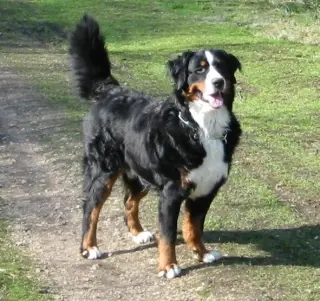
Breed facts
| Origin | Switzerland |
|---|---|
| Height at the withers | 60–68 cm |
| Weight | — |
| Life expectancy | — |
| Size group | Large |
| FCI | Group 2: Pinscher and Schnauzer, Molossoid and Swiss Mountain and Cattledogs · standard no. 45 |
| Breed standards | FCI |
From Wikidata (CC0) and the FCI breed list; — means Wikidata lists no figure.
Origin and history
The breed's name refers to Bern and to the Senne, the alpine herders and dairymen the dogs accompanied; it was also called the Dürrbächler after the town of Dürrbach. Its ancestral roots are traced to Roman mastiffs. Locals knew the cart-pulling farm dogs as cheese dogs.
In 1907 breeders from the Burgdorf region founded the first breed club and wrote the first standard, and the breed was formally recognized in 1912. The American Kennel Club recognized it in 1937, and it is a popular family dog in German-speaking countries.
Appearance and coat
The Bernese is large, heavy and muscular, slightly longer than tall, with a flat skull, triangular ears and a bushy tail carried low. It is the only Sennenhund with a long coat, which is tricolored: black with a white chest and rust markings above the eyes, on the sides of the mouth and on the legs. A white horseshoe around the black nose and a white Swiss cross on the chest are considered ideal. Weights are roughly 35 to 55 kg for dogs and 35 to 45 kg for bitches.
Temperament
The breed is described as energetic, attentive and impetuous but indisposed to biting, with a calm temperament suited to carting. Sources say it tends to attach to one person and has an inherent suspicion of strangers, making it a natural defender of home and stable.
Care and exercise
With training, many Bernese enjoy pulling small carts, and regional clubs hold carting workshops and competitions. The breed has been eligible for AKC herding events since 2010. It is described as tolerant of very cold winters; sources give little detail on grooming, though the long coat suggests regular brushing.
Health
The breed has a short life expectancy even for its size: studies report 8 to 8.4 years in Switzerland, the Netherlands and France, and 10.1 years in a 2024 UK study. One study attributed 55% of deaths to cancer. Conditions reported in the breed include malignant histiocytosis, mast cell tumors, elbow dysplasia, degenerative myelopathy, glomerulonephritis and other kidney disease, and von Willebrand's disease.
General information, not veterinary advice.
FAQ
How long do Bernese Mountain Dogs live?
Life expectancy is short: several European studies found about 8 years, and a 2024 UK study found 10.1 years. Cancer is a leading cause of death.
How big does a Bernese Mountain Dog get?
Dogs stand about 64 to 70 cm and bitches 58 to 66 cm. Weights are roughly 35 to 55 kg for males and 35 to 45 kg for females.
Are Bernese Mountain Dogs good with children?
They are popular family dogs and are described as calm and indisposed to biting; trained dogs often give children rides in carts. They can be wary of strangers.
Is the Bernese Mountain Dog recognised by the FCI?
Yes. The FCI lists it as breed number 45 in Group 2.