Dog breed · FCI 2
Great Dane
In short
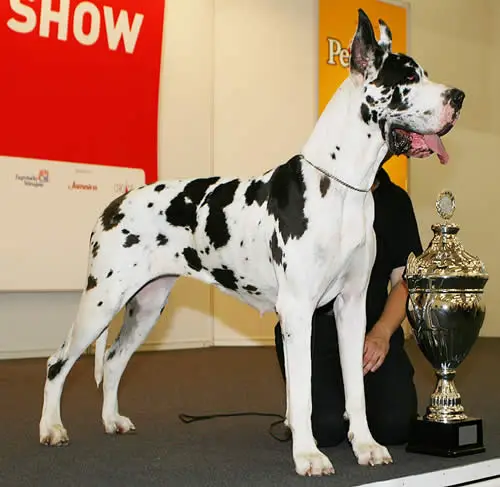
The Great Dane is a giant German breed of mastiff-sighthound type, descended from medieval hunting dogs used on bear, boar and deer and kept as guard dogs by German nobility. Along with the Irish Wolfhound it is among the tallest breeds; the AKC sets a minimum of 76 cm for males and 71 cm for females. It is described as strong and elegant, and generally not unduly aggressive toward people or other animals.
Breed facts
| Origin | Germany |
|---|---|
| Height at the withers | 72–90 cm |
| Weight | 50–90 kg |
| Life expectancy | 9 years |
| Size group | Giant |
| FCI | Group 2: Pinscher and Schnauzer, Molossoid and Swiss Mountain and Cattledogs · standard no. 235 |
| Breed standards | FCI |
From Wikidata (CC0) and the FCI breed list; — means Wikidata lists no figure.
Origin and history
In the 16th century European nobles imported strong, long-legged dogs from England and Ireland, known in Germany as the Englische Dogge, or English dog. German courts bred them from the early 17th century as catch dogs that held bear, boar or deer for the huntsman, and as chamber dogs that guarded sleeping princes. With the spread of firearms the type became rare.
In 1878 a committee in Berlin renamed the breed the Deutsche Dogge, laying the foundation of the modern breed. In English it was first called the German Boarhound; the name Great Dane comes from the French Grand Danois, although the breed has no known connection to Denmark.
Appearance and coat
The AKC describes a regal dog combining strength and elegance with great size, a smoothly muscled, square body and a long-reaching, powerful gait; it is often called the Apollo of dogs. The UK and New Zealand clubs set minimum adult weights of 54 kg for males and 45 kg for females. Ears are naturally floppy; cropping is banned or restricted in several countries. The short coat comes in fawn, brindle, black, harlequin, mantle, blue and, under some standards, merle.
Temperament
The Wikipedia source says little about temperament beyond noting that Great Danes are generally not unduly aggressive toward people and other animals. Like other giant breeds, they are described as having a fairly slow metabolism and less energy per kilogram than small dogs.
Care and exercise
Sources give little specific detail on exercise or grooming. The short coat is generally considered simple to care for. Because bloat is a major risk in the breed, owners are commonly advised to discuss prevention with a veterinarian.
Health
Bloat, or gastric dilatation volvulus, is described as the greatest killer of Great Danes. Other conditions reported in the breed include dilated cardiomyopathy and congenital heart disease, wobbler disease, hip dysplasia, and deafness or eye problems in double merles. The breed is nicknamed the heartbreak breed for these issues and its shorter lifespan; a 2024 UK study found 10.6 years.
General information, not veterinary advice.
FAQ
How big does a Great Dane get?
The AKC standard requires males to be at least 76 cm and females at least 71 cm at the shoulder. A Great Dane named Zeus, at 111.8 cm, was the tallest dog on record.
Is the Great Dane from Denmark?
No. It is a German breed known in Germany as the Deutsche Dogge; the English name comes from the French Grand Danois, and the breed has no known link to Denmark.
How long do Great Danes live?
A 2024 UK study found an average life expectancy of 10.6 years, well below the average for purebred dogs. Heart disease and bloat are major causes of death.
Are Great Danes aggressive?
They are described as generally not unduly aggressive toward people and other animals. Individual temperament varies.