Nostalgia · Everyday life · Remembered worldwide
What is Purikura (大头贴)?
Also called: Print Club, photo sticker booth, datoutie, プリクラ
In short
Purikura are photo sticker booths: you step into a curtained cubicle, take a few photos, decorate them with frames and graphics, and a few minutes later the machine prints a sheet of small sticker photos. The first one, Print Club (プリント倶楽部), was made by the Japanese game company Atlus with Sega and launched in July 1995 at 300 yen a play. The booths spread across Asia; in China, where they are called datoutie (大头贴, big-head stickers), they arrived around 2000, faded as phone selfies took over, and came back in fashion around 2024.
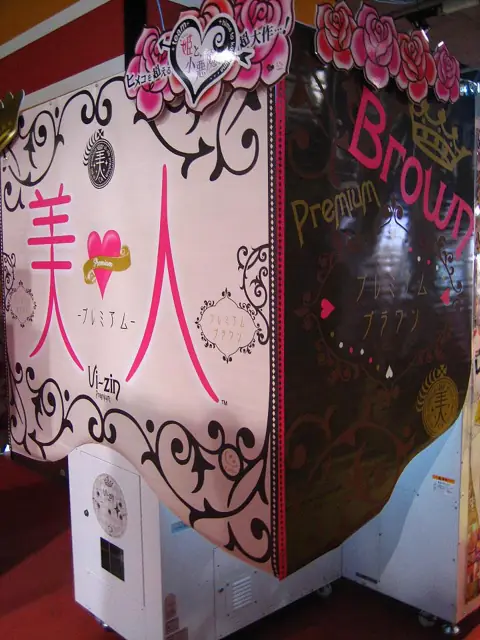
How a booth worked
Booths stood in arcades, malls and shopping streets, their curtains covered with sample photos of smiling models. Inside you posed in front of a screen while the machine took a short burst of shots, then picked frames, backgrounds and cartoon stickers, and on many machines wrote on the pictures. Out came a sheet of adhesive photo paper divided into small frames, which you cut up and stuck on notebooks, pencil cases and phones.
Chinese reports from 2024 recall that early machines in China came with a paper catalogue: you chose an effect and frame in the book, typed its number into the machine and then shot. The usual remembered price was about 5 yuan a sheet.
Timeline
| Year | What happened |
|---|---|
| July 1995 | Atlus launches Print Club in Japan, developed with Sega, 300 yen a play |
| 1997 | Purikura boom in Japan; tens of thousands of machines installed |
| 1990s–2000s | Booths spread to Taiwan, South Korea, Hong Kong and Southeast Asia |
| Around 2000 | Booths reach mainland China as datoutie |
| 2010s | Smartphone selfies and beauty apps cut demand; many booths disappear |
| Around 2024 | A retro datoutie revival in Chinese cities |
Purikura is short for Print Club and became the everyday Japanese word for every brand of booth. In Chinese the name datoutie comes from the close-up, big-head look of the photos.
Are they still around?
Yes. In Japan the number of booths fell from more than 50,000 in 1997 to about 11,000 by 2016, according to industry figures, but several companies still make new machines and taking purikura remains a normal outing for Japanese teenagers. In China the booths largely vanished in the 2010s, then reappeared in malls around 2024; newer machines usually send a digital copy to your phone as well as printing the stickers.
Details people remember
- Squeezing three or four friends into one tiny frame
- Star, heart and cartoon borders, plus names and dates written on the photos
- Cutting the sheet apart and swapping stickers with classmates
- Albums kept just for collecting purikura
FAQ
Who invented purikura?
The Japanese game company Atlus, working with Sega. Their Print Club machine launched in July 1995.
What does datoutie mean?
It is the Chinese name for photo sticker booths and their prints, literally big-head stickers, after the close-up shots.
Can you still use purikura booths?
Yes. They are still common in Japan, and in China they made a comeback around 2024.
Does it bring back memories?
Do you remember it?
Anonymous: no IP addresses are stored, and one network can add only a limited number of answers to a page each day.