Dog breed · FCI 8
Golden Retriever
In short
The Golden Retriever is a British retriever of medium-large size, bred in the late 19th century by Sir Dudley Marjoribanks at his Scottish estate, Guisachan. Dogs stand about 56 to 61 cm and bitches 51 to 56 cm. The breed is known for its gentle, affectionate nature and is widely kept as a companion and guide dog.
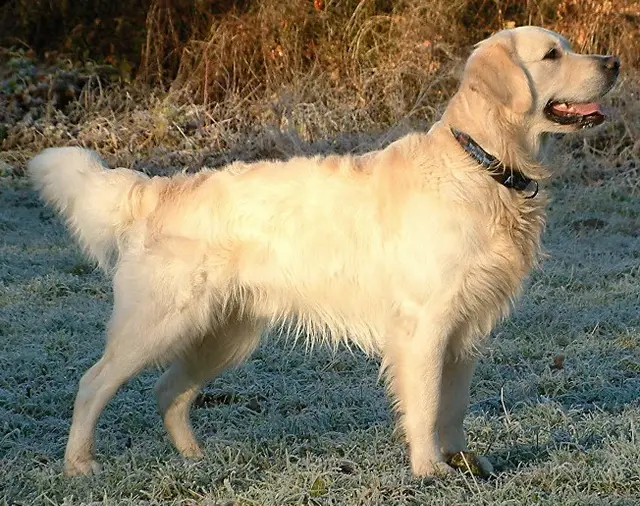
Breed facts
| Origin | United Kingdom |
|---|---|
| Height at the withers | 51–61 cm |
| Weight | — |
| Life expectancy | — |
| Size group | Large |
| FCI | Group 8: Retrievers, Flushing dogs, Water dogs · standard no. 111 |
| Breed standards | FCI, The Kennel Club (UK) |
From Wikidata (CC0) and the FCI breed list; — means Wikidata lists no figure.
Origin and history
Marjoribanks, later Baron Tweedmouth, began breeding at Guisachan in the 1860s from a yellow Flat-coated Retriever named Nous and a Tweed Water Spaniel named Belle, with later infusions of Red Setter, Labrador Retriever and Bloodhound. His stud book, covering 1868 to 1890, disproved popular tales of Russian circus ancestry.
The dogs were first registered as a color variety of the Flat-coated Retriever. The Kennel Club gave them a separate register in 1913 and the name Golden Retriever in 1920. Popularity grew after the First World War, with recognition in Canada in 1927 and the United States in 1932.
Appearance and coat
The Golden Retriever is powerfully built, with a broad head, dark eyes, a wide muzzle and moderately sized hanging ears. Healthy adults typically weigh 25 to 34 kg. The double coat has a flat or wavy outer layer with feathering and a dense, weather-resistant undercoat. Any shade of cream, yellow or gold is allowed under the Kennel Club standard, while North American standards call for a slightly taller dog and do not permit cream. Show lines tend to have longer, finer coats than working lines.
Temperament
The breed is commonly described as intelligent, gentle-natured and very affectionate, calm, biddable and keen to please. It is generally reported to be very tolerant of children and to have little guarding instinct, though aggressive individuals have been reported in some lines. Many keep a strong retrieving instinct and like to carry toys or objects, and the breed is considered slow to mature.
Care and exercise
As a working gundog, the Golden Retriever is generally described as needing regular activity, and it is used in field trials, obedience, guide and therapy work. Its long coat needs more grooming than a Labrador's, especially after working in mud or cover, where it picks up dirt and burrs.
Health
The breed is unusually prone to cancer; one US study found cancer to be the cause of death in about half of the dogs, while European studies found lower figures. Conditions reported in the breed include haemangiosarcoma, lymphoma, primary hypothyroidism and nonepidermolytic ichthyosis. A 2024 UK study found a median life expectancy of 13.2 years.
General information, not veterinary advice.
FAQ
How big does a Golden Retriever get?
Under the Kennel Club standard, dogs stand 56 to 61 cm and bitches 51 to 56 cm. Healthy adults typically weigh 25 to 34 kg.
Are Golden Retrievers good with children?
The breed is commonly described as gentle and generally very tolerant of children, which is why it is popular as a family dog. Individual temperament still varies.
How long do Golden Retrievers live?
A 2024 UK study found a median life expectancy of 13.2 years. The breed has a high rate of cancer, which is a leading cause of death.
Do Golden Retrievers shed?
They have a long double coat with a dense undercoat, and the long hair needs regular grooming. It is more maintenance than a Labrador's short coat.