Cat breed
Birman
In short
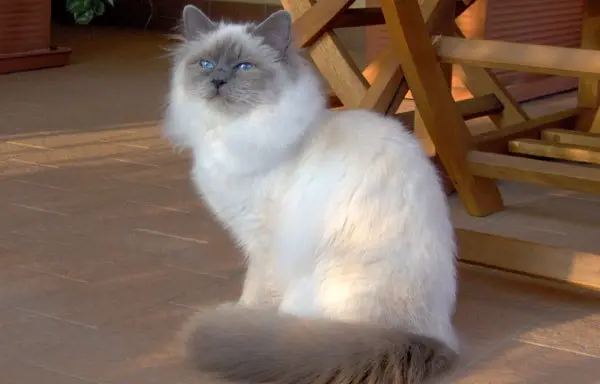
The Birman, also called the Sacred Cat of Burma, is a long-haired colorpoint domestic cat first recognized in France in 1925. It is a medium-sized cat with a silky, single coat, deep sapphire-blue eyes and symmetrical white gloves on all four paws.
Breed facts
| Origin | France |
|---|---|
| Height at the withers | — |
| Weight | — |
| Life expectancy | — |
| Size group | — |
| Breed standards | CFA, FIFe, GCCF, ACFA, ACF |
From Wikidata (CC0) and the FCI breed list; — means Wikidata lists no figure.
Origin and history
No clear record of the Birman's origin exists. It is often said to descend from temple cats of northern Burma, and many stories describe how the first cats reached France; the name comes from Birmanie, the French word for Burma. The breed was recognized by the Cat Club de France in 1925. It nearly vanished in World War II, when only a pair named Orloff and Xenia de Kaabaa survived in Europe, and it was rebuilt by outcrossing to Persians and Siamese. Pure litters returned by the early 1950s, and recognition followed in Britain and by the CFA in the 1960s. Birmans were used in developing the Ragdoll.
Appearance and coat
Birmans have a medium-sized, rectangular body, a broad face with a distinct Roman nose, and round, deep sapphire-blue eyes. The medium-long coat is silky and, unlike that of the Persian or Himalayan, has no undercoat, so it is much less prone to matting. The coat is always pointed, with a pale white to cream body and pure white gloves on each paw that extend up the back legs as laces. Recognized point colors include seal, chocolate, red, blue, lilac and cream, plus tabby and tortie variations.
Temperament
The source material says little about the Birman's personality. Breed clubs generally publish temperament descriptions, and individual cats vary.
Care and exercise
Because the coat lacks an undercoat, it mats much less readily than a Persian's, though as a long coat it still benefits from regular grooming. Sources give little other care detail.
Health
A UK study of veterinary records found a life expectancy of 14.39 years in a sample of 38 Birmans, above the 11.74-year overall average. Conditions reported in the breed include chronic kidney disease, feline infectious peritonitis, urate urolithiasis and feline audiogenic reflex seizures. A 2008 study found the Birman has one of the lowest levels of genetic diversity among breeds studied.
General information, not veterinary advice.
FAQ
How long do Birman cats live?
One UK study of veterinary records found an average life expectancy of 14.39 years in a sample of 38 Birmans.
Do Birmans mat easily?
Their medium-long silky coat has no undercoat, so it is much less prone to matting than a Persian or Himalayan coat.
Why do Birmans have white paws?
Symmetrical pure white gloves on each paw are the breed's trademark and are required by the breed standard.