Cat breed
Burmese cat
In short
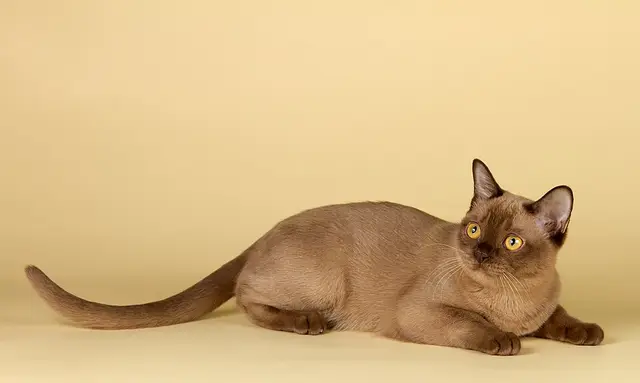
The Burmese is a pedigreed cat breed originating in Burma and developed through selective breeding in the United States and Britain, which now have different standards. It is a small to medium but substantial cat of about 4 to 6 kg with a short satin-like coat, known for being social, playful and vocal.
Breed facts
| Origin | Myanmar (Burma) |
|---|---|
| Height at the withers | — |
| Weight | — |
| Life expectancy | — |
| Size group | — |
| Breed standards | CFA, FIFe, GCCF, WCF, NZCF |
From Wikidata (CC0) and the FCI breed list; — means Wikidata lists no figure.
Origin and history
Most modern Burmese descend from Wong Mau, a dark female brought from Burma to San Francisco in 1930 by Joseph Cheesman Thompson and bred with a seal point Siamese. The CFA recognized the breed in 1936, suspended recognition a decade later because of heavy Siamese outcrossing, and lifted the suspension in 1954. In Britain the breed was revived and recognized by the GCCF by 1952, and most other countries follow the British model. The American and British, or European, types are kept distinct. Burmese have contributed to the Tonkinese, Bombay and Burmilla.
Appearance and coat
The standards differ in head and body. The British type is more slender, with a wedge-shaped head, large ears and a tapering muzzle; the American type is stockier, with a broader head, round eyes and a shorter muzzle. Both are muscular and feel heavy for their size, described as a brick wrapped in silk. The coat is very short, fine and glossy with a satin finish. The original color is a rich dark brown (sable), and blue, chocolate, lilac, red, cream and tortie variants exist, with recognition varying by registry. Eyes are green or gold.
Temperament
The Burmese is commonly described as notably people-oriented, keeping kitten-like energy into adulthood and forming strong bonds with owners, with some puppy-like traits such as playing fetch. It is described as persistently vocal, though with a softer voice than the Siamese, and as not suited to being left alone for long periods.
Care and exercise
Given its playful, companion-seeking nature, regular interaction and play suit the breed. Sources give little specific grooming detail for the short coat.
Health
A UK study of veterinary records found an average life expectancy of 14.42 years in a sample of 45 Burmese. Conditions reported in the breed include diabetes mellitus, feline orofacial pain syndrome, congenital hypotrichosis, gangliosidosis 2 and hypokalemia; the contemporary American line can carry a gene linked to the fatal Burmese head defect. Studies have also found low genetic diversity in the American Burmese.
General information, not veterinary advice.
FAQ
How long do Burmese cats live?
One UK study of veterinary records found an average life expectancy of 14.42 years in a sample of 45 Burmese.
What is the difference between American and European Burmese?
The European type is slimmer with a wedge-shaped head, while the American type is stockier with a broader head, round eyes and a shorter muzzle.
Are Burmese cats vocal?
Yes. They are described as persistently vocal, though their voices are softer than those of the Siamese.