Cat breed
Cornish Rex
In short
The Cornish Rex is a domestic cat breed that originated in Cornwall, Great Britain, in the 1950s. It is a slender, muscular cat whose fine, curly coat consists only of down hair, and it is sometimes called the Greyhound of cats for its sleek look and galloping run.
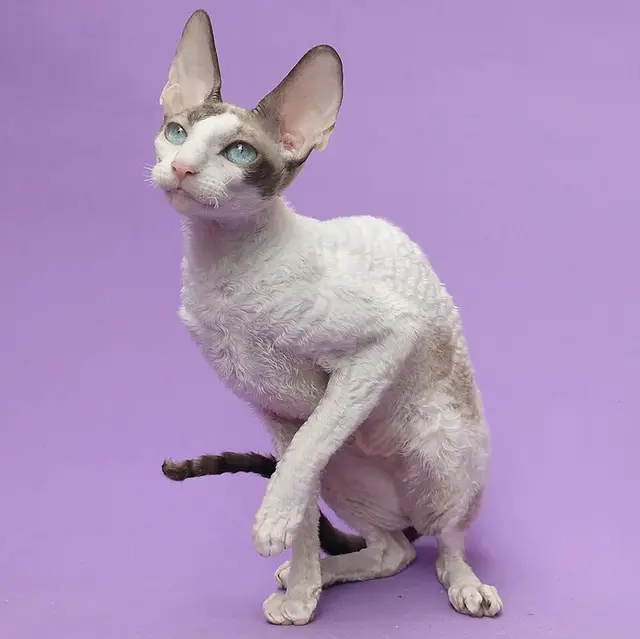
Breed facts
| Origin | United Kingdom |
|---|---|
| Height at the withers | — |
| Weight | — |
| Life expectancy | — |
| Size group | — |
| Breed standards | CFA, FIFe, GCCF, ACFA |
From Wikidata (CC0) and the FCI breed list; — means Wikidata lists no figure.
Origin and history
The breed began with a litter born in the 1950s on a farm in Cornwall, UK. One kitten, a cream male named Kallibunker, had an unusually fine, curly coat and became the first Cornish Rex. He was backcrossed to his mother to produce more curly kittens; his son Poldhu sired a female, Lamorna Cove, who was later taken to America and crossed with a Siamese, giving the breed its long whippy tail and big ears.
In 2013 researchers identified the defining mutation, a deletion in the LPAR6 gene, which affects the structure of the hair shaft. It is a different mutation from the one behind the Devon Rex.
Appearance and coat
Most cats have guard hairs, awn hairs and down hair; the Cornish Rex has only the fine down, which is naturally curly. It has a 'foreign' type: a slender, muscular body, slender legs and tail, small paws, a wedge-shaped head, oval eyes and large, wide-based ears with rounded tips described as mussel-shell shaped. Under the GCCF standard any coat color is allowed, and eyes come in all colors.
The Devon Rex looks similar but has shortened guard hairs and sheds, while the Cornish Rex lacks guard hairs altogether.
Temperament
The source material gives little detail on the breed's personality beyond its lively, galloping movement. Breed clubs generally describe it as an active cat, but individuals vary.
Care and exercise
The light coat makes the breed sensitive to low temperatures, and it is considered best suited to indoor living in warm, dry conditions. Despite popular belief, the Cornish Rex is not hypoallergenic: allergies are caused by the protein Fel d 1 in saliva and dander, not hair length, although some people report milder reactions.
Health
The available sources do not describe breed-specific health conditions. Owners should protect the cat from cold, and breed clubs recommend regular veterinary check-ups and health screening of breeding stock.
General information, not veterinary advice.
FAQ
Are Cornish Rex cats hypoallergenic?
No. Cat allergies come from the Fel d 1 protein in saliva and dander, not from hair, so a Cornish Rex can still trigger reactions, though some people report milder ones.
What is the difference between a Cornish Rex and a Devon Rex?
They are caused by different mutations. The Devon Rex has shortened guard hairs and sheds, while the Cornish Rex has no guard hairs, only curly down.
Do Cornish Rex cats get cold?
Yes, their thin coat makes them sensitive to low temperatures, so they are best kept indoors in warm, dry conditions.