Cat breed
Cymric cat
In short
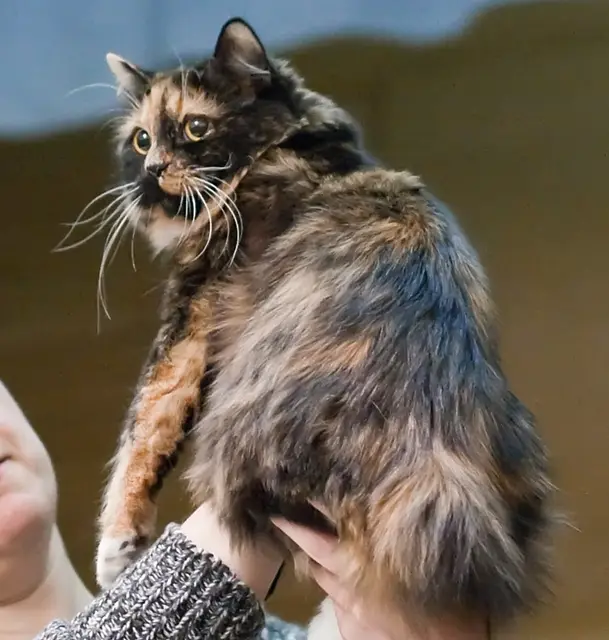
The Cymric is a cat breed developed in Canada in the 1960s as a semi-longhaired form of the Manx, whose bloodline comes from the Isle of Man; some registries treat it as a longhaired Manx. It is a compact, muscular, medium to large cat with a dense double coat and, in many cats, no tail.
Breed facts
| Origin | Canada |
|---|---|
| Height at the withers | — |
| Weight | — |
| Life expectancy | — |
| Size group | — |
| Breed standards | CFA, FIFe, GCCF, WCF, NZCF, SACC |
From Wikidata (CC0) and the FCI breed list; — means Wikidata lists no figure.
Origin and history
Taillessness began as a mutation in the domestic cats of the Isle of Man, where long-haired kittens were sometimes born to Manx cats but were discarded by breeders. In the 1960s similar kittens born in Canada were bred intentionally, and the breed gained popularity from the mid-1970s. The name comes from Cymru, the Welsh name for Wales, though the breed has no connection with Wales.
FIFe, WCF, CCA-AFC, ACF, NZCF, SACC, ACFA and CFF treat the Cymric as a separate breed. TICA, the CFA, CCCA and GCCF cover it under the Manx standard as a longhaired variety, under names such as Manx Longhair.
Appearance and coat
The Cymric is muscular and compact with sturdy bone and a rounded look, and the lack of a tail can make it appear smaller than it is; adults usually weigh up to about 5 kg. The front legs are shorter than the hind legs, the ears are tall with moderate tufts, and eyes may be amber, green, hazel, copper, gold, yellow or orange.
The semi-long, dense double coat forms a ruff, a shirtfront and 'breeches' on the hindquarters, and comes in many colors. Tails range from rumpy (none) through rumpy riser and stumpy to longy; rumpies are most valued for showing. Fully tailed cats are used as breeding stock, and the NZCF recognizes them as the Isle of Man Longhair.
Temperament
The source material gives little detail on the Cymric's personality. As it is the same as the Manx apart from coat length, breed clubs tend to describe both similarly, but individual cats vary.
Care and exercise
Sources give little specific care advice. The dense double coat will benefit from regular brushing, and any changes in movement or toileting are worth discussing with a veterinarian given the breed's spinal risks.
Health
The tailless gene is linked to conditions reported in the breed including spina bifida and Manx syndrome, which can affect movement and waste elimination and may cause a rabbit-like hop; problems are usually identified before six months. Kittens with two copies of the gene die before birth, about 25% of kittens, so litters are often small. The ACF and GCCF impose breeding restrictions for welfare reasons.
General information, not veterinary advice.
FAQ
What is the difference between a Cymric and a Manx?
Apart from the Cymric's semi-long coat they are the same, and both types can appear in one litter. Some registries treat the Cymric as a longhaired Manx.
Do all Cymric cats have no tail?
No. Tails range from completely absent (rumpy) to short stumps and near-full length, and fully tailed cats are kept as breeding stock.
Is the Cymric from Wales?
No. The name comes from Cymru, the Welsh name for Wales, but the breed was developed in Canada from Manx cats of the Isle of Man.