Cat breed
Donskoy cat
In short
The Donskoy, also called the Don Sphynx or Russian Hairless, is a hairless cat breed that originated in Rostov-on-Don, Russia, in 1987. It is a medium-sized, muscular cat with wrinkled skin and large ears, and its hairlessness is caused by a dominant mutation unrelated to the Sphynx.
Breed facts
| Origin | Russia |
|---|---|
| Height at the withers | — |
| Weight | — |
| Life expectancy | — |
| Size group | — |
| Breed standards | FIFe |
From Wikidata (CC0) and the FCI breed list; — means Wikidata lists no figure.
Origin and history
The breed traces back to a single kitten. In 1987 breeder Elena Kovaleva rescued a blue tortoiseshell kitten named Varvara in Rostov-on-Don, which began losing its fur at about four months. Varvara's kittens with a local tomcat were born hairless or lost their hair, and became the founding stock; the line was later outcrossed with European Shorthairs.
The WCF recognized the breed in 1987 and TICA in 2005. The Peterbald was created by crossing Donskoys with Oriental Shorthairs, but Donskoy-Peterbald matings have not been permitted since 2000. Since 2014 the Netherlands has banned breeding from cats with mutations such as hairlessness that cause welfare issues.
Appearance and coat
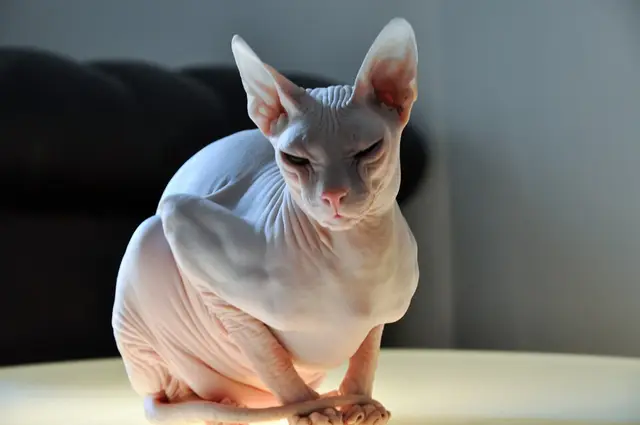
The Donskoy is medium-sized and muscular, with a triangular head, large ears and almond-shaped eyes that give an elf-like look, plus long, webbed toes. The skin is very wrinkled, especially on the face, neck, chest and tail base, and skin colors often look faded. Eyes may be blue, green, amber, orange, yellow or brown.
There are four coat types: rubber bald (born and staying bald), flock (a peach-fuzz coat usually lost), velour (a short wavy coat lost in the first year) and brush (a wiry coat with bald patches, disqualified from shows). Some grow a faint coat in winter that falls out in warm weather.
Temperament
As commonly described, the Donskoy is extremely social, inquisitive, friendly and intelligent, which makes it easy to train. It is said to be gentle and good with children, to get on with playful cats and, with proper introduction, dogs, though its energy can be a challenge for older cats. It reportedly does not do well when left alone for long periods.
Care and exercise
Despite lacking a coat, the Donskoy needs frequent grooming, but over-bathing can make the skin very oily. It is an active breed that spends more time moving than the average cat and needs plenty of stimulation.
Health
Not all registries recognize the breed, partly due to concerns about its genetic health. The dominant hairless mutation could cause feline ectodermal dysplasia in cats with two copies, with problems including poor teeth and reduced ability to lactate or sweat.
General information, not veterinary advice.
FAQ
Is the Donskoy the same as a Sphynx?
No. The Sphynx's hairlessness comes from a recessive mutation, while the Donskoy's comes from a dominant one, and the breeds are not related.
Do Donskoy cats need grooming?
Yes. They need frequent grooming despite having no coat, though over-bathing can make their skin very oily.
Are Donskoy cats good with children?
They are commonly described as gentle, social and good with children, and they do best with company rather than long periods alone.