Cat breed
Japanese Bobtail
In short
The Japanese Bobtail is a domestic cat breed from Japan with a short, kinked tail that resembles a rabbit's. It is a medium-sized, lean and muscular cat of about 2.7 to 4 kg, known for centuries in Japanese folklore and art, and commonly described as active, intelligent and talkative.
Breed facts
From Wikidata (CC0) and the FCI breed list; — means Wikidata lists no figure.
Origin and history
Cats with short, kinked tails were documented long ago in Southeast Asia and southern China, and a 2016 study found the same HES7 gene mutation behind those tails and the Japanese Bobtail's, suggesting the trait predates the breed's arrival in Japan. Cats probably reached Japan through trade, possibly with Buddhist monks in the 6th century. A 1602 decree freed cats to control rodents threatening silkworms, and bobtails became Japan's street and farm cats. Elizabeth Freret first imported the breed to the West in 1968; the CFA accepted the shorthair for championship in 1976 and the longhair in 1993. The beckoning maneki-neko figure is based on the breed.
Appearance and coat
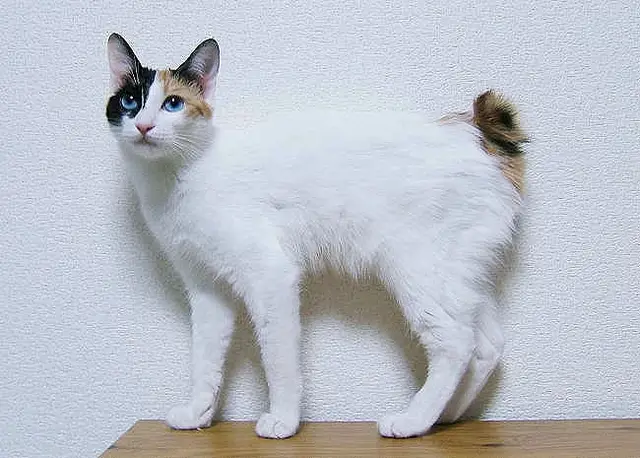
The breed standard calls for a head shaped like an equilateral triangle, large upright ears, large oval eyes and a long, lean, muscular torso, with long slender legs, the hind legs longer than the front. Cats usually weigh 2.7 to 4 kg, males larger than females. The shorthair coat is medium length, soft and silky; the longhair is medium-long to long. The tail has one or more kinks or curves, and no two are alike. Almost any color is possible, with the white-dominant calico, or mi-ke, especially favored; odd eyes occur more often than in most breeds.
Temperament
Japanese Bobtails are commonly described as active, intelligent and strongly human-oriented, easier than most breeds to train for tricks, harness walking and fetch. They are said to be unusually talkative, with soft voices of many tones, and are described as good for families.
Care and exercise
The coat is reported to be easy to groom, with minimal to medium shedding. The breed is said to enjoy climbing and can be prone to obesity, so activity and regular veterinary check-ups suit it.
Health
Japanese Bobtails are described as generally healthy, and unlike the Manx gene, the bobtail gene is not associated with spinal or bone abnormalities. The breed is reported to be among the most genetically diverse pedigree breeds. The average lifespan is given as 9 to 15 years.
General information, not veterinary advice.
FAQ
How long do Japanese Bobtails live?
The breed's average lifespan is given as 9 to 15 years.
Does the bobtail cause health problems?
The bobtail gene is not associated with spinal or bone abnormalities, unlike the gene behind the Manx cat's tail.
Do Japanese Bobtails shed?
They are reported to have minimal to medium shedding, and the coat is easy to groom.