Cat breed
Manx cat
In short
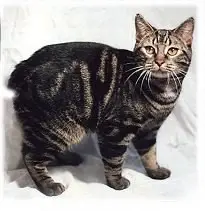
The Manx is a domestic cat breed from the Isle of Man whose dominant mutation shortens or removes the tail. It is a medium-sized, muscular cat with hind legs longer than the front, a rounded head and a thick double coat, and is traditionally described as social, tame, active and a skilled hunter.
Breed facts
| Origin | Isle of Man |
|---|---|
| Height at the withers | — |
| Weight | — |
| Life expectancy | — |
| Size group | — |
| Breed standards | GCCF, ACFA, NZCF |
From Wikidata (CC0) and the FCI breed list; — means Wikidata lists no figure.
Origin and history
Tailless cats were known as cats from the Isle of Man by the early 19th century. The trait comes from a spontaneous mutation that spread on the island through the founder effect; folk tales of shipwrecks, Noah's Ark or cat-rabbit hybrids are of relatively recent origin. Manx have been shown since the late 1800s, Charles Henry Lane published the first known breed standard in 1903, and the Manx was one of the first breeds recognized by the CFA. Valued as farm and ship's cats, they remain a national symbol of the Isle of Man, appearing on its coins and stamps.
Appearance and coat
Tail length varies within a litter, from rumpy (no tail) and riser to stumpy, stubby and longy; show standards generally favor rumpy to stumpy cats. The Manx is medium-sized, broad-chested and firmly muscular, with notably longer hind legs that create a rounded, arched outline often called rabbit-like. Lane recorded males of about 4.5 to 5.5 kg and females of about 3.5 to 4.5 kg. The head is round with largish ears and large round eyes. The thick double coat may be short or, in the Cymric or Manx Longhair, medium-long, and most colors occur today.
Temperament
Fanciers often describe the Manx as doglike, though this description is relatively modern. Lane's early account called the cats docile, good-tempered and sociable, and alert, active and energetic. The breed is prized as a hunter.
Care and exercise
Sources give little routine care detail. The lack of a tail is reported not to affect balance. Because of the health risks linked to the tailless gene, some registries place special restrictions on breeding Manx cats.
Health
Two copies of the tailless gene are usually lethal before birth, so breeders avoid mating two tailless Manx. When the gene shortens the spine too much it can cause Manx syndrome, a form of spina bifida with bowel, bladder and digestive problems; one report found it in about 30 percent of Manx studied, nearly all rumpies. Other conditions reported in the breed include arthritis of partial tails, megacolon, rump fold intertrigo and corneal dystrophy.
General information, not veterinary advice.
FAQ
Are all Manx cats tailless?
No. Tail length varies even within one litter, from no tail at all to a full-length tail.
Does having no tail affect a Manx cat's balance?
No. Balance is controlled mainly by the inner ear, and Manx cats are reported not to have balance problems.
What is a Cymric cat?
The Cymric is the long-haired form of the Manx. Some registries treat it as a separate breed; others, such as the CFA, treat it as a Manx variety.