Cat breed
Norwegian Forest Cat
In short
The Norwegian Forest Cat is a pedigreed domestic cat breed from Norway, adapted to a cold climate with a long, glossy, water-repellent coat over a woolly undercoat. It is larger than average and strongly built, and is described as friendly, intelligent and energetic.
Breed facts
| Origin | Norway |
|---|---|
| Height at the withers | — |
| Weight | — |
| Life expectancy | — |
| Size group | — |
| Breed standards | CFA, FIFe, GCCF, WCF, ACF |
From Wikidata (CC0) and the FCI breed list; — means Wikidata lists no figure.
Origin and history
The breed's ancestors may include short-haired cats brought to Norway by the Vikings around AD 1000 and longhaired cats brought later, mixing with farm and feral stock; they probably served as ships' mousers and later as farm cats. Norse legends speak of a skogkatt, a fairy cat able to climb sheer rock. The Norwegian Forest Cat Club was formed in Oslo in 1938, and after near-extinction during World War II its breeding program revived the breed. King Olav V declared it the official cat of Norway, FIFe registered it in the 1970s, and it is now among the most popular breeds in Europe.
Appearance and coat
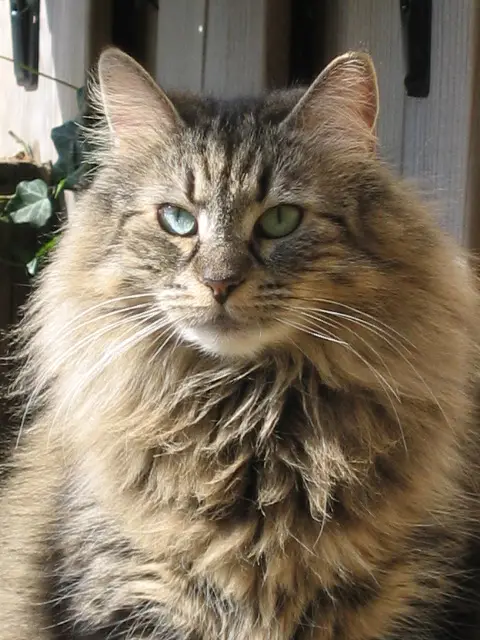
Norwegian Forest Cats are strongly built and larger than average: females weigh about 3.6 to 8 kg and males about 4.5 to 9 kg. They have a long, sturdy body, long legs and a bushy tail. The head is shaped like an equilateral triangle with a straight profile, a strong chin and large, high-set, tufted ears. The coat has a long, glossy, water-repellent top layer and a woolly undercoat that forms a ruff and is thickest on the legs, chest and head. Eyes may be any color, and all traditional, sepia and mink colors are accepted.
Temperament
The breed is commonly described as friendly, intelligent, energetic and good with people. Fanciers note a range of high-pitched chirping sounds. One study found its kittens more likely to explore than kittens of several Oriental breeds.
Care and exercise
Strong claws make these cats excellent climbers, and the breed is described as adapting to indoor life as well as outdoor living. A long double coat of this kind generally benefits from regular grooming.
Health
Conditions reported in the breed include glycogen storage disease type IV, a rare but potentially fatal disorder found in an inbred family, hip dysplasia, hereditary cardiomyopathy and eosinophilic granuloma complex. Breed clubs recommend health screening of breeding stock.
General information, not veterinary advice.
FAQ
How big does a Norwegian Forest Cat get?
It is larger than an average cat: females typically weigh about 3.6 to 8 kg and males about 4.5 to 9 kg.
Are Norwegian Forest Cats good indoor cats?
They are described as adapting to indoor life, though they are energetic climbers that appreciate space to climb and play.
Is the Norwegian Forest Cat the same as the Maine Coon or Siberian?
No. It is a separate breed from Norway, although longhaired cats like those ancestral to the Siberian may be among its ancestors.