Cat breed
Peterbald
In short
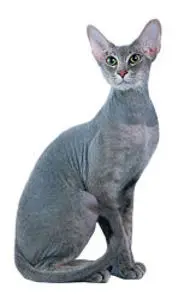
The Peterbald is a hairless cat breed created in St. Petersburg, Russia, in 1994 by crossing a Donskoy with an Oriental Shorthair. It has a slim, elegant Oriental build and a dominant hair-losing gene, and is described as affectionate, curious and energetic.
Breed facts
| Origin | Russia |
|---|---|
| Height at the withers | — |
| Weight | — |
| Life expectancy | — |
| Size group | — |
| Breed standards | — |
From Wikidata (CC0) and the FCI breed list; — means Wikidata lists no figure.
Origin and history
The breed was created in late 1994 by Russian felinologist Olga S. Mironova, who mated a Don Sphynx male named Afinogen Myth with an Oriental Shorthair female champion, Radma von Jagerhov. Four kittens from the first two litters became the foundation stock.
The Russian SFF adopted the breed in 1996, TICA in 1997 and the WCF in 2003. The ACFA accepted it for Championship competition from May 2009, and TICA recognized the brush-coat Peterbald for Championship in 2008. Standards encourage outcrossing to Oriental and Siamese cats. Since 2014 the Netherlands has banned breeding from cats with welfare-related mutations, including hairlessness.
Appearance and coat
Peterbalds resemble Oriental Shorthairs: slim and muscular, with a long, narrow head, straight profile, wedge-shaped muzzle, almond eyes and large, set-apart ears. They have a long whip-like tail, webbed feet and oval paws said to let them grasp objects and even open lever doorknobs.
Kittens can be born bald, flocked, velour, brush or straight-coated, and all but straight-coats may lose their hair over time. All colors and markings are allowed.
Temperament
As commonly described, Peterbalds are sweet-tempered, affectionate, peaceful, curious, smart and energetic. They are moderately vocal, tend to follow their owners around, and are said to live in harmony with other cats, pets and children.
Care and exercise
Sources give little specific care advice for the Peterbald. Hairless and lightly coated cats generally need protection from cold and attention to their skin, and an energetic breed will benefit from regular play.
Health
The available sources do not list breed-specific conditions, though the lack of protective fur is the reason breeding hairless cats is restricted in the Netherlands. Breed clubs recommend health screening of breeding stock and regular veterinary check-ups.
General information, not veterinary advice.
FAQ
Are Peterbald cats always hairless?
No. They can be born bald, flocked, velour, brush or straight-coated, and those with hair other than straight coats may lose it over time.
What is the difference between a Peterbald and a Donskoy?
The Peterbald was bred from the Donskoy and the Oriental Shorthair, so it carries the same dominant hairless gene but has a slimmer Oriental body type.
Are Peterbalds affectionate?
They are commonly described as sweet-tempered and affectionate, tending to follow their owners and get on with children and other pets.