Cat breed
Scottish Fold
In short
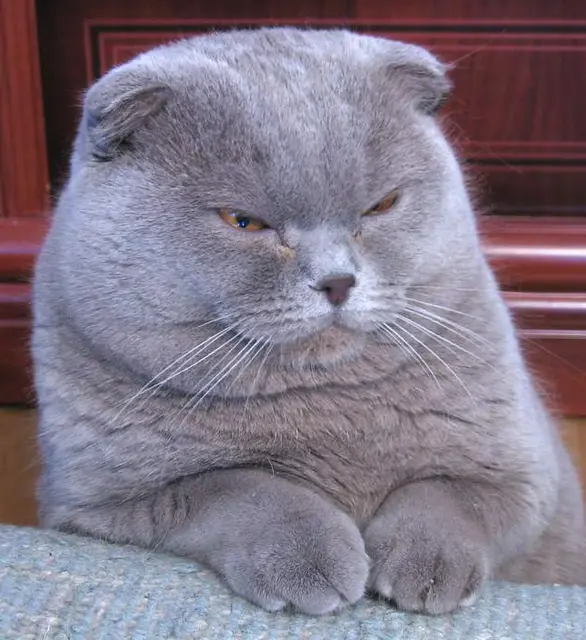
The Scottish Fold is a domestic cat breed from Scotland whose ears fold forward and down, giving an owl-like look. The fold comes from a dominant mutation that also causes feline osteochondrodysplasia, a cartilage and bone disorder affecting all folded cats, and the breed is banned from breeding in several countries and not recognized by some major registries.
Breed facts
| Origin | United Kingdom |
|---|---|
| Height at the withers | — |
| Weight | — |
| Life expectancy | — |
| Size group | — |
| Breed standards | CFA |
From Wikidata (CC0) and the FCI breed list; — means Wikidata lists no figure.
Origin and history
The breed began with Susie, a white barn cat with folded ears found near Coupar Angus in Tayside, Scotland, in 1961. Neighboring farmers William and Molly Ross acquired one of her fold-eared kittens and, with geneticist Pat Turner, developed the breed, registering it with the GCCF in 1966. The GCCF stopped registering it in the early 1970s over health concerns. Cats went to the United States from 1970, where breeding continued with American and British Shorthair outcrosses, and the CFA granted championship status in 1978. Breeding is now banned in several countries, including Austria and the Netherlands, on welfare grounds.
Appearance and coat
The Scottish Fold is a medium to large cat; males typically weigh 4 to 6 kg and females 2.7 to 4 kg. The folded ears give a cap-like look, and the head, cheeks, eyes and body are all rounded, with a short nose, short neck and medium to short legs. Kittens without folded ears are called Scottish Straights. The coat may be short, thick and soft, or long with tufts, and comes in nearly any color.
Temperament
The source material says little about personality beyond noting the breed's reputation as an unusually loving companion. As with any breed, individual temperament varies.
Care and exercise
Sources give little routine care detail. Because the breed's cartilage disorder can cause lameness, stiffness and pain, some breed bodies recommend periodic veterinary examinations of breeding cats for these signs.
Health
Research indicates that all Scottish Folds are affected by feline osteochondrodysplasia, which can lead to painful, progressive joint disease, sometimes at a young age; severity varies, and cats with two copies of the gene are affected most severely. Other conditions reported in the breed include polycystic kidney disease and hypertrophic cardiomyopathy. Because of these concerns, the GCCF and FIFe do not recognize the breed.
General information, not veterinary advice.
FAQ
Why are Scottish Folds controversial?
The mutation that folds the ears also causes osteochondrodysplasia, a cartilage and bone disorder that can lead to painful joint disease, so breeding is banned in several countries.
Is the Scottish Fold recognized by all registries?
No. The CFA recognizes it, but the GCCF and FIFe do not, because of its health problems.
How big does a Scottish Fold get?
It is a medium to large cat; males typically weigh 4 to 6 kg and females 2.7 to 4 kg.