Cat breed
Siberian cat
In short
The Siberian, formally the Siberian Forest Cat, is a centuries-old Russian landrace developed into a formal breed from the late 1980s and recognized by all major registries since 2006. It is a strong, medium to large cat of about 4.5 to 9 kg with a dense semi-long to long coat, commonly described as playful, friendly and easygoing.
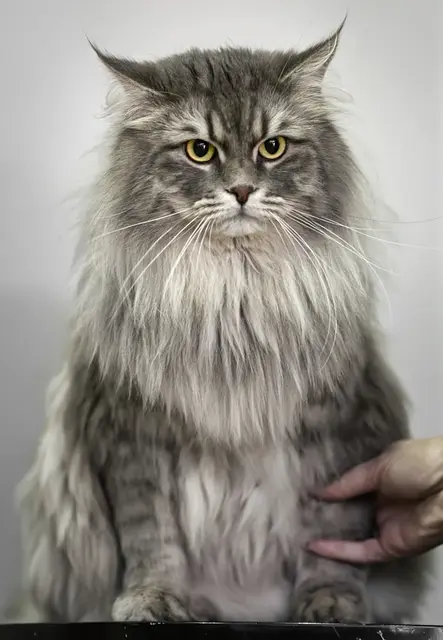
Breed facts
| Origin | Russia |
|---|---|
| Height at the withers | — |
| Weight | — |
| Life expectancy | — |
| Size group | — |
| Breed standards | FIFe, GCCF, WCF, ACF, NZCF, SACC |
From Wikidata (CC0) and the FCI breed list; — means Wikidata lists no figure.
Origin and history
Siberian landrace cats have long lived in the forests of Siberia and appear in Slavic folktales and art dating back to the 10th century. The breed is the national cat of Russia and is genetically close to the Norwegian Forest Cat. Western books mentioned Siberian cats in 1864 and in the 1890s, but those early imports were crossed with other longhairs. After the fall of the Berlin Wall, a pair was taken from St. Petersburg to Berlin in 1987 to start a breeding program. Siberians reached the United States in 1990, and the breed gained championship status with TICA in 1996 and the CFA in 2006. The colorpoint Neva Masquerade is treated as a separate breed by some registries.
Appearance and coat
The Siberian is strong and powerfully built, with a barrel-shaped torso, heavy-boned but relatively short legs, large round paws and a bushy tail. Hind legs slightly longer than the front give a slight arch to the back. The face is round with large round eyes and medium, round-tipped ears. Adults weigh on average 4.5 to 9 kg, with females considerably smaller, and the breed matures slowly, at around five years. The semi-long to long triple coat is very dense with water-repellent guard hairs, shorter in summer than winter. Most colors are allowed; brown mackerel tabby is the most common.
Temperament
Siberians are commonly described as playful, adventurous, friendly and easygoing, with dog-like loyalty and affection. They are said to be intelligent and quick to learn, often playing fetch, very social and keen to join household activities, and often fascinated by water. They are described as vocal in frequency rather than loudness, with chirping sounds and a deep purr.
Care and exercise
The dense coat needs grooming several times a week to prevent matting. Siberians molt heavily in spring and lightly in late summer, but still shed year-round. The breed is described as an exceptionally agile, energetic jumper.
Health
The Siberian is described as a relatively healthy breed with the highest genetic variation of any cat breed. A large study of about 550,000 cats found it had the highest injury risk among purebreds, linked to its athleticism, but among the lowest overall disease risk; it also had a higher rate of locomotor and female reproductive conditions. Solid white, blue-eyed cats have a higher rate of genetic deafness.
General information, not veterinary advice.
FAQ
Are Siberian cats hypoallergenic?
No cat is allergen-free. Studies found all Siberians tested produce some Fel d 1, though about half had lower levels than other breeds, so individual cats vary.
How big does a Siberian cat get?
Adults weigh on average 4.5 to 9 kg, with females considerably smaller than males, and they reach full size at about five years.
Do Siberian cats shed?
Yes. They molt heavily in spring and lightly in late summer, shed year-round and need grooming several times a week.