Math and school
How to calculate how much concrete you need
Order too little concrete and the pour stops halfway; order too much and you pay to throw it away. You will measure the job, put every size in one unit, work out the volume, add a margin for waste and turn it into bags or a ready-mix order.
Measure the depth at several points. Ground is rarely level, and an extra half inch over a whole slab adds about 12% more concrete.
Open Concrete calculatorContents
Open the Concrete calculator on cv.cm
Choose what you are pouring: a slab or patio, a footing, a wall, round columns or post holes, a hollow tube or a set of stairs.
Open Concrete calculatorMeasure and put every size in one unit
Volume is length × width × thickness, but only when all three are in the same unit. A 10 × 10 ft slab 4 in thick is 10 × 10 × 0.333 ft = 33.3 ft³. The calculator lets each size have its own unit and converts for you.
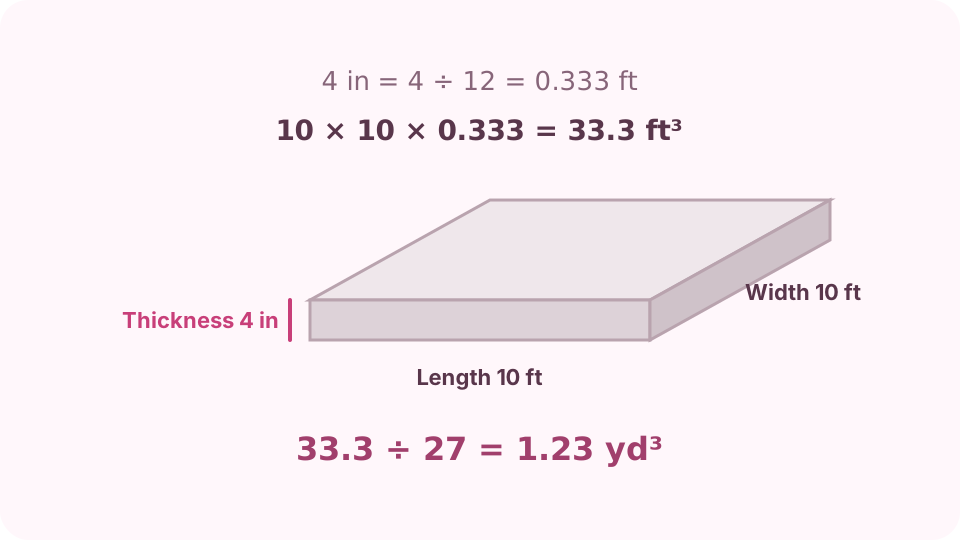
Volume = length × width × thickness, all in feet. Convert to the unit you order in
In the US concrete is sold by the cubic yard: divide cubic feet by 27, so 33.3 ft³ is 1.23 yd³. Elsewhere it is sold by the cubic metre; 1 yd³ is 0.765 m³.
Add a margin for waste
Add 5% for formed slabs on a flat base and 10% or more for uneven ground, footings dug by hand or a first pour. The calculator adds 10% unless you change it.
Turn the volume into bags
An 80 lb bag of premix makes about 0.60 ft³, a 60 lb bag 0.45 ft³ and a 40 lb bag 0.30 ft³. Divide and round up: the 10 × 10 ft slab with 10% waste needs 62 bags of 80 lb.
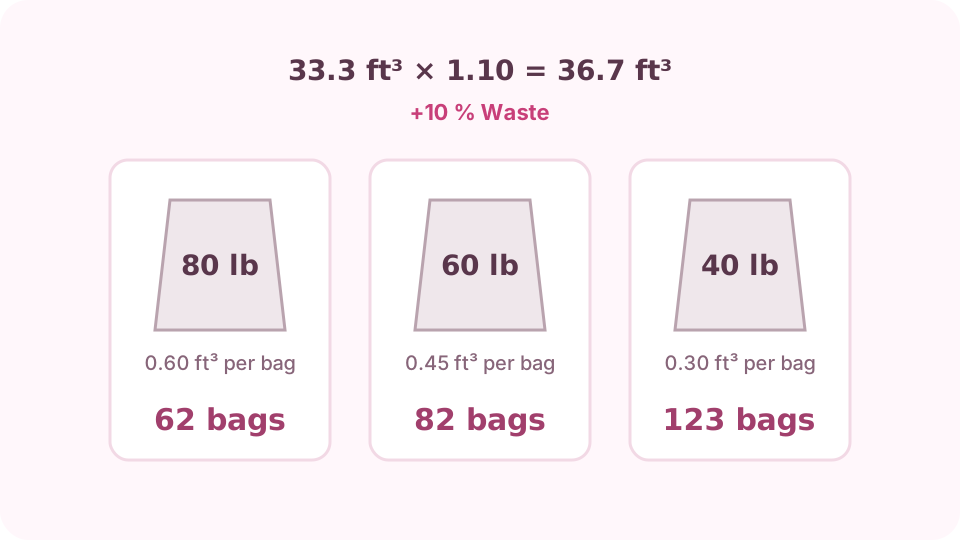
Add waste, then divide by what one bag makes. Decide between bags and ready-mix
Bags suit small jobs such as post holes and steps. From about 1 yd³ (0.75 m³), a ready-mix truck is usually cheaper, quicker and more even than mixing dozens of bags by hand.
FAQ
How many cubic yards are in a 10 × 10 slab?
At 4 in thick, 1.23 yd³; at 6 in thick, 1.85 yd³. Add your waste margin on top.
How thick should a slab be?
Usually 4 in (10 cm) for patios and paths, and 5–6 in (12–15 cm) for driveways or where vehicles park. Follow local building rules for structural work.
How do I calculate concrete for a post hole?
Use Round column: the hole's diameter and depth, times the number of holes. Subtract nothing for the post; the margin covers it.
How many 80 lb bags are in a yard?
About 45, since 27 ft³ ÷ 0.60 ft³ per bag = 45.
What is the difference between concrete and cement?
Cement is the powder that binds; concrete is cement mixed with sand, gravel and water. Premix bags already contain all the dry parts.