Academic and research
How to calculate sample size for a survey
A sample that is too small gives wide, unreliable results; one that is too big wastes time. You will set a confidence level and margin of error, use Cochran's formula, adjust for a small population, see what Slovin's formula does, and plan for people who do not answer.
These formulas assume a simple random sample. Quota, convenience or cluster samples need other methods; ask your supervisor or a statistician.
Open Sample size calculatorContents
Open the Sample size calculator on cv.cm
Choose the method: a proportion (Cochran) for yes/no and percentage questions, Slovin's formula, or a mean when you know the standard deviation.
Open Sample size calculatorChoose the confidence level and margin of error
95 % confidence (z = 1.96) and a ±5 % margin are the usual choices. A smaller margin needs a much larger sample: halving it roughly quadruples n.
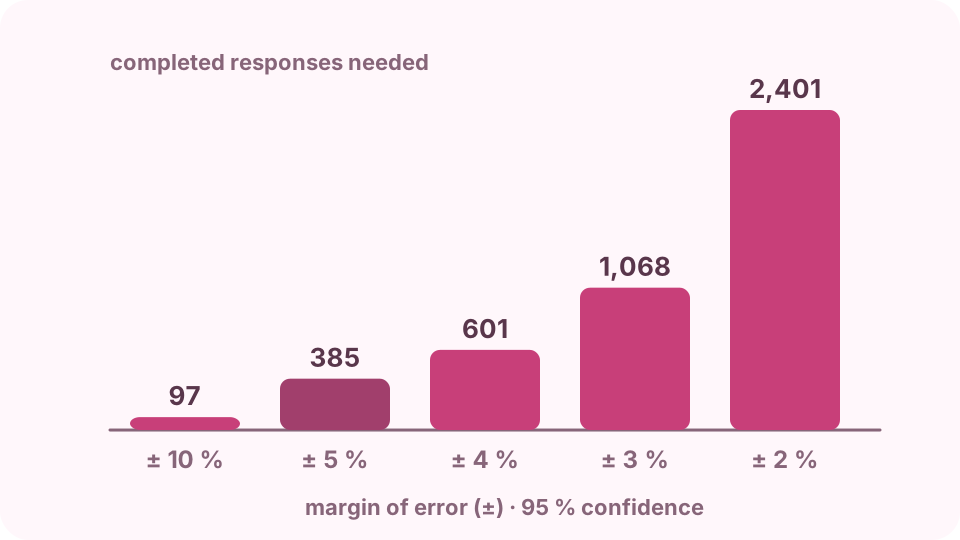
The sample needed at 95 % confidence grows fast as the margin of error shrinks. Use Cochran's formula
n₀ = z² × p(1 − p) ÷ e². With no earlier estimate, use p = 50 %, which gives the largest sample: 1.96² × 0.5 × 0.5 ÷ 0.05² = 384.2, rounded up to 385.
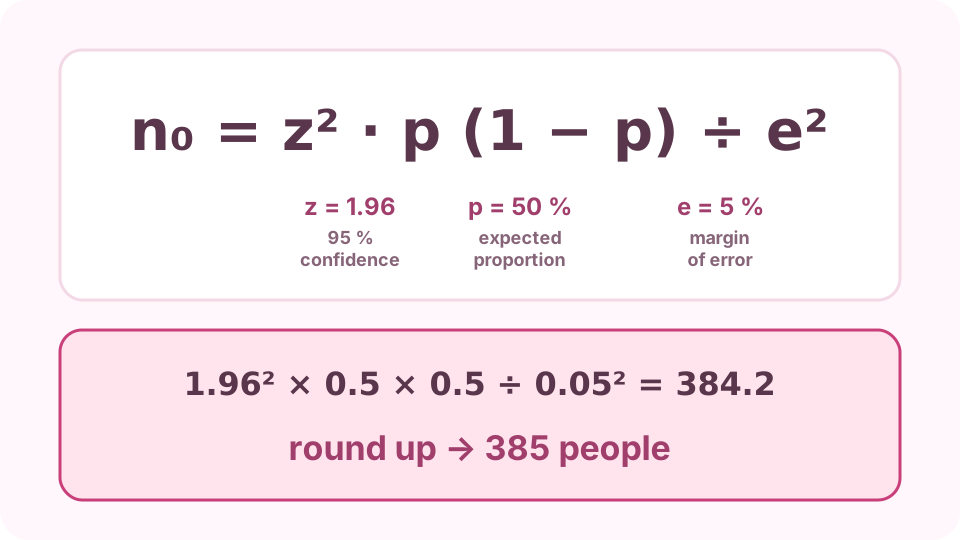
Cochran's formula at 95 % confidence, a ±5 % margin and p = 50 %. Correct for a small population
When you know the population size N, use n = n₀ ÷ (1 + (n₀ − 1) ÷ N). For N = 1,000, n₀ = 384.2 becomes 278. For very large populations the correction changes almost nothing.
Know what Slovin's formula does
Slovin's n = N ÷ (1 + N × e²) gives 286 for N = 1,000 and e = 5 %. It fixes p at 50 % and ignores the confidence level, so many reviewers prefer Cochran's formula; use Slovin when your department asks for it.
Plan for the response rate
Divide the sample size by the share of people you expect to answer: 385 at a 40 % response rate means inviting 963. Report the formula, its inputs and the final number in your methods section.
FAQ
What sample size do I need for a survey?
For a large population, 95 % confidence and a ±5 % margin, about 385 completed responses. Smaller populations need fewer; enter yours in the calculator.
What is Slovin's formula?
n = N ÷ (1 + N × e²), with N the population size and e the margin of error. It is common in theses in Indonesia and the Philippines but ignores the confidence level and the expected proportion.
Why use 50 % as the proportion?
p(1 − p) is largest at 50 %, so it gives the safest sample when you do not know the answer in advance.
Does a bigger population need a bigger sample?
Only up to a point. Above roughly 20,000 people the required sample barely changes: 385 is enough for a city and for a country at the same precision.
How do I calculate sample size for comparing two groups?
That needs a power analysis with the effect size you expect, α and the power you want (often 80 %). It is a different calculation from these survey formulas.