Math and school
How to calculate volume
Volume tells you how much a tank, a box, a pot or a room holds, how much concrete or soil to order, or what a parcel measures. You will measure, pick the formula, keep one unit and turn the answer into litres or gallons.
Volume is in a unit cubed: centimetres give cm³. 1,000 cm³ is exactly 1 litre.
Open Volume calculatorContents
Open the Volume calculator on cv.cm
Measure with one unit. For how much a container holds, measure the inside; for how much material you need, the outside.
Open Volume calculatorPick the formula for the solid
Box: length × width × height. Cylinder: π × r² × h. Sphere: 4/3 × π × r³. Cone and pyramid: one third of the matching cylinder or box. The calculator covers 12 solids.
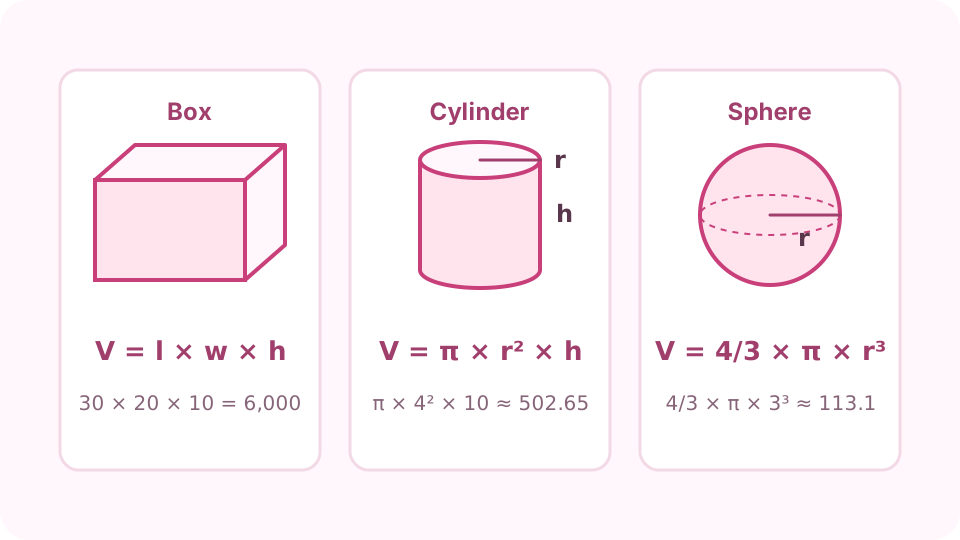
Formulas for three common solids. Type the sizes
Choose the solid and unit, then enter each size. A box 30 × 20 × 10 cm gives 6,000 cm³. Use the radius, which is half the diameter, for round shapes.
Read the surface area too
Surface area is the outside skin: what you would paint, wrap or insulate. A 30 × 20 × 10 cm box has 2,200 cm² of surface.
Convert to litres or gallons
1 cm³ = 1 mL and 1,000 cm³ = 1 L, so 6,000 cm³ is 6 L. One cubic metre is 1,000 L. A US gallon is 3.785 L and an imperial gallon 4.546 L; a cubic foot is 28.3 L.
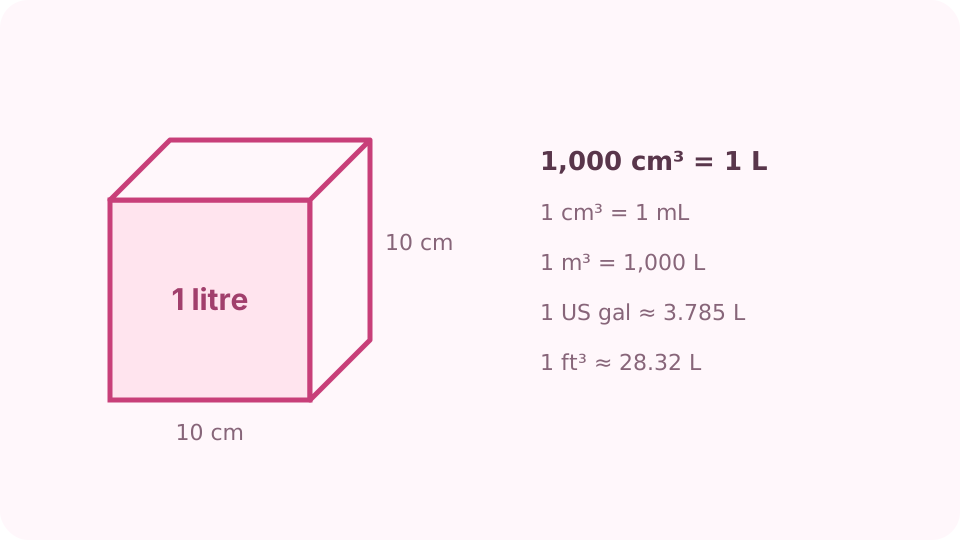
A 10 cm cube holds exactly one litre. Allow for real shapes
A tank is rarely filled to the brim, and walls take space: subtract the wall thickness from each inside size. For concrete or soil add 5–10% for waste and settling.
FAQ
How do I work out litres from centimetres?
Multiply the three inside sizes in cm to get cm³, then divide by 1,000. 40 × 30 × 25 cm = 30,000 cm³ = 30 L.
What is the volume of a cone?
V = 1/3 × π × r² × h, a third of the cylinder with the same base and height.
How do I find the volume of a pipe or tube?
Take the outer circle minus the inner circle and multiply by the length: V = π × (R² − r²) × h. The inside alone holds π × r² × h.
How many gallons in a cubic foot?
About 7.48 US gallons (28.32 litres).
Is volume the same as capacity?
Capacity is the volume a container holds, usually given in litres or gallons; volume is any amount of space, often in cubic units.