Academic and research
How to calculate a z-score
A z-score tells you how many standard deviations a value lies from the mean, which lets you compare values measured on different scales. You will calculate z, turn it into a percentile, use the 68–95–99.7 rule and work back from a percentile to a value.
Percentiles from z assume a roughly normal (bell-shaped) distribution. For skewed data, use the actual ranks instead.
Open Z-score calculatorContents
Open the Z-score calculator on cv.cm
Choose Value → z-score, Percentile → value, or Probability between two values.
Open Z-score calculatorCalculate z
z = (x − μ) ÷ σ: subtract the mean from the value and divide by the standard deviation. An IQ of 130 with mean 100 and SD 15: (130 − 100) ÷ 15 = 2.
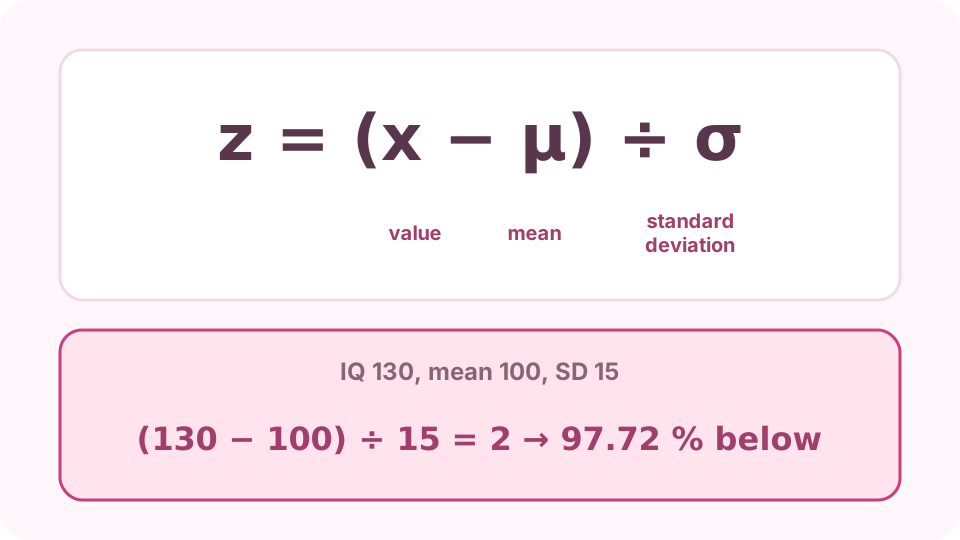
z = (x − μ) ÷ σ for an IQ of 130 with mean 100 and SD 15. Turn z into a percentile
The share of the normal curve below z is the percentile: z = 2 is above 97.72 % of scores, and only 2.28 % are higher. A negative z lies below the mean.
Use the 68–95–99.7 rule
About 68 % of values lie within 1 SD of the mean, 95 % within 2 and 99.7 % within 3. A z beyond ±2 is unusual; beyond ±3 it is rare.
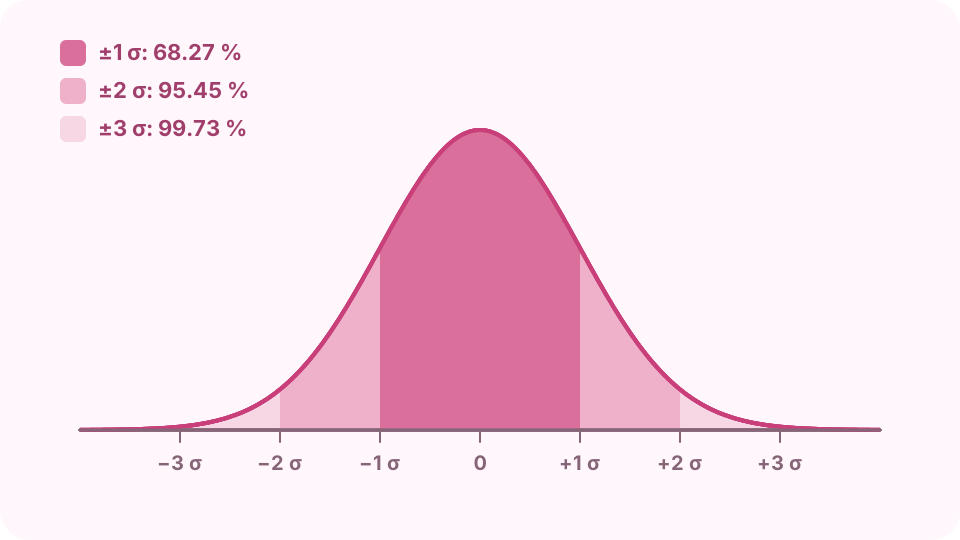
The 68–95–99.7 rule: the share of a normal distribution within 1, 2 and 3 standard deviations. Go from a percentile back to a value
x = μ + z × σ. The 90th percentile has z = 1.28, so for IQ it is 100 + 1.28 × 15 = 119.2.
Find the probability between two values
Enter both values: between 85 and 115 (z = −1 to 1) lies 68.27 % of the distribution. The curve in the calculator shades the area for you.
FAQ
What does a z-score mean?
How many standard deviations a value is above (positive) or below (negative) the mean. z = 0 is exactly average.
What is a good z-score?
It depends on what is measured: a high z is good for test scores, bad for blood pressure. Values beyond ±2 are unusual whichever way they go.
How do I convert a z-score to a percentile?
Find the area of the normal curve below z: z = 1 is about the 84th percentile, z = −1 the 16th, z = 1.645 the 95th.
What is the difference between a z-score and a t-score?
A z-score uses the known population SD. In a t-test the t statistic uses the sample's SD, so it follows the t distribution, which has heavier tails for small samples.
Can a z-score be greater than 3?
Yes. In a normal distribution only about 0.3 % of values lie beyond ±3, so such values are rare and worth checking for errors.