A t-test asks whether a difference in means is larger than chance would explain. You will choose the right t-test, enter the data, read t, the degrees of freedom and the p-value, add an effect size and report the result.
7-minute read
Today's result A t-test for your data with its p-value, confidence interval, Cohen's d and an APA-style sentence.
t-tests assume roughly normal data within each group, or groups large enough (about 30 or more) for that not to matter much. With small, skewed samples consider a non-parametric test.
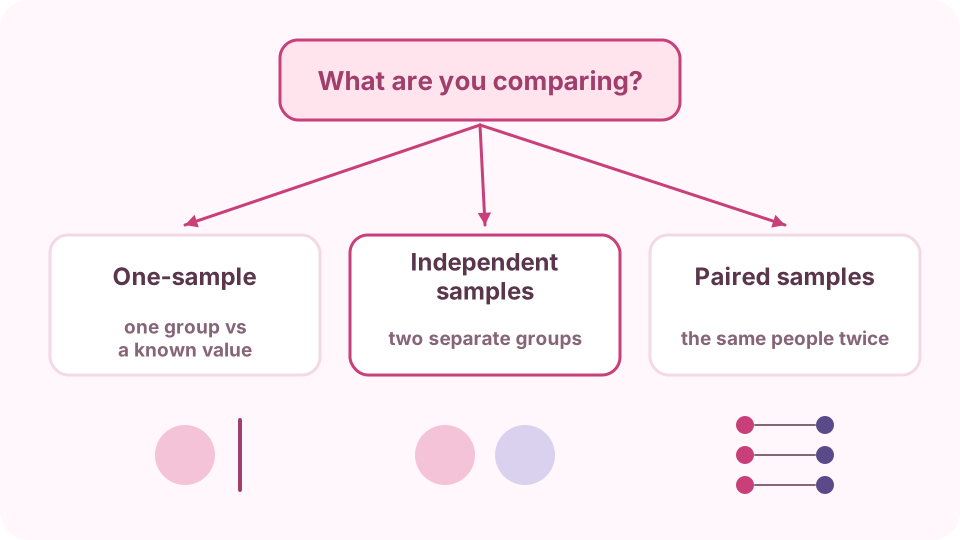
Choose the test: one-sample compares one group with a fixed value, independent samples compares two separate groups, and paired compares two measurements of the same people.
Which t-test to use: one group against a value, two separate groups, or the same people twice.Open T-test calculator
Enter the data
Paste each group's numbers. For a paired test list both measurements in the same order, so each before value sits opposite its after value.
Keep Welch for two groups
Welch's test does not assume equal variances and is the safer default, which is why the calculator starts with it. Student's pooled test assumes equal variances and gives whole-number degrees of freedom.
Read t, df and p
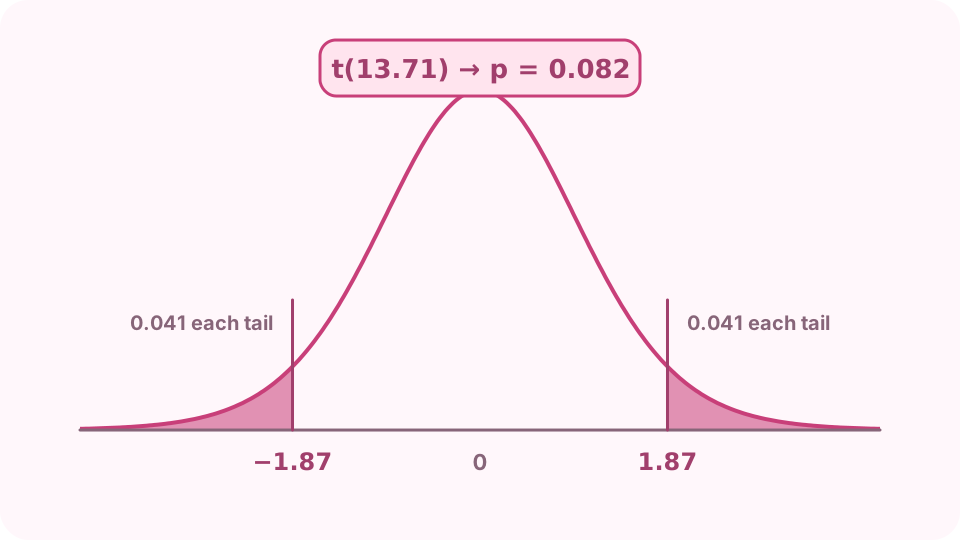
The example groups give t(13.71) = 1.87, p = .082. The p-value is the chance of a difference at least this large if there were no real difference; .082 is above .05, so the difference is not statistically significant.
The t distribution: the shaded tails beyond ±1.87 make up the two-tailed p-value of .082.
Add the interval and the effect size
The 95 % confidence interval for the difference, −0.06 to 0.91, includes 0, which matches the non-significant result. Cohen's d = 0.94 is a large difference, so a bigger sample might well find it significant.
Report it
Give the means and SDs, then t, df, p and d: "Group A (M = 5.61, SD = 0.49) did not differ significantly from group B (M = 5.19, SD = 0.42), t(13.71) = 1.87, p = .082, d = 0.94." Copy the APA line from the calculator.
One-sample for one group against a known value, independent samples for two separate groups, and paired for two measurements of the same people or matched pairs.
What does the p-value in a t-test mean?
The probability of a difference at least as large as yours if the population means were equal. Below your significance level (usually .05), the difference is called significant.
What is Cohen's d?
The difference in means in standard deviations. Around 0.2 is small, 0.5 medium and 0.8 large. Report it with every t-test.
One-tailed or two-tailed?
Use two-tailed unless you stated before collecting data that only one direction counts. When the effect goes the predicted way a one-tailed p is half the two-tailed one (the other way it is 1 minus that half), which is why reviewers ask for the reason.
What if my data are not normal?
With 30 or more per group the t-test is usually robust. With small, skewed samples use the Mann-Whitney U test (independent) or the Wilcoxon signed-rank test (paired).