Nostalgia · Toys and playground games · Remembered worldwide
What were Pogs?
Also called: milk caps, POG, slammers, Pog game
In short
Pogs were small, round cardboard discs, originally milk-bottle caps, used in a game where you stacked them face down and hit the stack with a heavier disc called a slammer, keeping the ones that flipped face up. The game came from Hawaii, was revived there in 1991 and became a worldwide craze that peaked in the mid-1990s. Many schools banned it as a form of gambling, and the fad was over by about 1997.
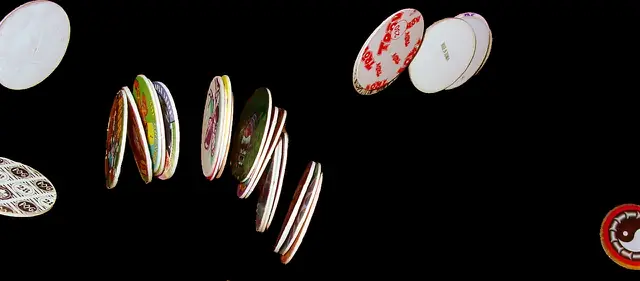
How the game worked
A pog is a flat cardboard circle a little bigger than a coin, printed on one or both sides; the commercial ones of the 1990s were thicker and glossier than the old dairy caps. A slammer is about the same width but heavier, usually plastic, rubber or metal.
- Each player puts the same number of pogs into one stack, face down.
- Players take turns throwing the slammer onto the stack so the pogs scatter.
- Any pog that lands face up goes to the player who threw.
- The face-down ones are restacked for the next turn, until none are left; whoever has the most wins.
Players agreed beforehand whether they were playing "for keeps", meaning the winner kept the pogs, or just for fun. Rules varied from school to school.
Where Pogs came from
| Year | What happened |
|---|---|
| 1920s–30s | Children in Hawaii play a game with milk-bottle caps; the exact origin is not known |
| 1971 | Haleakala Dairy launches POG juice, named for its passion fruit, orange and guava; its caps carry the name |
| 1991 | A teacher on Oʻahu introduces the cap game to her fifth-graders, and it takes off across Hawaii |
| 1992–93 | The craze spreads to the US mainland and then worldwide; caps are printed by the million |
| 1994 | World POG Federation wins exclusive use of the POG name after a lawsuit |
| 1997 | Canada Games Company, which sold POG-brand caps, goes out of business after the fad ends |
Strictly, "POG" was a trademark and the generic name was "milk caps", but almost everyone called them Pogs. At the peak they were given away with Happy Meals and even with new bank accounts.
Why schools banned them
Because children kept the caps they won from each other, many school districts treated playing for keeps as gambling. Teachers also complained about classroom distraction and playground arguments over who had won what. Schools across North America banned the game, and it was also banned in parts of Australia and Sweden.
What happened to Pogs
Like most toy fads, Pogs faded as fast as they arrived; by the late 1990s the companies behind them had moved on or closed. There have been occasional relaunch attempts since, but nothing close to the original craze. Today Pogs and slammers mostly turn up as second-hand lots and in collections, and the game itself needs nothing more than a stack of caps.
Things people remember
- Tubes of pogs and a favorite heavy slammer kept in a pocket or backpack
- Holographic, skull and cartoon designs, and endless licensed sets
- Arguing over whether a game was "for keeps" after someone lost their best ones
- In The Simpsons episode "Bart Sells His Soul", Milhouse shows off his Alf pogs
FAQ
What does POG stand for?
Passion fruit, orange and guava, the flavors of a Hawaiian juice made by Haleakala Dairy whose bottle caps gave the game its name.
Why were Pogs banned in schools?
Mainly because playing for keeps looked like gambling, and because the game caused distraction and fights. Bans spread across North America in the mid-1990s.
Are Pogs worth anything now?
Usually not much. They were printed by the million, so ordinary ones are common; only scarce or unusual sets in good condition interest collectors.
Does it bring back memories?
Did you ever play with it?
Anonymous: no IP addresses are stored, and one network can add only a limited number of answers to a page each day.