Cat breed
Korat
In short
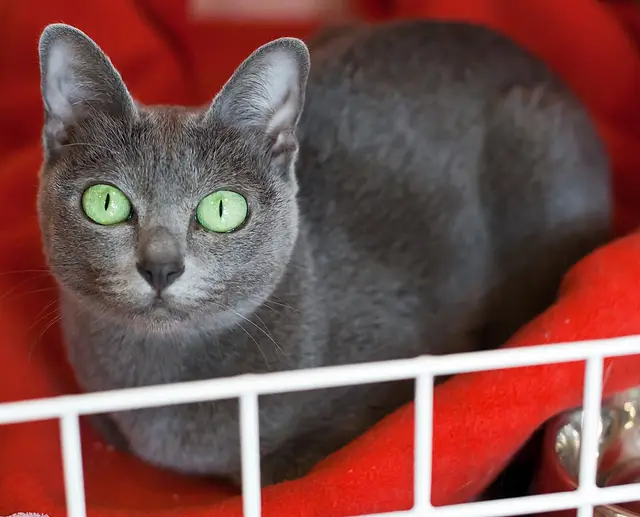
The Korat is a natural cat breed from Thailand, named after Nakhon Ratchasima Province and traditionally known as a good-luck cat. It is a small to medium, semi-cobby cat that is heavy for its size, with a silver-tipped blue-grey coat, a heart-shaped head and large green eyes, and is described as intelligent, playful and vocal.
Breed facts
| Origin | Thailand |
|---|---|
| Height at the withers | — |
| Weight | 2–4.5 kg |
| Life expectancy | — |
| Size group | Small |
| Breed standards | ACFA, ACF |
From Wikidata (CC0) and the FCI breed list; — means Wikidata lists no figure.
Origin and history
The Korat is one of the oldest stable cat breeds and has changed little over the centuries. It originates from Phimai in Thailand and is known there as Si sawat, 'colour of the sawat seed'. A probable early reference appears in the Thai Tamra Maew (Cat-Book Poems), written between 1350 and 1767. Traditionally, Korats were given in pairs to newlyweds or esteemed people for good luck, and until recently were given only as gifts rather than sold.
Korats appeared in Britain as 'Blue Siamese' in 1889 and 1896 but disappeared by 1901. In 1959 the Cedar Glen cattery imported the first breeding pair to the US, and the breed gained championship status in 1966.
Appearance and coat
The Korat has a small to medium build, low body fat and a semi-cobby body that is unusually heavy for its size; the reference data lists a weight of about 2 to 4.5 kg. The head is heart-shaped and the front legs are shorter than the back. Adult eyes are large and peridot green; kittens' eyes are amber or golden-green and change over two to four years.
The short single coat is silver-tipped blue, which Thais call 'rain-cloud grey' with a 'sea foam' shimmer; it is the only color accepted for the Korat. White spots or faint stripes occasionally occur and are show faults, though they do not affect health. The GCCF registers related lilac and pointed cats as Thai Lilac, Thai Blue Point and Thai Lilac Point.
Temperament
As commonly described, the Korat is an intelligent, playful and active cat that forms strong bonds with people. It is known for being very vocal, with a voice described as different from other breeds.
Care and exercise
Sources give little specific care information. The short single coat suggests modest grooming needs, and an active, playful cat will benefit from regular play and interaction.
Health
Conditions reported in the breed include gangliosidosis 1 and 2, inherited through recessive mutations, and the GCCF requires genetic testing for gangliosidosis for full registration. Atherosclerosis, rarely seen in cats, has also been reported in Korats, with a genetic predisposition assumed.
General information, not veterinary advice.
FAQ
Why is the Korat called a good-luck cat?
In Thailand Korats were traditionally given in pairs to newlyweds or highly esteemed people to bring good luck, and were once given only as gifts.
What color is a Korat cat?
Korats come only in silver-tipped blue, a shimmering blue-grey coat, with green eyes in adults.
How big does a Korat get?
It is a small to medium cat that feels heavy for its size; reference data lists about 2 to 4.5 kg.