Cat breed
Turkish Angora
In short
The Turkish Angora, or Ankara cat, is one of the ancient natural cat breeds, originating in the Ankara region of central Anatolia, Turkey. It is a slender, fine-boned cat weighing roughly 2.5 to 5 kg, with a silky coat and a plumed tail, and is described as playful and intelligent.
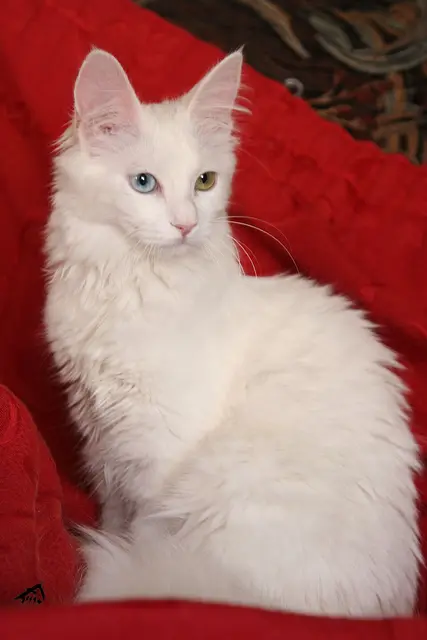
Breed facts
| Origin | Türkiye |
|---|---|
| Height at the withers | — |
| Weight | 2.5–5 kg |
| Life expectancy | — |
| Size group | Medium |
| Breed standards | FIFe, ACFA |
From Wikidata (CC0) and the FCI breed list; — means Wikidata lists no figure.
Origin and history
Longhaired cats reached Britain and France from Asia Minor, Persia and Russia from the late 16th century, and the Turkish Angora was recognized as a distinct breed in Europe by the 17th century. Early writers often treated Angoras and Persians as the same cat, and in the 20th century Angoras were used to improve the Persian coat. In the early 20th century the Atatürk Forest Farm and Zoo began a program to preserve pure white Angoras, especially odd-eyed cats. The breed came to Canada in 1963 and gained CFA championship status in 1973; only white cats were recognized until 1978.
Appearance and coat
The Turkish Angora has a long, slender, muscular body with fine bone and a silky coat. It is best known in shimmering white, but many colors are allowed; chocolate, lavender and colorpoint are disallowed. The head is small to medium with a smooth wedge, the ears are large, pointed and wide-set, and the large almond-shaped eyes may be blue, green, amber, yellow or odd-colored. The plumed tail is often carried upright.
Temperament
Turkish Angoras are commonly described as playful, intelligent, athletic and involved. They are said to bond with people, often choosing one family member as a constant companion.
Care and exercise
Sources give little specific care detail. Given its athletic, playful reputation, regular play and activity suit the breed, along with routine grooming and veterinary check-ups.
Health
The gene responsible for a white coat with blue eyes can cause deafness. Conditions reported in the breed also include ataxia in kittens and hypertrophic cardiomyopathy in adult cats. Breed clubs recommend health screening of breeding stock.
General information, not veterinary advice.
FAQ
How big does a Turkish Angora get?
It is a slender, fine-boned cat; listed weights are roughly 2.5 to 5 kg.
Are Turkish Angoras always white?
No. White is the best-known color, but many colors and patterns are accepted; chocolate, lavender and colorpoint are not.
Is the Turkish Angora the same as the Persian?
Historically the names were sometimes used interchangeably, but the Angora has always differed in type, especially from the modern flat-faced show Persian.