Dog breed · FCI 1
Australian Cattle Dog
In short
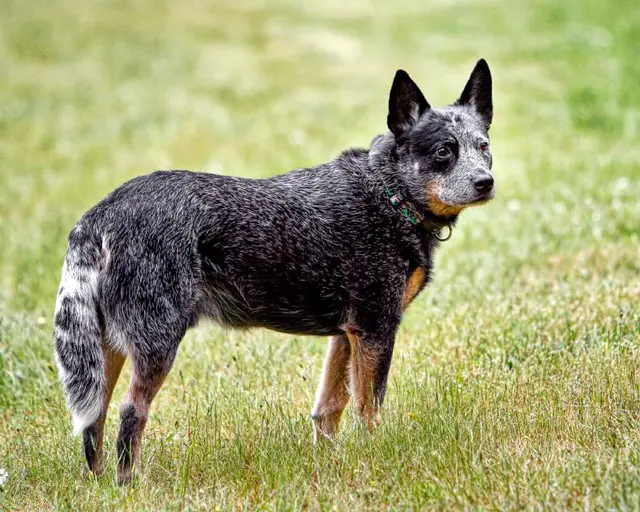
The Australian Cattle Dog, nicknamed the Red or Blue Heeler, is a medium-sized herding breed developed in Australia to drove cattle over long distances and rough terrain. Females stand about 43 to 48 cm and males 46 to 51 cm. It is described as energetic, intelligent and independent, strongly attached to its owner and reserved with strangers.
Breed facts
| Origin | Australia |
|---|---|
| Height at the withers | 43–51 cm |
| Weight | — |
| Life expectancy | 13–15 years |
| Size group | Medium |
| FCI | Group 1: Sheepdogs and Cattledogs (except Swiss Cattledogs) · standard no. 287 |
| Breed standards | FCI |
From Wikidata (CC0) and the FCI breed list; — means Wikidata lists no figure.
Origin and history
In the mid-1800s pastoralist Thomas Simpson Hall crossed blue-speckled Highland Collies with dingoes in New South Wales to produce Halls Heelers, which worked silently and nipped the heels of cattle. In the 1880s and 1890s Jack and Harry Bagust of Sydney developed these into the Australian Cattle Dog and the Australian Stumpy Tail Cattle Dog.
Robert Kaleski drew up the first standard, published in 1903, describing a small thick-set dingo. The breed was fully recognized by the American Kennel Club in 1980 and by the Canadian Kennel Club the same year, and a breed society was recognized in the UK in 1985.
Appearance and coat
The breed is sturdy, muscular and compact, slightly longer than tall, with a broad skull, pricked ears and dark oval eyes. Its double coat has short, straight guard hairs over a dense undercoat. Accepted colors are red and blue: red or black hairs ticked through a white coat, often with a mask over one or both eyes and a white tail tip. Puppies are born white and color in from about four weeks. Breed standards call for a natural, undocked tail.
Temperament
The breed is commonly described as energetic, intelligent and independent, ranking tenth in Stanley Coren's obedience ranking. At home it is affectionate and playful, but it is reserved with strangers, protective of its owner and may herd people, particularly running young children, by nipping at their heels. Sources say it is good with older, considerate children and can show aggression when several dogs establish a pecking order.
Care and exercise
The Cattle Dog demands a high level of activity and structured, varied tasks that challenge it, such as herding trials, agility, obedience, canicross or disc dog. Once exercised it is not hyperactive and can adapt to city life. Known as a wash-and-wear dog, it needs little grooming beyond brushing when it blows its coat about once a year.
Health
A small 2024 UK study found an average life expectancy of 14 years. The most common problems are hereditary deafness, linked to piebald genes, and progressive rod-cone degeneration causing blindness, along with accidental injuries. Other conditions reported in the breed include hip and elbow dysplasia, spondylosis, arthritis, cruciate ligament tears and, very rarely, hereditary polioencephalomyelopathy.
General information, not veterinary advice.
FAQ
Is a Blue Heeler the same as an Australian Cattle Dog?
Yes. Blue Heeler and Red Heeler are nicknames for the Australian Cattle Dog based on its coat color and its habit of nipping cattle at the heels.
How long do Australian Cattle Dogs live?
A small 2024 UK study found an average of 14 years, and many dogs remain active at 12 to 14 years of age.
Are Australian Cattle Dogs good with children?
They are described as good with older, considerate children but may nip at the heels of young children who run and squeal. Early socialization and supervision are advised.
Do Australian Cattle Dogs shed?
They are not year-round shedders but blow their coat about once a year, or twice in intact females. Otherwise they need little grooming.