Dog breed · FCI 1
Australian Shepherd
In short
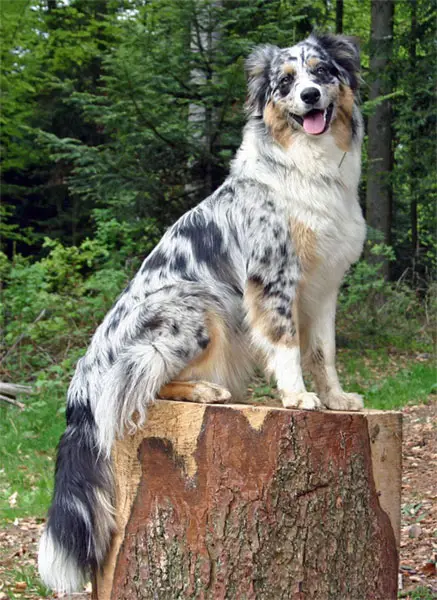
The Australian Shepherd, or Aussie, is a medium-sized herding dog developed in California in the nineteenth century, despite its name. It has a moderately long double coat in merle, black or red, and is described as intelligent, active and loyal.
Breed facts
| Origin | Australia and United States |
|---|---|
| Height at the withers | 46–58 cm |
| Weight | — |
| Life expectancy | 13–15 years |
| Size group | Large |
| FCI | Group 1: Sheepdogs and Cattledogs (except Swiss Cattledogs) · standard no. 342 |
| Breed standards | FCI, American Kennel Club |
From Wikidata (CC0) and the FCI breed list; — means Wikidata lists no figure.
Origin and history
The breed descends in part from sheepdogs that came with Spanish flocks to North America and from collies imported with sheep from Australia and New Zealand, which is where it reportedly got its name. It spread across the western United States as a ranch dog for sheep and cattle and was little known outside farming until the rodeo performer Jay Sisler popularized it in the mid-twentieth century. Recognition came from the UKC in 1979, the AKC in the 1990s and later the FCI.
Appearance and coat
Aussies typically stand 46–58 cm and weigh 16–32 kg. The double coat is moderately long and wavy, short on the face and feathered on the back of the legs. The standard allows blue merle, red merle, solid black or solid red, with or without white markings and tan points. Some dogs are born with naturally bobbed tails.
Temperament
The breed is described as intelligent, active, loyal, protective, playful and adaptive. Many retain a strong herding instinct, and companion dogs may try to herd children or other pets.
Care and exercise
The Australian Shepherd is a very active breed and is known to become destructive without enough exercise. Like other herding breeds it does well in sports such as herding trials, agility, dock diving, obedience, rally, tracking, disc and flyball.
Health
Conditions reported in the breed include eye problems such as hereditary cataracts, the MDR1 gene mutation that causes sensitivity to certain drugs, and, at relatively low levels, hip dysplasia. Puppies from merle-to-merle breeding (double merles) can have hearing and vision problems. A 2024 UK study found a median life expectancy of 13.7 years.
General information, not veterinary advice.
FAQ
Are Australian Shepherds actually from Australia?
No. The breed was developed in California; its name is linked to collies imported with sheep from Australia and New Zealand.
How big does an Australian Shepherd get?
Aussies typically stand 46–58 cm at the withers and weigh about 16–32 kg.
How long do Australian Shepherds live?
A commonly cited range is 13–15 years, and a 2024 UK study found a median of 13.7 years.
Is the Australian Shepherd recognised by the FCI?
Yes. The FCI lists it as breed number 342 in Group 1, sheepdogs and cattle dogs.