Money
How to calculate simple interest
Simple interest is paid only on the amount you first borrowed or saved, so it grows by the same amount every year. You will learn the formula, how to count months and days, how to work back to the principal, rate or time, and how it differs from compound interest.
Loans and savings that compound, such as most mortgages, credit cards and savings accounts, grow faster than this. Check which kind yours uses.
Open Simple interest calculatorContents
Open the Simple interest calculator on cv.cm
Choose what to find: the interest and total, or the principal, rate or time.
Open Simple interest calculatorUse the formula
Interest I = P × r × t: the principal times the yearly rate as a decimal times the time in years. 10,000 at 5 % for 3 years: 10,000 × 0.05 × 3 = 1,500.
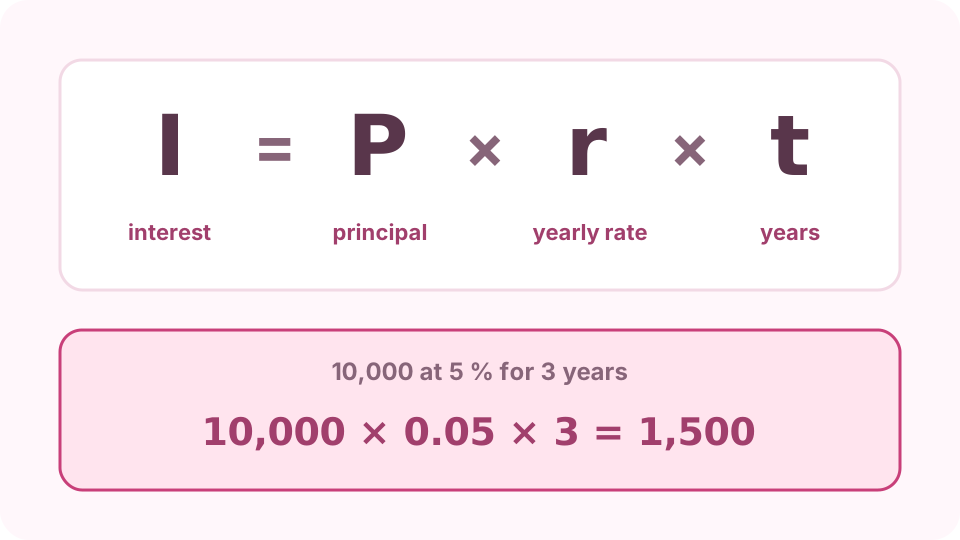
The simple interest formula with an example. Turn the rate into a decimal
Divide the percentage by 100: 5 % is 0.05 and 4.5 % is 0.045. The rate must be per year; a monthly rate times 12 gives the yearly rate.
Count the time in years
Divide months by 12 and days by 365. Some loans use a 360-day year, which gives a little more interest: 10,000 at 6 % for 90 days is 147.95 on 365 days but 150.00 on 360.
Find the missing value
Rearrange the formula: P = I ÷ (r × t), r = I ÷ (P × t) and t = I ÷ (P × r). Earning 300 on 5,000 at 4 % takes 300 ÷ (5,000 × 0.04) = 1.5 years.
Compare with compound interest
Add the interest to the principal for the total you repay or receive: 11,500 in the first example. Compounded yearly at the same rate it would be 11,576.25, and the gap grows every year. The table shows both.
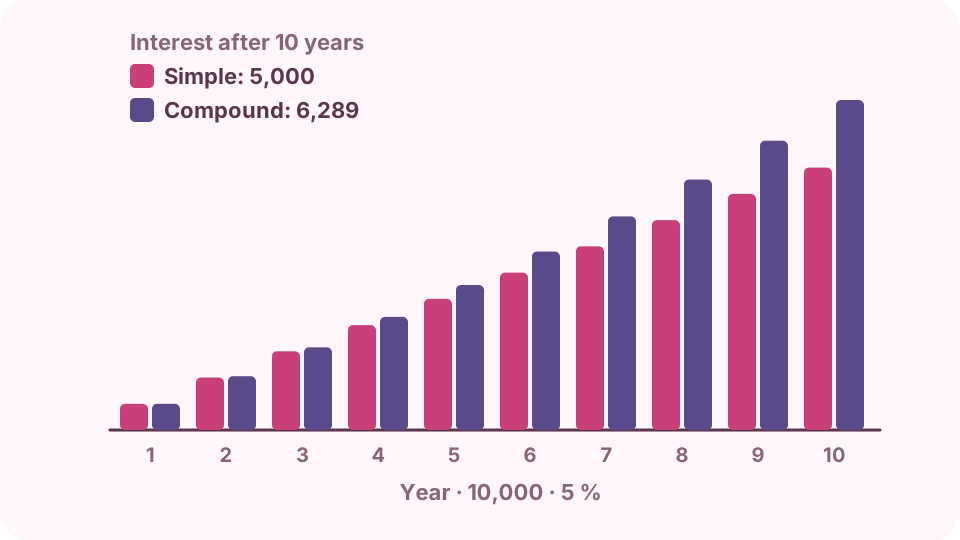
Simple interest grows in equal steps; compound interest grows faster.
FAQ
What is the simple interest formula?
I = P × r × t, where P is the principal, r the yearly rate as a decimal and t the time in years. The total is P + I.
How do I calculate simple interest per month?
Divide the yearly interest by 12. 10,000 at 6 % a year earns 600 a year, or 50 a month.
What is the difference between simple and compound interest?
Simple interest is paid on the principal only. Compound interest is also paid on earlier interest, so it grows faster over time.
Why do some loans use a 360-day year?
It is an old banking convention that made calculations easier. Dividing the days by 360 instead of 365 makes the interest about 1.4 % higher.
Where is simple interest used?
Many car loans and short personal loans, bond coupons and some savings certificates. Mortgages, credit cards and savings accounts usually compound.