Nostalgia · Consoles and games · Remembered worldwide
What happened to video arcades?
Also called: video arcade, game center, 游戏厅 (yóuxì tīng), 街机厅 (jiējī tīng)
In short
A video arcade is a hall full of coin-operated game cabinets where you buy tokens and spend one per game; they boomed worldwide after Space Invaders (1978) and Pac-Man (1980). Home consoles slowly emptied them: North America went from about 13,000 arcades at its peak to about 4,000 in 1998, and Japan from 26,573 game centers in 1986 to 4,022 in 2019. In China, game halls (游戏厅) peaked in the 1990s and shrank from nearly 100,000 to about 17,000 after a 2000 government crackdown; today arcades survive mostly as claw-machine and rhythm-game centers and bar-arcades.
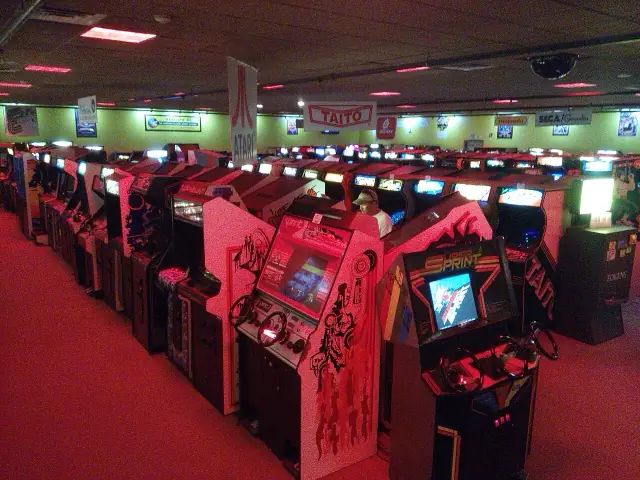
What an arcade was like
Rows of upright cabinets, each with a screen, a joystick, a few buttons and a coin slot. You changed money for tokens at the counter, dropped one in for a game, and when you died you could pay again to continue. Two players could team up side by side; in fighting games anyone could drop a token into the other side and challenge you.
Arcades sat near schools, stations and malls and were busiest after school, and many parents disapproved, which was part of the appeal.
Timeline
| Year | What happened |
|---|---|
| 1978–1980 | Space Invaders, Galaxian and Pac-Man make video arcades a worldwide craze |
| 1980–1982 | North American arcades more than double; the 1983 video game crash follows |
| 1986 | Japan peaks at 26,573 game centers (police white paper) |
| Early 1990s | Fighting games such as Street Fighter II and sports games like NBA Jam bring a revival |
| 2000 | China halts new game-hall licences and bans the making and sale of game machines |
| 2019 | Japan is down to 4,022 game centers |
Arcades in China
Arcade machines came into coastal Chinese cities via Hong Kong after the early 1980s; Pac-Man and Galaga were early hits, and the Contra arcade game drew attention from 1987. In the early 1990s Capcom's Tenchi wo Kurau II (Warriors of Fate in the West, 吞食天地 II), known in China simply as 三国志 ("Three Kingdoms"), packed game halls, and in the late 1990s Taiwanese studio IGS's Knights of Valour (三国战纪) and Oriental Legend (西游释厄传) broke Japan's grip on the market. Fighting games such as The King of Fighters '97 became fixtures.
In June 2000 the State Council circulated a notice from the Ministry of Culture and six other departments that stopped approving new game venues and banned new equipment. Game halls fell sharply and teenagers moved to internet cafés. The equipment ban was lifted nationwide in July 2015.
Are there still arcades?
Yes, in a different form. Chinese malls have game centers built around claw machines, rhythm and racing games and ticket redemption; Western chains pair arcades with bars, bowling or restaurants; and retro arcades with pay-at-the-door free play exist in some cities. Classic token-fed halls full of fighting and shooting games are now rare.
FAQ
Why did arcades die out?
Home consoles caught up with arcade graphics, so fewer people paid per game. In China a 2000 crackdown and the rise of internet cafés closed most game halls.
What are arcade tokens?
Metal coins issued by an arcade, bought with cash at the counter and usable only in that arcade's machines.
How many arcades are left in Japan?
The police white paper counted 4,022 in 2019, down from 26,573 in 1986, and the decline continued after that.
Does it bring back memories?
Did you ever play it?
Anonymous: no IP addresses are stored, and one network can add only a limited number of answers to a page each day.