Dog breed · FCI 3
Bull Terrier
In short
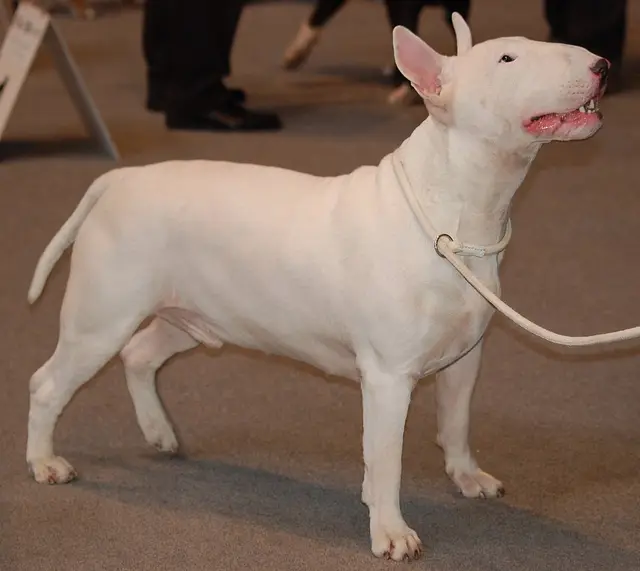
The Bull Terrier is an English terrier breed, developed in the mid-nineteenth century by James Hinks from bull-and-terrier dogs crossed with the English White Terrier. It is muscular and full-bodied, with a distinctive egg-shaped head and small triangular eyes, and is described as even-tempered and sociable. A separate Miniature Bull Terrier also exists.
Breed facts
| Origin | United Kingdom |
|---|---|
| Height at the withers | 53–56 cm |
| Weight | — |
| Life expectancy | — |
| Size group | Medium |
| FCI | Group 3: Terriers · standard no. 11 |
| Breed standards | FCI |
From Wikidata (CC0) and the FCI breed list; — means Wikidata lists no figure.
Origin and history
The bull and terrier dogs of the early nineteenth century combined Old English Bulldogs with terriers for vermin control and blood sports, and later divided into the ancestors of the Bull Terrier and the Staffordshire Bull Terrier. Hinks bred for a cleaner, all-white dog, later adding breeds such as the Dalmatian and Whippet. Lord Gladiator, from 1917, is recognized as the first dog with no stop. Because of health problems linked to all-white breeding, colored dogs were introduced, and the AKC recognized colored Bull Terriers as a separate variety in 1936.
Appearance and coat
Seen from the front, the head is egg-shaped, with an almost flat top and a profile curving down to a black nose. The eyes are small, dark, deep-set and triangular, which is rare among dogs. The body is full and round with strong shoulders, and the tail is carried horizontally. Colors are white, red, fawn, black, brindle or combinations of these.
Temperament
The breed is described as even-tempered, open to discipline and sociable. A 2008 German study found no significant temperament difference from Golden Retrievers, although the breed is subject to breed-specific legislation in some places, including an import ban in Germany.
Care and exercise
Sources give little detail on exercise or grooming needs. Many Bull Terriers develop skin allergies, and insect bites can trigger itching and rashes, so owners commonly keep an eye on the skin.
Health
Conditions reported in the breed include deafness, which one survey found in 20.4% of pure white Bull Terriers and 1.3% of colored ones, skin allergies, lethal acrodermatitis in white dogs, neutrophilic cholangitis and patellar luxation. A 2024 UK study found a life expectancy of 12 years.
General information, not veterinary advice.
FAQ
How big does a Bull Terrier get?
Bull Terriers are commonly listed at about 53–56 cm at the shoulder, with a full, muscular body.
Why do Bull Terriers have egg-shaped heads?
Breeders selected away from a skull stop over many generations; Lord Gladiator in 1917 was the first dog with no stop at all.
How long do Bull Terriers live?
A 2024 UK study found a life expectancy of 12 years, while an earlier UK survey gave a median of 10 years.
Is the Bull Terrier recognised by the FCI?
Yes. The FCI lists the Bull Terrier as breed number 11 in Group 3, terriers.