Dog breed · FCI 7
German Shorthaired Pointer
In short
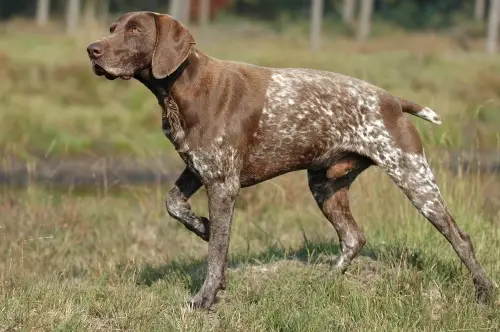
The German Shorthaired Pointer, or Deutsch Kurzhaar, is a continental pointing dog that originated in Germany in the 19th century. It is a medium-sized dog, with males standing about 62 to 66 cm and females a few centimeters less. It was bred as an all-purpose gun dog and may also be kept as a companion.
Breed facts
| Origin | Germany |
|---|---|
| Height at the withers | 58–66 cm |
| Weight | — |
| Life expectancy | — |
| Size group | Large |
| FCI | Group 7: Pointing dogs · standard no. 119 |
| Breed standards | FCI |
From Wikidata (CC0) and the FCI breed list; — means Wikidata lists no figure.
Origin and history
European pointing breeds descend from the extinct Old Spanish Pointer. In Germany, a mixed population of bird dogs, including dogs brought from England and many of Burgos Pointing Dog type, was known simply as Hühnerhunde or Jagdhunde. Standards for the Deutsch Kurzhaar were introduced in Hannover in 1879, and the first stud book followed in 1897. The AKC recognized the breed in 1930 and the FCI definitively accepted it in 1954. A German Shorthaired Pointer won Best in Show at Westminster in 2016.
Appearance and coat
The coat is dense, short and rough to the touch, in brown or black. It comes in three patterns: solid, sometimes with small white flecks; white with a colored head and patches; and roan, either dark or light. The head has a convex profile and a long, broad, strong muzzle for carrying game, with brown eyes and high-set, close-hanging ears. Where permitted, working dogs may have the tail docked to about half length.
Temperament
Sources give little detail on temperament beyond the breed's working character. It was bred to find and point game, retrieve gently, follow blood trails and defend against poachers and predators. It may also be kept as a companion dog.
Care and exercise
The breed is built to work in all weathers and terrains, and registration is subject to passing a working trial. Beyond hunting, it does well in agility, dock diving and obedience and is used by police for detection work. As a working gun dog it is generally expected to need plenty of activity.
Health
The breed is described as tough and healthy. Conditions reported in the breed include several neurological diseases such as GM2 gangliosidosis and sensory neuropathy, as well as cataract, cruciate ligament rupture, hereditary lupoid dermatosis, progressive retinal atrophy and von Willebrand's disease. A 2024 UK study found a median longevity of 13.4 years.
General information, not veterinary advice.
FAQ
How big does a German Shorthaired Pointer get?
Males stand about 62 to 66 cm at the withers, and females about 3 or 4 cm less.
How long do German Shorthaired Pointers live?
A 2024 UK study found a median longevity of 13.4 years, slightly above the 12.5-year average for all dogs.
What colors do German Shorthaired Pointers come in?
They are brown or black, in solid, white with colored patches, or roan patterns.
Is the German Shorthaired Pointer recognized by the FCI?
Yes. The FCI definitively accepted it in 1954, and it is breed number 119 in Group 7.