Dog breed · FCI 7
Irish Setter
In short
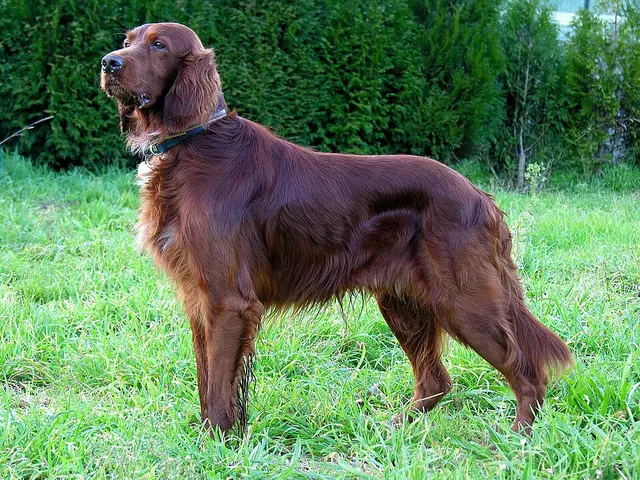
The Irish Setter, or Red Setter, is a gundog from Ireland bred to locate and point upland game birds. It is a tall, deep-chested dog; the FCI standard calls for about 55 to 67 cm depending on sex. The breed is known for a friendly, gentle and affectionate temperament.
Breed facts
| Origin | Ireland |
|---|---|
| Height at the withers | 55–67 cm |
| Weight | — |
| Life expectancy | — |
| Size group | Large |
| FCI | Group 7: Pointing dogs · standard no. 120 |
| Breed standards | FCI |
From Wikidata (CC0) and the FCI breed list; — means Wikidata lists no figure.
Origin and history
Setting dogs are described in English writing from 1570, though those early dogs did not resemble today's breed. By the 18th century Irish gentry were breeding their own setters, and the de Freyne family kept stud records from 1793. Early Irish setters were often red and white, and selection for solid red shaped the modern look. The Irish Red Setter Club in Dublin approved the first standard in 1886. In the US, show breeding favored the solid red dog, and from the 1940s a separate, smaller field-bred Red Setter was developed through outcrossing to English Setters.
Appearance and coat
The coat is moderately long, silky and red or chestnut, with feathering on the ears, chest, legs and tail and an undercoat that thickens in winter. Irish Setters are deep-chested with small waists. Males typically weigh about 29 to 34 kg and females 25 to 29 kg. Working Red Setters are smaller and lighter in color, often with white patches on the face and chest.
Temperament
UK standards state that the breed should be demonstrably affectionate, and the American Kennel Club standard describes a rollicking personality full of humor and character. Shyness is not considered part of its temperament.
Care and exercise
The silky coat needs frequent brushing to stay in condition and free of mats. As a hunting dog bred to work fields and moorland, the Irish Setter is generally expected to need plenty of exercise.
Health
Conditions reported in the breed include an inherited gluten intolerance affecting the small intestine, atopic dermatitis and gastric dilatation volvulus, or bloat, which is associated with deep-chested dogs. Life expectancy tends to be around 11 to 12 years, and a 2024 UK study found 12.9 years.
General information, not veterinary advice.
FAQ
How big does an Irish Setter get?
The FCI standard calls for males of about 58 to 67 cm and females of about 55 to 62 cm, with males weighing roughly 29 to 34 kg.
How long do Irish Setters live?
Life expectancy tends to be around 11 to 12 years, and a 2024 UK study found 12.9 years.
Are Irish Setters good family dogs?
The breed is known for a friendly, gentle and affectionate temperament and is described as both a gundog and a family dog.
Is the Irish Setter recognized by the FCI?
Yes. The FCI lists it as the Irish Red Setter, breed number 120 in Group 7.