Folklore · Europe · Creature
Banshee (Bean Sí)
Also known as: Bean sí, Bean sídhe, Ben síde, Bean chaointe, Badhbh, The Bow, Banshie
In short
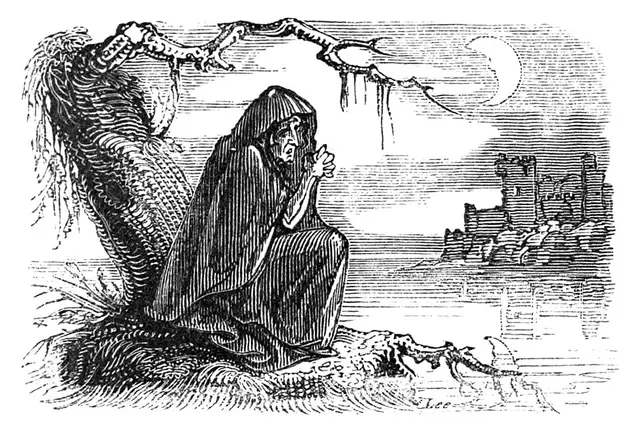
The banshee, in Irish bean sí, is a woman of the otherworld whose crying at night warns that a member of a particular family is about to die. She is heard more often than seen. Tradition says she follows old Irish families, often those whose surnames begin with Ó or Mac.
At a glance
| Where | All of Ireland; related figures in Gaelic Scotland |
|---|---|
| Name | Irish bean sí, Old Irish ben síde, "woman of the fairy mound" |
| Earliest record | A washer of armour at a ford in Caithréim Thoirdhealbhaigh, a 14th-century history of the O'Briens of Clare |
| Best-known version | The Bunworth Banshee in Thomas Crofton Croker's Fairy Legends and Traditions of the South of Ireland (1825) |
| Type | Death messenger, family spirit, fairy woman |
| Signs | Keening or wailing at night near the house, sometimes hand-clapping; often seen combing long hair |
The Bunworth Banshee (Croker, 1825) Contains the ending
Thomas Crofton Croker printed this account in Fairy Legends and Traditions of the South of Ireland. It is about the Reverend Charles Bunworth (1704 to 1772), rector of Buttevant in County Cork, a harper himself and a patron of travelling harpers.
When he fell ill, his herdsman came home one night from Mallow badly frightened. He said a banshee had followed him past Ballybeg Priory, keening and calling out the rector's name. Miss Bunworth called it an idle superstition and told him to say nothing, since her father seemed to be getting better.
His illness grew worse. On his last night his bed had been moved to the parlour beside a window. Outside, a rose bush moved as if something had pushed past it, and a low woman's moaning and the clapping of hands were heard. Two men went out and searched the garden. They found no one and no footprints in the soft earth. When they came back in, the sounds were louder. He died as morning came.
Croker gives no source, and Wikipedia notes that the story does not appear in accounts of Bunworth's death written at the time. Croker was related to the family, so it may be a family legend.
The families she follows
Tradition holds that she mourns only the old Irish families and not the descendants of Normans or English settlers. Irish Wikipedia names the Ó Néill and Mac Carrthaigh families as examples. There are exceptions, such as the Geraldines. The O'Brien banshee, Aibell, was said to rule over twenty-five other banshees.
The Schools' Collection, gathered by Irish schoolchildren for the Irish Folklore Commission between 1937 and 1939, has many local accounts. A teacher in Srahmore, County Mayo, wrote that the banshee cried there for the Conways and the McManamons, and in nearby districts for families with Mc and O names. A pupil in Ballinlass, County Galway, wrote down her father's account of a banshee heard crying all night by a bridge, and washing on a flagstone by the river where local women once washed clothes.
How other places tell it
- Leinster, especially Wexford and Carlow: she is called the badhbh, written in English as the Bow. The name recalls Badb, a war goddess of early Irish literature.
- Tipperary and other parts of Munster and Connacht: she is often called the bean chaointe, the keening woman.
- Many regions: she has long hair and is seen combing it. Patricia Lysaght noted that the comb is rare in the west, where mermaids combing their hair are common in legend, and suggested the two images are related.
- Irish-language tradition: she often appears with her head bowed under long hair, and has the face of an old woman when she raises it.
Banshee and the Scottish bean nighe
The bean nighe, Scottish Gaelic for washerwoman, belongs to the Highlands and islands. She washes the bloodstained clothes or shrouds of people who are about to die, at a lonely stream or pool. She is said to be the spirit of a woman who died in childbirth. A person who catches her may learn their fate or be granted wishes. The banshee of later Irish tradition mostly cries and keens and does not wash. The older Irish texts, such as Caithréim Thoirdhealbhaigh, do show a washer at the ford, and writers on the subject see the Scottish washer as keeping that older image.
What she is
The folklorist Patricia Lysaght, in The Banshee: The Irish Death-Messenger (1986), described her as a supernatural counterpart of the keening women who lamented at Irish wakes and funerals. The human keeners sang the caoineadh after a death. The banshee cries before it. Lysaght found the belief spread across the whole island, with local names and looks.
In modern culture
In English, to scream like a banshee means to make a high, wild noise. Disney's Darby O'Gill and the Little People (1959) shows a banshee who calls the death coach. The word is now used freely for wailing spirits in games and fantasy books that have little to do with the Irish belief.
Similar legends elsewhere
Same story: the plot is close. Same kind of figure: a similar being in a different story.
- Same kind of figure · Mexico and Latin AmericaLa LloronaA weeping woman heard at night; she cries for her own drowned children
- Same kind of figure · ScotlandBean nigheThe washer at the ford who washes the clothes of those about to die
- Same kind of figure · WalesCyhyraethA Welsh spirit whose moaning foretells death
- Same kind of figure · Germany and Central EuropeWhite Lady (Weiße Frau)A woman in white whose appearance in noble houses was said to announce a death
FAQ
Is the banshee evil?
No. In Irish tradition she does not cause the death. She announces it and mourns it.
What does a banshee look like?
Accounts vary. She is often described as short, with long hair that she combs, in a grey cloak or a white dress. Many people who tell of her only heard her.
Which families have a banshee?
Tradition links her to old Irish families, often with Ó or Mac surnames, such as the O'Neills and MacCarthys. Local accounts name other families in each district.
What is the difference between a banshee and a bean nighe?
The Irish banshee cries and keens before a death. The Scottish bean nighe is seen washing the clothes of the person who will die.
Sources
- Fairy Legends and Traditions of the South of Ireland, "The Bunworth Banshee", Thomas Crofton Croker, 1825
- The Schools' Collection, Vol. 0087, p. 125 (Sraith Mór, Co. Mayo), Deaths - The Banshee, Brighid Bean Mhic Ultaigh, 1937–1939
- The Schools' Collection, Vol. 0037 (Baile an Leasa, Co. Galway), The Banshee, Nora Meehan, from Seán Ó Miadhacháin, 1937–1939
- The Banshee: The Irish Death-Messenger, Patricia Lysaght, 1986
- Banshee, English Wikipedia
- Bean sí, Irish Wikipedia
- Charles Bunworth, English Wikipedia
- Bean nighe, English Wikipedia
Folktales have many versions. This page follows the best-known version and the earliest written records. Sources checked .