Folklore · Japan · Creature
Kitsune (Japanese Fox Spirit)
Also known as: Japanese fox spirit, 狐, きつね, Kyūbi no kitsune, 九尾の狐, Fox yokai, Inari fox
In short
Kitsune is the Japanese word for fox, and in folklore the fox is an animal with magic powers. It can take human form, most often a beautiful woman, trick people, and possess them. Foxes are also the messengers of Inari, the god of rice, so the same animal can be a sacred attendant at a shrine or a dangerous wild spirit.
At a glance
| Where | All of Japan; fox statues guard Inari shrines across the country |
|---|---|
| Earliest record | Nihon Ryōiki (early 9th century): a man in Mino Province marries a woman who turns out to be a fox |
| Best-known stories | Tamamo-no-Mae, the nine-tailed fox at court; Kuzunoha, fox mother of Abe no Seimei |
| Type | Shape-shifting animal spirit (yōkai); divine messenger of Inari |
| Signs | Extra tails with age (up to nine) and fox fire (kitsunebi) |
The first fox wife and the name kitsune Contains the ending
The oldest Japanese fox-wife tale is in the Nihon Ryōiki, a collection of Buddhist tales compiled in the early Heian period, around 822. It is set in Mino Province (today southern Gifu) in the reign of Emperor Kinmei in the 6th century.
A man marries a woman and they have a son. The household dog keeps barking at her, and one day it chases her. She takes fright and turns back into a fox. The man tells her that since they have a child he will not forget her, and asks her to come and sleep with him.
The book explains the word kitsune from this story as kitsu-ne, "come and sleep". This is a folk etymology, and other old explanations of the name exist.
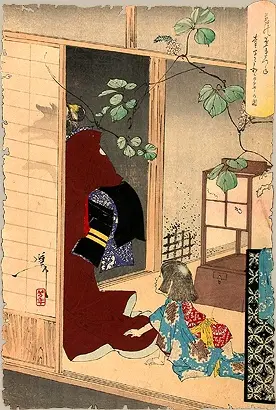
The same pattern returns centuries later in the story of Kuzunoha. Abe no Yasuna saves a white fox from a hunter. The fox comes back as a woman named Kuzunoha, marries him and bears a son, who grows up to be the famous onmyōji Abe no Seimei. When the boy sees her tail, she leaves a farewell poem and returns to the Shinoda Forest in Izumi. The tale became the play Ashiya Dōman Ōuchi Kagami for bunraku and kabuki.
Four sides of the fox
- Inari's messenger. Foxes serve Inari, the god of rice and harvests, and stone foxes stand at Inari shrines, most famously Fushimi Inari Taisha in Kyoto. Edo-period writers divided foxes into good foxes (zenko) that serve Inari and wild foxes (yako or nogitsune) that cause trouble.
- Kitsune-tsuki (fox possession). A person, often a woman, was believed to be possessed by a fox and to act strangely. Accounts go back to the Heian period. In some regions certain families were said to keep fox spirits, such as kudagitsune or osaki, that could possess others.
- Tamamo-no-Mae. A court lady of the late Heian period, said to be a nine-tailed fox. Most Japanese versions place her at the court of Emperor Toba; English sources often name Emperor Konoe. An onmyōji of the Abe family (Abe no Yasunari or Abe no Yasuchika, depending on the text) unmasks her, and she flees to the plain of Nasu in today's Tochigi, where the warriors Miura-no-suke and Kazusa-no-suke kill her. Her spirit becomes the Sesshō-seki, a poisonous stone, which the monk Gennō later splits. The story is in Muromachi-period otogizōshi and the Noh play Sesshōseki.
- Kitsune no yomeiri (the fox's wedding). A shower of rain while the sun shines is called a fox's wedding across Japan. In parts of Honshu, Shikoku and Kyushu the name also means a line of strange lights seen at night in the hills, like a lantern-lit bridal procession.
What a kitsune is
In Japanese belief the fox is a wild animal that gains power with age. Folktales say a fox grows extra tails as it gets older, and one, five, seven and nine tails are the numbers that appear most. The nine-tailed fox itself comes from Chinese classics such as the Shan Hai Jing.
Foxes are said to make kitsunebi, fox fire, and to lead travellers astray with it. The kitsune has two faces in the same tradition: a sacred attendant of a god and a trickster or danger in the fields. Its Korean and Chinese relatives, the gumiho and the huli jing, are compared on the nine-tailed fox page.
In modern culture
The Sesshō-seki in Nasu split in two on 5 March 2022, probably from natural weathering, and the news spread widely because of the Tamamo legend. In Tsugawa, Agano Town, Niigata, a fox wedding procession has been held as a town festival since 1990: a real couple marries, and the bride and her party walk at night in fox make-up to Kirin-zan. Akira Kurosawa's film Dreams (1990) shows a boy watching a fox wedding in the rain. Fox characters with many tails in manga, anime and games mostly draw on the nine-tailed Tamamo image.
Similar legends elsewhere
Same story: the plot is close. Same kind of figure: a similar being in a different story.
- Same kind of figure · KoreaGumihoNine-tailed fox that takes a woman's form, usually dangerous and after human livers or energy
- Same kind of figure · China, Japan, Korea, VietnamThe nine-tailed fox across AsiaWhere Tamamo-no-Mae's nine tails come from and how each country tells it
- Same story · ChinaLegend of the White SnakeAn animal spirit marries a man and is exposed by a monk
- Same kind of figure · ChinaHuli jingChinese fox spirits; Daji in Fengshen Yanyi is the fox Tamamo is said to have been before
- Same story · East Asia, EuropeSwan maiden talesA wife from another world leaves once her true nature is seen
FAQ
Are kitsune good or evil?
Both. Foxes that serve Inari are sacred and bring good fortune. Wild foxes in folktales trick people, possess them or, like Tamamo-no-Mae, ruin a ruler. Many fox wives, such as Kuzunoha, are kind.
How many tails does a kitsune have?
Folktales say a fox gains tails as it ages. One, five, seven and nine are the most common numbers. Nine tails mark the oldest and strongest foxes and come from Chinese tradition.
Why is a sunshower called a fox's wedding?
The name kitsune no yomeiri is used across Japan for rain under a clear sun. The same name is used for lines of mysterious lights at night, said to be the lanterns of a fox bridal procession.
Is a kitsune the same as a gumiho?
They share the fox form and the nine tails, which both take from China. The kitsune is also a divine messenger of Inari, while the Korean gumiho is almost always a dangerous creature.
Sources
- Nihon Ryōiki (日本現報善悪霊異記), vol. 1, tale 2, Kyōkai, c. 822
- Tamamo no sōshi (玉藻の草紙), anonymous otogizōshi, Muromachi period
- Kitsune, English Wikipedia
- 日本の文化における狐, Japanese Wikipedia
- 玉藻前, Japanese Wikipedia
- Tamamo-no-Mae, English Wikipedia
- 狐の嫁入り, Japanese Wikipedia
- Kuzunoha, English Wikipedia
- つがわ 狐の嫁入り行列, Agano Town (阿賀町)
Folktales have many versions. This page follows the best-known version and the earliest written records. Sources checked .