Folklore · Europe · Creature
Baba Yaga
Also known as: Баба-яга, Baba Jaga, Ježibaba, Jędza, Baba Roga, Яга Ягишна, Baba-Yuga
In short
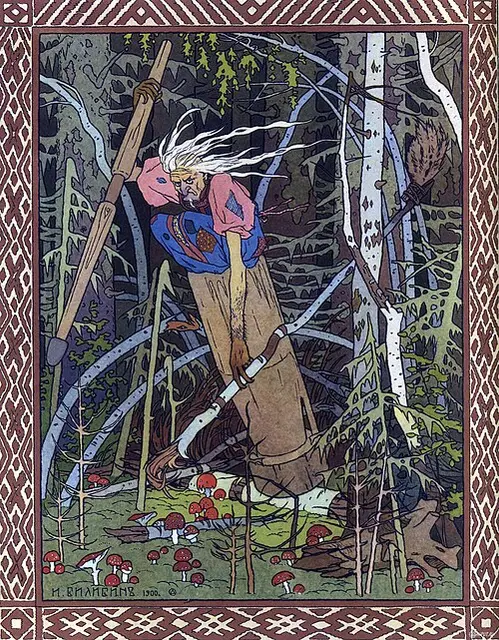
Baba Yaga is an old woman of the forest in Russian and other Slavic folktales. She lives in a hut that stands on chicken legs, flies in a mortar steered with a pestle and sweeps away her tracks with a broom. In some tales she eats people, and in others she gives the hero advice, a horse or a magic object.
At a glance
| Where | Russia, Ukraine, Belarus and other Slavic lands; related figures in Poland, Czechia, Slovakia and the Balkans |
|---|---|
| Earliest record | Accounts differ: Giles Fletcher's 16th-century report on Russia, or Lomonosov's Russian Grammar (1755) |
| Best-known version | Vasilisa the Beautiful, tale No. 104 in Afanasyev's Russian Folk Tales |
| Type | Witch, forest spirit, guardian of the border with the land of the dead |
| Signs | Hut on chicken legs, mortar, pestle and broom, a bony leg, a fence of skulls |
Vasilisa the Beautiful (Afanasyev No. 104) Contains the ending
A merchant's wife dies when their daughter Vasilisa is eight. On her deathbed she gives the girl a small doll and tells her to feed it and ask it for advice when she is in trouble. The merchant marries a widow with two daughters, who give Vasilisa all the hard work. The doll does the work for her at night.
The family moves to a house near a forest where Baba Yaga lives. One autumn evening the stepsisters put out the last candle and send Vasilisa to Baba Yaga for fire. On the way she sees three riders, one white, one red and one black. Baba Yaga later tells her they are her day, her sun and her night. The yard is fenced with human bones and topped with skulls.
Baba Yaga flies home in her mortar and agrees to give fire if Vasilisa works for her. She sets tasks such as cleaning the house and picking black seeds out of grain. The doll does them all. Vasilisa asks about the riders but not about the invisible hands that serve the house, and Baba Yaga approves of her caution. When Baba Yaga asks how she manages, Vasilisa says her mother's blessing helps her. Baba Yaga wants no blessed people in her house. She sends her away with a skull whose eyes burn.
At home the skull's eyes stare at the stepmother and her daughters until they are burnt to ashes. Vasilisa moves in with an old woman in town and, with the doll's help, weaves linen so fine that it reaches the tsar. She sews his shirts, and he marries her.
Records and collections
Russian Wikipedia gives the earliest mention as an idol called "Iaga baba" in the English envoy Giles Fletcher's account of Russia, Of the Russe Commonwealth. English Wikipedia gives Mikhail Lomonosov's Russian Grammar (1755) as the first clear reference. Woodblock prints (lubki) from around 1700 already show her in comic scenes.
Most of the tales people know come from Alexander Afanasyev's Russian Folk Tales (Narodnye russkie skazki), published in eight parts in Moscow between 1855 and 1863. Besides Vasilisa the Beautiful (No. 104), she appears in tales such as Baba Yaga (Nos. 102 and 103), Baba Yaga and Zamoryshek (No. 105), Marya Morevna and The Frog Princess.
How other places tell it
- Russia: in Marya Morevna she is called Yaga Yagishna and keeps a herd of magic mares. In The Maiden Tsar the hero visits three Baba Yagas, who are sisters.
- Ukraine and Belarus: names include Baba-Yuga and Yahinya (Belarusian) and Baba-Yazya (Ukrainian).
- Poland: jędza.
- Czechia: Ježibaba, also jezinka. Slovenia: jaga baba or ježi baba.
- Serbia, Croatia and Montenegro: Baba Roga, alongside the Serbian Baba Jaga.
What she is
Vladimir Propp saw three kinds of Baba Yaga in the tales: the giver who helps the hero, the kidnapper of children, and the warrior who fights. He did not think wickedness was her main trait. He read the hero's visit to her hut, where he is bathed, fed and questioned, as a trace of initiation rites, a passage through death into another world. Some scholars link the hut on chicken legs to small funeral houses raised on posts, and the bony leg to a foot that already stands in the world of the dead. The meaning of the name Yaga is uncertain.
In modern culture
Ivan Bilibin's 1900 illustrations for Vasilisa the Beautiful fixed her look for many readers. Modest Mussorgsky's piano suite Pictures at an Exhibition (1874) includes The Hut on Hen's Legs (Baba Yaga). In Soviet fairy-tale films she was played many times by the actor Georgy Millyar, for example in Morozko (1964). Today she appears in cartoons, games and fantasy novels in many languages.
Similar legends elsewhere
Same story: the plot is close. Same kind of figure: a similar being in a different story.
- Same story · WorldwideCinderella talesVasilisa the Beautiful shares the cruel stepmother and the help that comes from the dead mother
- Same kind of figure · GermanyThe witch in Hansel and GretelA child-eating old woman in a house deep in the forest, from the Grimms' collection
- Same kind of figure · HungaryVasorrú bábaThe iron-nosed old woman of Hungarian tales, close to Baba Yaga
- Same kind of figure · Alpine EuropeKrampusAnother figure parents use to frighten children into behaving
FAQ
Is Baba Yaga good or evil?
Both, depending on the tale. She threatens to eat Vasilisa and other children, but she also gives heroes advice, horses and magic objects. Propp counted the helper among her main roles.
Why does Baba Yaga's hut have chicken legs?
The tales do not explain it. Some scholars link the hut to small wooden funeral houses raised on posts, which would make it a house on the edge of the land of the dead.
Why does Baba Yaga fly in a mortar?
The mortar, pestle and broom are her fixed attributes in Russian tales. She rows through the air with the pestle and sweeps away her tracks with the broom. Their origin is not certain.
Who collected the Baba Yaga stories?
The best-known texts are in Alexander Afanasyev's Russian Folk Tales, published from 1855 to 1863.
Sources
- Народные русские сказки (Narodnye russkie skazki), No. 104 Василиса Прекрасная, Alexander Afanasyev, 1855–1863
- Народные русские сказки (Афанасьев), contents, Russian Wikisource
- Баба-яга, Russian Wikipedia
- Baba Yaga, English Wikipedia
- Alexander Afanasyev, English Wikipedia
Folktales have many versions. This page follows the best-known version and the earliest written records. Sources checked .