Folklore · Europe · Creature
Krampus
Also known as: Krampusse, Kramperl, Bartl, Tuifl, Parkelj, Klaubauf, Ganggerl
In short
Krampus is a horned, hairy devil figure who comes with St Nicholas in Austria, Bavaria, South Tyrol and neighbouring lands. On the evening of 5 December, the eve of St Nicholas Day, Nicholas rewards good children while Krampus threatens the naughty ones with birch rods, chains and a basket on his back. Today he is best known from the Krampuslauf, a noisy run of masked Krampusse through town streets.
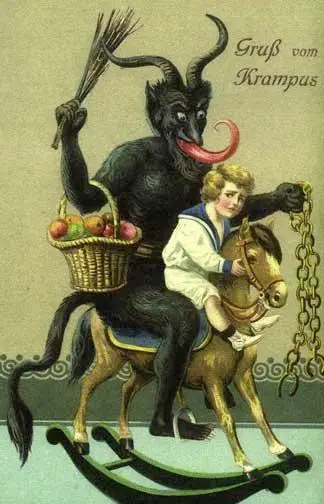
At a glance
| Where | The Eastern Alps: Austria, Bavaria, South Tyrol, Slovenia, and parts of Hungary, Croatia, Czechia and Slovakia |
|---|---|
| When | Krampusnacht, the evening of 5 December, before St Nicholas Day on 6 December |
| Earliest record | No sources mention him before the late 16th century; paired with St Nicholas from the 17th century |
| Type | Tamed devil, companion of St Nicholas, masked custom |
| What he carries | Birch rods (Ruten), a chain, cowbells, and a basket or tub (Butte) for carrying children off |
What happens on Krampusnacht
The core custom is a house visit, in German an Einkehrbrauch. On the evening of 5 December, St Nicholas comes into the house in a bishop's vestments with a staff. He asks the children about their year and rewards the good ones with gifts. Krampus comes in behind him, rattling a chain and ringing bells, and threatens the children who have been bad with his rods. Nicholas keeps him in check. Folk-custom research calls Krampus a tamed devil.
The costume is a coat of sheep or goat fur, a carved wooden mask (Larve) of stone pine or lime wood with real horns, cowbells on a belt, and a bundle of birch twigs. Many modern masks are made of plastic, rubber or aluminium. In Styria, families receive a bundle of birch rods painted gold, which is kept in the house through the year.
Where he comes from
German Wikipedia notes that no source mentions Krampus before the end of the 16th century. The house visit developed from about the mid-17th century out of school festivities in which a boy played a bishop. Animal-masked devils had already appeared in medieval church plays. Some folklorists have argued for pre-Christian roots, and the idea is common in popular writing. Historians generally treat it as unproven.
In 18th-century Vienna, writers of the Enlightenment objected to frightening children with the Krampus. Public Krampus runs became common again from the mid-19th century. The name probably comes from Middle High German Krampen, a claw, or from Bavarian Krampn, something withered or dead.
How other places tell it
- Bavaria, Salzburg and Upper Austria: called Kramperl. In Bavarian dialect the whole group around Nicholas is a Pass.
- Carinthia and Styria: called Bartl, from Bartholomew. Carinthian runs use torches and fireworks.
- Tyrol: called Tuifl, a dialect form of Teufel, devil. East Tyrol has rough games such as the Krampuswurf, a wrestling throw.
- Berchtesgaden: fur-clad Kramperl are kept apart from lighter Gankerl, who guard the straw-wrapped Buttnmandl.
- Slovenia: the parkelj, a name probably taken from Bartl.
Krampus and the Perchten
Krampus belongs to Advent and to St Nicholas. The Perchten belong to the Rauhnächte, the nights around Christmas and New Year that end on 5 January, and have no saint. A Krampus mask usually has two horns, while Perchten masks often have four or more. Because the wild Schiachperchten look much like Krampusse, the two customs mixed in the 20th century, and many groups now appear in both seasons. Folk-custom associations in Salzburg try to keep them apart.
In modern culture
Greeting cards with the words Gruß vom Krampus (Greetings from Krampus) have been sent since the 19th century. Many artists drew them between about 1900 and 1911, and a Wiener Werkstätte card (No. 542) sold for 11,000 euros in 2003. Older cards show a frightening figure, later ones a cuter one. The Krampuslauf is now a large event. In St. Johann im Pongau more than 1,000 Krampusse took part in 2008. Runs have also had problems with violence. In 2013 eight people were taken to hospital in Lienz after runs in East Tyrol. Krampus events have spread to North America, and the 2015 horror comedy Krampus made him a film villain.
Similar legends elsewhere
Same story: the plot is close. Same kind of figure: a similar being in a different story.
- Same kind of figure · GermanyKnecht RuprechtNicholas's dark-cowled helper in the Protestant north; he comes alone, while Krampusse come in groups
- Same kind of figure · Austria and BavariaPerchtenMasked fur-clad figures of the nights after Christmas, often confused with Krampus
- Same kind of figure · Russia and Slavic landsBaba YagaAnother figure used to scare children, who carries them off to eat them
FAQ
When is Krampusnacht?
On the evening of 5 December, the eve of St Nicholas Day. Many Krampus runs now start weeks earlier, in November.
Is Krampus the devil?
He is shown as a devil, with horns, fur and a long tongue, but in the custom he is a tamed devil who serves St Nicholas. Nicholas has the last word.
Is Krampus pagan?
This is often said, but there is no record of him before the late 16th century, and he has always been tied to the Christian feast of St Nicholas. Most historians see him as a Christian-era figure.
What is the difference between Krampus and Perchten?
Krampus comes with St Nicholas on 5 December. Perchten run in the Rauhnächte after Christmas and are linked to the figure of Perchta. Their costumes look alike, and the customs have mixed.
Sources
- Krampus, German Wikipedia
- Krampus, English Wikipedia
- Krampus- und Perchtenläufe unterscheiden sich im Ursprung wesentlich, meinbezirk.at (Landeck)
- Krampuslauf in Bayern: Herkunft, Ablauf, Termine, brauchtum-in-bayern.de
Folktales have many versions. This page follows the best-known version and the earliest written records. Sources checked .